

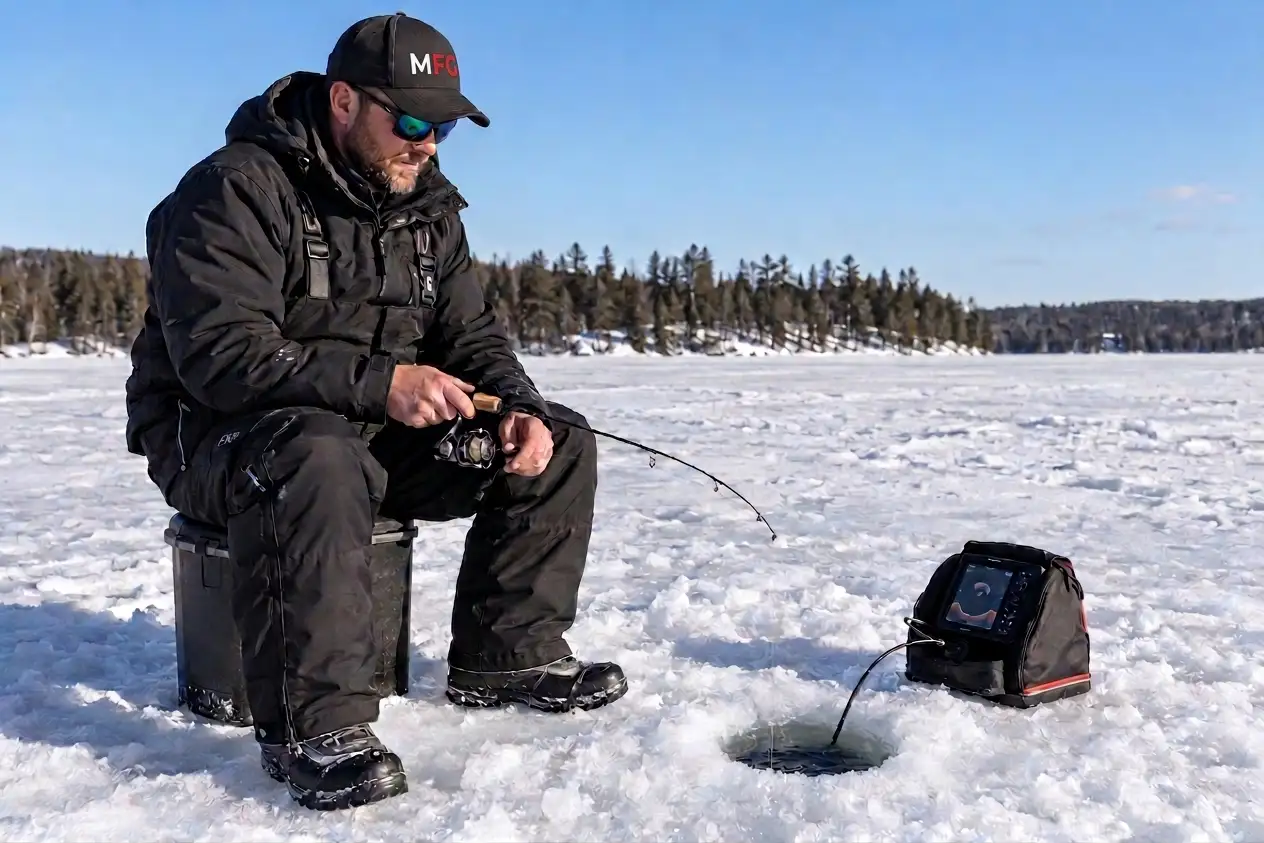
How to Jig for Pike Through the Ice: Lures, Cadence & What to Change
Learning how to jig for pike through the ice is not just about dropping a spoon and lifting it up and down. The real test comes when a pike appears on the sonar, rises toward the lure—and then stops or turns away. We have seen that happen often enough to know that repeating the same motion usually is not the answer. Sometimes the fish wants a harder snap. Sometimes it only commits when the lure is lifted away from it. And sometimes the best move is to stop jigging altogether.
Unlike a bait left under a tip-up, a jigging lure lets you actively search the water column and change the presentation while the fish is still near the hole. Flash, vibration and sound can bring a pike in, but the final few feet often depend on cadence, lure size and how the bait behaves when you pause it. There is no single “perfect” rhythm for every lake or every day, so this guide focuses on reading the fish and knowing what to change when your first approach does not work.
This article covers jigging technique only. If you are still choosing between tip-ups, jigging and deadsticking, start with our Ice Fishing for Pike guide. If you also run flags, the rigging side is covered in How to Set Up Tip-Ups for Pike.
The Quick Version: How to Jig for Pike Through the Ice
Use a flashy, noisy lure, work it with lifts and pauses, and keep it where pike can see it. If you are using sonar, watch how the fish respond and change one part of the presentation at a time.
- Lure: Start with a spoon, minnow-style jig, lipless crankbait, blade bait or soft plastic tube that produces flash, vibration or an erratic fall.
- Motion: Lift the lure, let it fall and pause. Many strikes come on the fall or during the pause, so maintain enough line control to detect the hit.
- Depth: Keep the lure high enough to remain visible, usually above the weed tops rather than buried in the cover.
- Leader: Use steel or heavy fluorocarbon to reduce the risk of a bite-off, while accounting for the difference in visibility, stiffness and durability.
- Reaction: If a pike follows but refuses the lure, change the speed, lift height or pause before switching baits or leaving the hole.
- Movement: Drill several holes and move when a hole produces no signs of activity instead of working the same water for too long.
The Jigging Setup: Rod, Reel, Line and Leader
A pike jigging setup needs enough power to drive the hooks home without becoming so stiff that it pulls them free during a run. The goal is not specialized gear for its own sake, but a balanced setup that controls a heavy lure, protects the line around the ice and keeps pressure on the fish near the hole.
Rod: A 36- to 40-inch (91–102 cm) medium-heavy spinning rod is our starting point for most pike jigging. That range provides leverage below the hole while leaving enough flex to absorb headshakes and sudden changes of direction. If shelter space forces you to use a shorter rod, choose the longest model you can work without hitting the roof or walls. Heavier power makes sense for especially large spoons and soft plastics, but it gives up some sensitivity and forgiveness. Specific options are covered in our ice fishing rods for pike guide.
Reel: Smooth drag matters more than a fast gear ratio. Before lowering the lure, pull line from the reel and confirm that the drag starts without sticking. Ice around the spool, roller or line can interrupt an otherwise smooth drag, so clear it before fishing rather than discovering the problem during a hard run. Our ice fishing reels for pike guide covers the spinning and inline options we use for this type of cold-weather fishing.
Line: We use 20 lb (9 kg) braid as a practical starting point for most pike jigging through the ice. It provides direct contact with the lure, enough strength for a hard hookset and less unnecessary bulk than the heavier braid commonly used for casting around thick cover. Step up only when larger fish, heavy weeds or repeated contact with the edge of the hole justify it. Braid can hold water and collect ice when fished outside in severe cold, so an ice-specific braid helps, while monofilament remains a workable alternative when line icing becomes the larger problem. Our pike fishing line guide compares the lines we have used in more detail.
Leader: Wire provides maximum resistance to pike teeth, while heavy fluorocarbon offers a less visible presentation in clear or pressured water. Neither material is automatically correct for every situation: the leader must provide enough protection without overpowering the lure’s movement. Inspect wire for kinks and fluorocarbon for cuts or rough spots after every fish. Our pike leader guide compares both materials, strengths and diameters in detail. Later in this guide, we will also consider the leader as one variable to change when a pike repeatedly follows but refuses the lure.
Choosing a Jigging Lure for Pike
Choose a jigging lure by answering three questions: how easily can a pike detect it, how aggressively are the fish responding, and how much room does the lure have to move? Those factors are more useful than starting with a favorite brand or assuming that one lure type works at every depth.
| Situation | Starting Lure | Reason to Start There |
|---|---|---|
| Deep, stained or low-light water | Rattle Spoon or Blade Bait | Sound, vibration and flash make the presentation easier to detect when visibility is limited. |
| Active pike with room to chase | Minnow-Style Jig or Lipless Crankbait | Both suit an active search presentation, but exposed hooks make them a poor choice inside dense weeds. |
| Clear water or pike that approach but hesitate | Flutter Spoon or Vertical Jigging Spoon | A quieter presentation lets you reduce the intensity without immediately abandoning the hole. |
| Large forage around open weed edges or basin transitions | Soft Plastic Tube | A larger horizontal profile can match substantial forage while remaining quieter than a metal bait. |
In deep or stained water, we usually begin with enough sound or vibration to make the lure easier to locate, then reduce the intensity if a fish approaches without striking. In shallow, clear or heavily pressured water, we may reverse that order and begin with a quieter spoon. The fish’s response—not a fixed lure sequence—decides the next change.
This guide focuses on choosing the right presentation for the situation. For the movement, trade-offs and specific models we tested in each category, see our best ice fishing lures for pike guide.
Jigging Cadence: Lifts, Falls and Pauses
Cadence is three separate decisions, not one rhythm: how far and how fast you lift, how the lure falls, and how long you hold the rod still. Treating them separately lets you change the presentation on purpose instead of simply jigging harder and hoping.
Our lure testing showed why one fixed cadence does not work across every presentation. We worked a Rippin’ Rap with firm lifts of roughly 8–12 inches (20–30 cm), while the wider Williams Wabler needed a slower 12–18-inch (30–46 cm) lift to complete its wobbling fall. Each lure needed enough movement to activate its own action, not the same repeated snap of the wrist.
The pause mattered just as much. During our Jigging Rap W9 test, we used two short, sharp rips and then held the rod still. The pike did not strike during either rip. It committed about four seconds into the hold, when the lure had almost finished circling and appeared nearly motionless. That experience is why we use a 3–5-second hold after the lift as a practical starting point instead of moving the lure again immediately.
| Variable | What It Controls | How to Adjust It |
|---|---|---|
| Lift | The amount of flash, vibration and water displacement the lure produces. | Use a larger lift when searching with no fish nearby. Reduce the lift once a pike approaches or begins following. |
| Fall | Whether the lure swims outward, flutters or returns almost directly beneath the hole. | Use controlled slack when the lure needs freedom to move, or maintain light contact when strike detection and precise depth control matter more. |
| Pause | How long the rod remains still while the lure completes its fall, circle or final movement beneath the hole. | Start by holding the rod still for 3–5 seconds after the lift. Shorten or extend that hold only after you see how the lure and fish respond. |
Many pike strike while the lure is falling or hanging still rather than during the lift. Keep enough control to recognize a tick, extra weight or a line that suddenly goes slack, because not every take feels like a hard pull.
Begin with a firm lift, a controlled fall and a 3–5-second hold after the lift. Repeat that sequence several times before changing anything, so you can identify whether the cadence is producing a response. If no fish is visible on sonar, an occasional larger lift can increase flash and displacement. A rhythm that stops working is a signal to change one part of the presentation, not simply to jig harder.
How High to Jig Above Weeds and Bottom
Jig height is a visibility decision: the lure needs to remain where a pike can see it without disappearing into vegetation or dragging through bottom debris. This section covers the position of an actively jigged lure. The broader question of where pike hold during different parts of winter is already covered in our main ice fishing pillar.
Our own results show why the correct height changes with the job. Over vegetation, we keep the lure above the highest visible weed tops so its hooks remain clear and its full movement stays visible. During our Buck-Shot test over a 22-foot (6.7 m) basin edge, however, we deliberately tapped the bottom twice, raised the spoon roughly 6 inches (15 cm) and then held it about 4 inches (10 cm) above the silt. The pike took the spoon during that low pause. Fishing high improves visibility, but fishing low can be useful when the lure is meant to disturb the bottom and then remain directly above it.
| Situation | Starting Height | Reason to Start There |
|---|---|---|
| Weed flat or weed edge | Just above the highest weed tops | Keeps exposed hooks clear while leaving the entire lure visible above the cover. |
| Shallow water with little cover | In the upper half of the water column | Pike looking upward can see the lure without it repeatedly contacting the bottom. |
| Suspended pike visible on sonar | Level with or slightly above the mark | Places the lure where the fish can rise toward it instead of forcing it to drop lower. |
| Fish holding close to a clean bottom | About 4–6 inches (10–15 cm) above bottom | Allows a spoon or blade bait to disturb the bottom before being held just above the debris. |
When sonar shows a fish, use the mark rather than a fixed depth rule. Without a mark, begin above the highest weeds or in the upper half of open water, then move the lure in small steps between complete jigging sequences. A pike that ignores the lure at one height may respond when the same presentation passes slightly above or below its previous path.
What to Change When Pike Follow but Won’t Bite
When a pike follows the lure but refuses it, change one variable at a time in an order that keeps the fish interested for as long as possible. Ripping harder or immediately replacing the lure can remove a presentation that already succeeded in bringing the fish close. Start with the smallest adjustment and move toward the largest only when the previous change produces no better response.
First, identify what the fish is actually doing. A flasher or fish finder shows the lure’s depth and a pike rising, stopping or dropping away in real time. An underwater camera adds details that a conventional sonar mark cannot: whether the fish is facing the lure, holding behind vegetation or already turning back toward cover. In shallow, clear water, you may also be able to see part of the interaction through the hole. Our ice fishing fish finder guide explains which sonar types work best for tracking fish beneath and beyond the hole.
During our camera testing, we recorded pike following a lure for 20–40 seconds before losing interest. That was enough time to make a deliberate adjustment, but not enough to cycle randomly through several changes and still know which one affected the fish.
| What You See | Possible Cue | First Change to Try |
|---|---|---|
| Pike rises, follows and then turns away | The movement may be too fast or aggressive at close range | Shorten the lift and hold the rod still a few seconds longer. |
| Pike hangs below the lure without closing the distance | The fish is interested but has not committed to chasing | Raise the lure slowly a few inches as if it is moving away. Stop if the fish does not continue upward. |
| Pike moves closer only after the lure stops | The hold is more convincing than the lift | Extend the hold in small steps while maintaining enough line control to detect the strike. |
| Pike repeatedly backs away when the lure rattles or moves sharply | The presentation may be too loud or intrusive | Reduce the lift first, then switch to a quieter spoon if the same reaction continues. |
| Pike nips or bumps the lure without staying hooked | The profile may be too large, or the hooks may not be contacting cleanly | Check that the hooks are sharp and free of weeds, then try a smaller profile before changing the entire presentation. |
The order matters. Change the lift and hold first because both adjustments are immediate and reversible. Next, move the lure slightly higher or lower while the fish remains visible. If the pike continues to follow without striking, change the lure’s size or color. Change the lure type only after those smaller adjustments fail.
A change in lure type should create a genuinely different presentation. If a loud rattle spoon or blade bait brings a fish close but repeatedly makes it turn away, try a quieter flutter spoon or vertical jigging spoon. If a spoon draws attention but produces no commitment, a minnow-style jig such as a Jigging Rap adds a wider circling path rather than simply changing color. When switching lures, change only the lure and begin with the same depth so you can compare the response.
The leader is the final presentation variable. Wire provides greater protection against teeth, but its visibility and stiffness can matter in clear, shallow water. If repeated refusals continue after cadence, height and lure changes, a heavy fluorocarbon leader of approximately 0.80–1.00 mm (0.031–0.039 in) is a reasonable test. Inspect it carefully after every fish because fluorocarbon is not bite-proof. If the pike remains visible but ignores every controlled change, stop cycling through tackle and give the hole a rest before moving on.
When to Leave the Hole and Cover New Water
Leaving a hole is part of the technique, not a sign that jigging failed. A mobile presentation works only if you eventually bring it to an active fish, so the time spent over one hole should depend on what the lure and electronics show—not on how long you are willing to hope.
Without a visible fish, use five to ten minutes as a maximum starting window rather than a timer that must always run out. Make one more aggressive pass and one slower pass, testing two or three useful heights. If nothing appears, follows or touches the lure, move. A pike that remains visible changes the decision because it gives you a reason to work through the controlled adjustments from the previous section.
| What You See | Stay or Move | Why |
|---|---|---|
| Baitfish or an unidentified mark appears near the lure | Stay briefly | Test a second height and cadence before deciding that the mark will not respond. |
| A pike approaches or follows | Stay and change one variable at a time | The fish is responding, so a controlled adjustment may still turn the follow into a strike. |
| The same pike returns but refuses after several controlled changes | Mark the hole, move and return later | A short break may be more useful than cycling through increasingly random presentations. |
| No mark, follow or contact after two complete passes at useful depths | Move | The sonar cone is not showing a reachable active fish, so the next hole offers a better use of time. |
Make moving easy by drilling a short sequence of holes before you begin fishing. Place them along the weed edge, point or drop-off you intend to check, so moving means carrying the rod and electronics a few steps rather than restarting the auger after every empty hole. A light, reliable ice auger for pike fishing matters most in this mobile style because the number of useful holes is more important than remaining over one unproductive spot. A sled makes it easier to haul the auger, rod and electronics between holes, and ice cleats improve traction on slick ice while you keep moving.
If a pike showed interest but never struck, remember or mark that hole and return after checking the nearby water. The fish may still be using the same weed turn, break or basin edge even if it was not willing to commit on the first pass. As you move beyond the area already checked, continue testing ice thickness and quality rather than assuming conditions remain uniform across the structure.
How to Combine a Jigging Rod with a Deadstick or Tip-Up
The two presentations work together because they have different jobs: an active jigging lure can attract a pike’s attention, while a nearby deadstick or tip-up offers a slower target. This is not about choosing one method over the other. It is about giving a fish that refuses the lure another opportunity to strike.
- Jigging rod: Stays in your hand and provides the flash, vibration and movement that may draw a pike toward the area.
- Deadstick: Holds a bait nearly still in a secure rod holder, within sight and close enough for you to reach immediately.
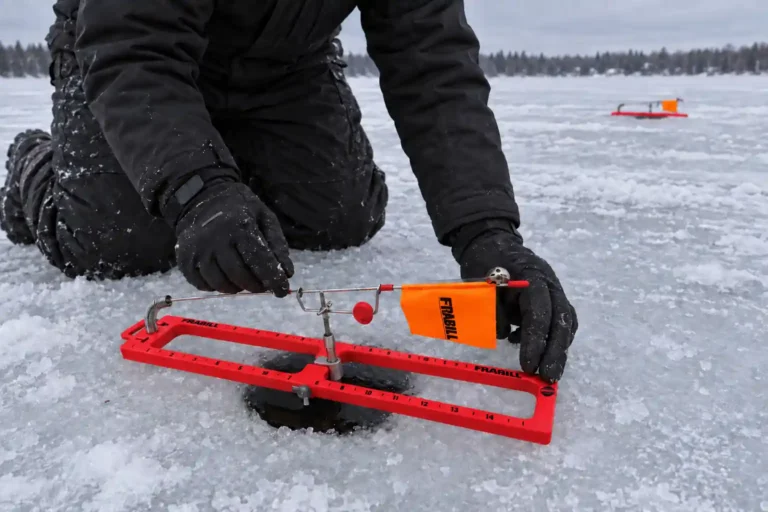
- Tip-up: Places a stationary bait at another position along the same weed edge, point or break and signals a take with a flag. If you still need one, we compare suitable tip-ups for pike separately.
In our logged sessions, we have repeatedly seen large pike charge toward a heavy flash spoon worked in the upper third of the water column, then stop several feet below it. If rhythmic lifts, shorter strokes and subtle quivers fail to produce a strike, we do not continue forcing the same presentation. We remove the spoon and lower a dead bait through the same hole, stopping it just above the depth where the pike stalled. The spoon provides the flash that brings the fish into the sonar cone, while the nearly motionless bait gives it a slower target at eye level.
You can apply the same principle without changing the bait in the jigging hole. Work the lure normally while a deadstick or tip-up holds a stationary bait nearby. If a pike follows the lure but refuses it, shorten the lifts and then hold the lure motionless. Do not immediately start ripping harder. A fish that will not commit to the active presentation may turn toward the easier meal on the second line.
Place the deadstick far enough from the jigging hole that the lines are unlikely to cross, but close enough that you can see the rod tip and reach the rod without delay. There is no fixed distance that works everywhere because water depth, line angle, shelter position and the structure beneath the holes all affect the layout. A tip-up can cover a position farther away, provided it remains visible and the spread complies with local regulations.
Use a bite-resistant leader on the stationary presentation as well. A pike taking a motionless bait can cut an unsuitable leader just as easily as one striking a jigging lure. After landing a fish, check the leader for kinks, cuts or abrasion before lowering the bait again.
Check the current regulations for the exact water before setting a second line. The number of lines allowed—and whether a held rod, deadstick and tip-up all count toward that limit—varies by state, province and sometimes individual water. Rules concerning hook arrangements, identification and how closely a line must be attended can also differ, so use current official regulations, such as the Minnesota DNR fishing regulations, rather than a general number from an article.
Hooksets and Fighting a Pike Through the Hole
A jigging strike comes on a short rod, a nearly vertical line and directly beneath a small opening, so control matters more than an exaggerated hookset. This section covers what is specific to landing a jig-caught pike through the ice. For hook removal and release, see our guide to handling pike safely.
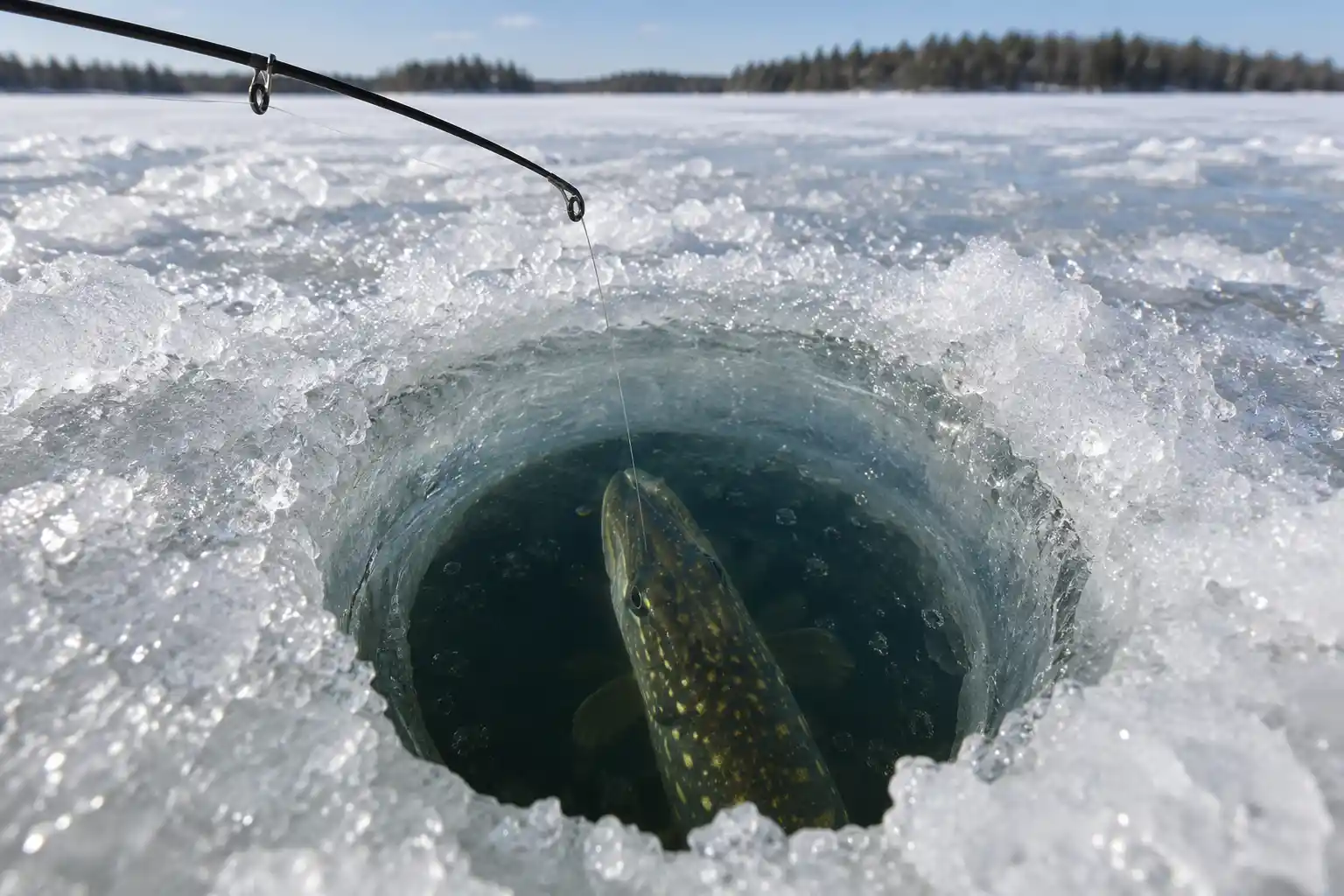
Wait until you feel the fish’s weight, then set the hook with a firm upward sweep. Striking at the first flash on sonar or the first tap can pull the lure away before the pike has it. Once the rod loads, keep it bent and maintain steady pressure. Do not pump the rod aggressively, because every drop of the rod tip creates an opportunity for the line to go slack and the hooks to come free.
Set the drag before the lure enters the water. It should release line during a strong run without slipping throughout the hookset. A pike directly beneath the hole can change direction quickly, so let the drag absorb each surge while keeping the rod loaded. Do not tighten it during a run simply because the fish is taking line.
Watch where the line meets the underside of the ice. A pike circling below the hole can pull the line against a sharp or rough edge. Follow the fish around the opening with the rod, and lower the rod tip toward—or slightly into—the water when necessary to improve the line angle. Avoid forcing the fish upward while the line is rubbing against the ice.
Treble hooks and the fixed hooks on minnow-style jigs can catch the underside of the hole as the fish turns near the surface. Keep the pike centered beneath the opening and guide it upward only when its head is aligned with the hole. If the lure catches the ice, maintain light pressure rather than jerking harder, which can tear the hooks free or damage the fish.
Expect one more surge when the pike reaches the hole. Keep its head beneath the opening until it is properly aligned, then guide it through headfirst without lifting it by the line or lure. Keep your fingers away from the mouth and exposed hooks. Have long-nose pike pliers ready before you begin fishing so the hooks can be controlled as soon as the fish is secured.
FAQ: Jigging for Pike Through the Ice
What is the best lure for jigging pike through the ice?
There is no single best lure. Rattle spoons and blade baits are a good starting point in deep, stained or low-light water. Minnow-style jigs and lipless crankbaits suit active fish with room to chase, while quieter flutter or vertical spoons can help when a pike approaches but hesitates. Start with the type that fits the situation and change it according to the fish’s response.
Do I need a leader when jigging for pike?
Yes. Pike can cut through light line, so use a bite-resistant steel or heavy fluorocarbon leader. Steel provides the greatest protection against teeth, while heavy fluorocarbon is less visible but must be inspected carefully for cuts and abrasion. Check either type after every fish.
How high should I jig above the weeds?
Start just above the weed tops so the lure remains visible without fouling the hooks. When sonar shows a fish, use the mark to set the height and keep the lure at or slightly above it. Change the height in small steps rather than making large jumps.
Why do pike follow my lure but not bite?
The presentation may be too fast, too aggressive or at the wrong height for that fish. Change one variable at a time: shorten the lift, extend the hold, adjust the height and only then change the lure’s size, color or type. Treat the leader as the final variable because changing it may reduce protection against bite-offs.
How long should I jig one hole before moving?
Without a visible fish, five to ten minutes is a reasonable maximum starting window rather than a fixed timer. Stay longer when a pike follows or another mark appears near the lure. Move when nothing appears, follows or touches the lure after an aggressive and a slower pass through the useful depths.
Can I jig and fish a tip-up at the same time?
Often yes, but it depends on how many lines are permitted and whether a rod held in your hand counts toward that limit. Check the current official regulations for the exact water before setting a second line.