

Best Underwater Fishing Cameras: 6 Tested for Ice and Open Water
We’d been marking a fish on the flasher for almost a minute, holding steady six inches off bottom and refusing to move toward the jig no matter how we worked it. A flasher tells you a fish is there — an underwater fishing camera can show you why it won’t bite. We lowered one through the next hole and saw a pike sitting motionless behind a clump of weeds, watching the jig but unwilling to leave cover. That context is difficult to get from a conventional sonar return alone.
An underwater camera isn’t a replacement for a flasher or sonar — either still does a better job of covering water and checking depth quickly. What video adds is confirmation: species identification, a direct view of weeds and bottom composition, and the ability to watch how a fish responds to your presentation instead of interpreting another moving mark.
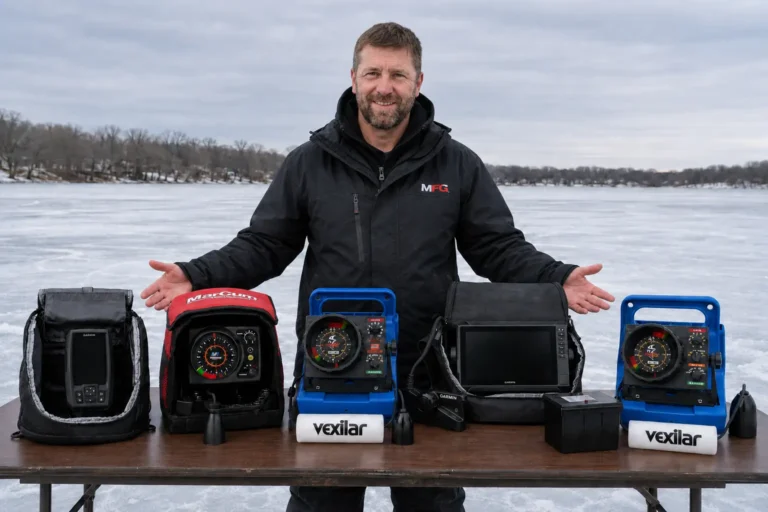
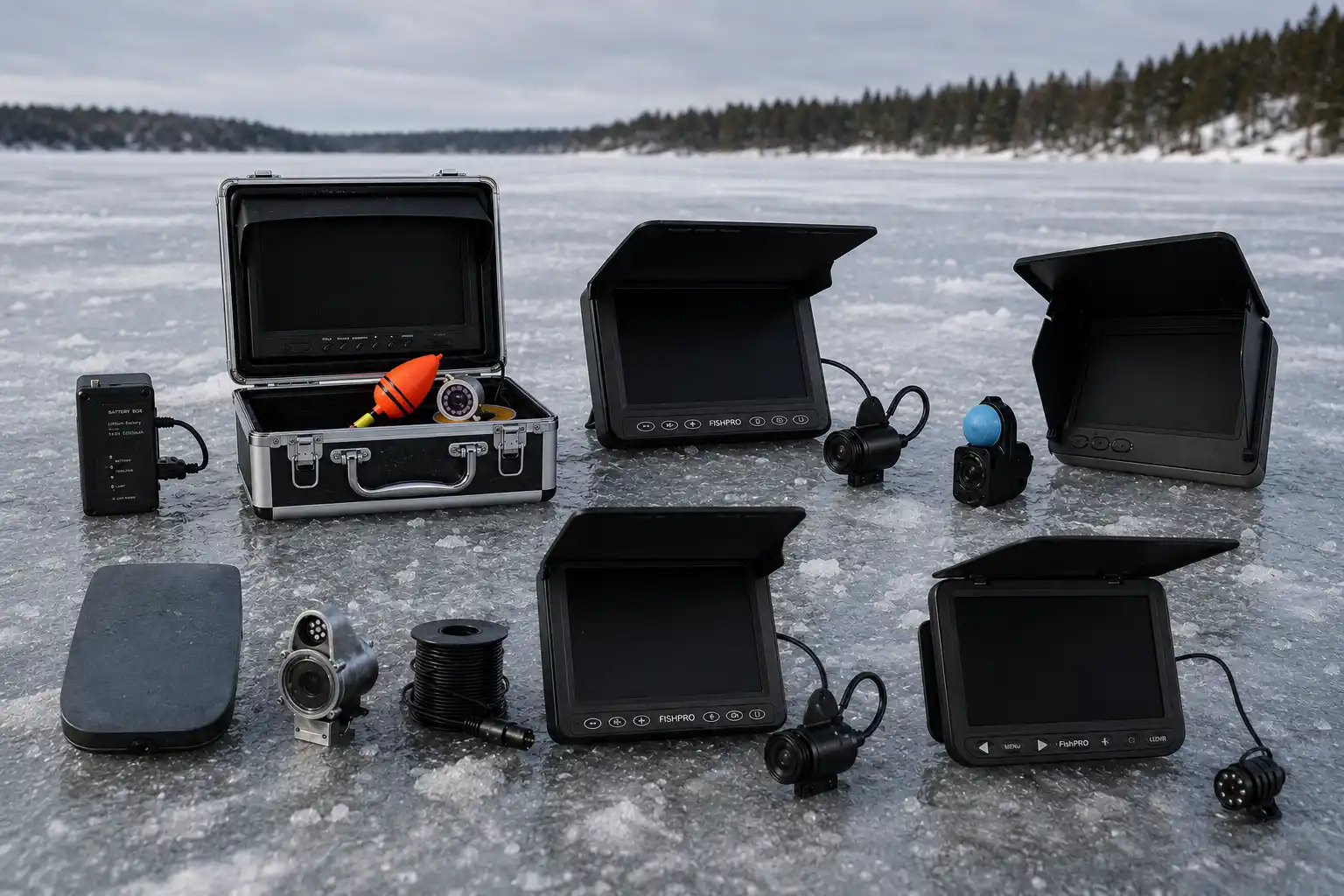
We selected six cameras for six ways anglers actually use them: an all-around system balancing screen size, battery life, and recording; a genuine budget option that still produces a usable picture; a large-screen model for shelters and group viewing; an app-connected system that streams to a phone; a straightforward option for beginners and families; and a compact unit for checking holes without hauling a full setup. Every pick can be used on the ice and in open water.
As an Amazon Associate, we earn from qualifying purchases at no additional cost to you. Read more ›
How we tested: We ran all six systems through the ice and in open water, comparing image clarity in clear and stained conditions, infrared performance in low light, cable handling and durability, battery runtime in cold temperatures, and how easily each system could be set up and operated while wearing gloves. For the open-water portion, we lowered each camera beside the boat and worked along weed edges and bottom transitions, paying particular attention to screen visibility in daylight, how easily the cable could be controlled without an ice hole to steady it, and whether boat movement or suspended sediment made the picture harder to use.
MFG Quick List: Best Underwater Fishing Cameras
If you’re short on time, these six cameras cover the situations anglers actually run into — from an all-around daily driver to a genuine budget pick, a large screen for the shelter, and a compact option for checking holes fast.
- FishPRO NO.1 HD 1080P DVR — Best Overall: a 1080p camera and 7″ IPS screen, DVR recording, and a 10,000mAh battery built to run all day.
- ZXBVSU Underwater Fishing Camera — Best Budget: a real 100 ft cable and usable HD picture at a fraction of the price of the field.
- Eyoyo 9″ 1080P DVR — Best Large-Screen Camera: the biggest display here, built for shelter use and watching in a group.
- CHASING CanFish CF1 — Best App-Connected Camera: streams live to your phone with AI-powered fish alerts.
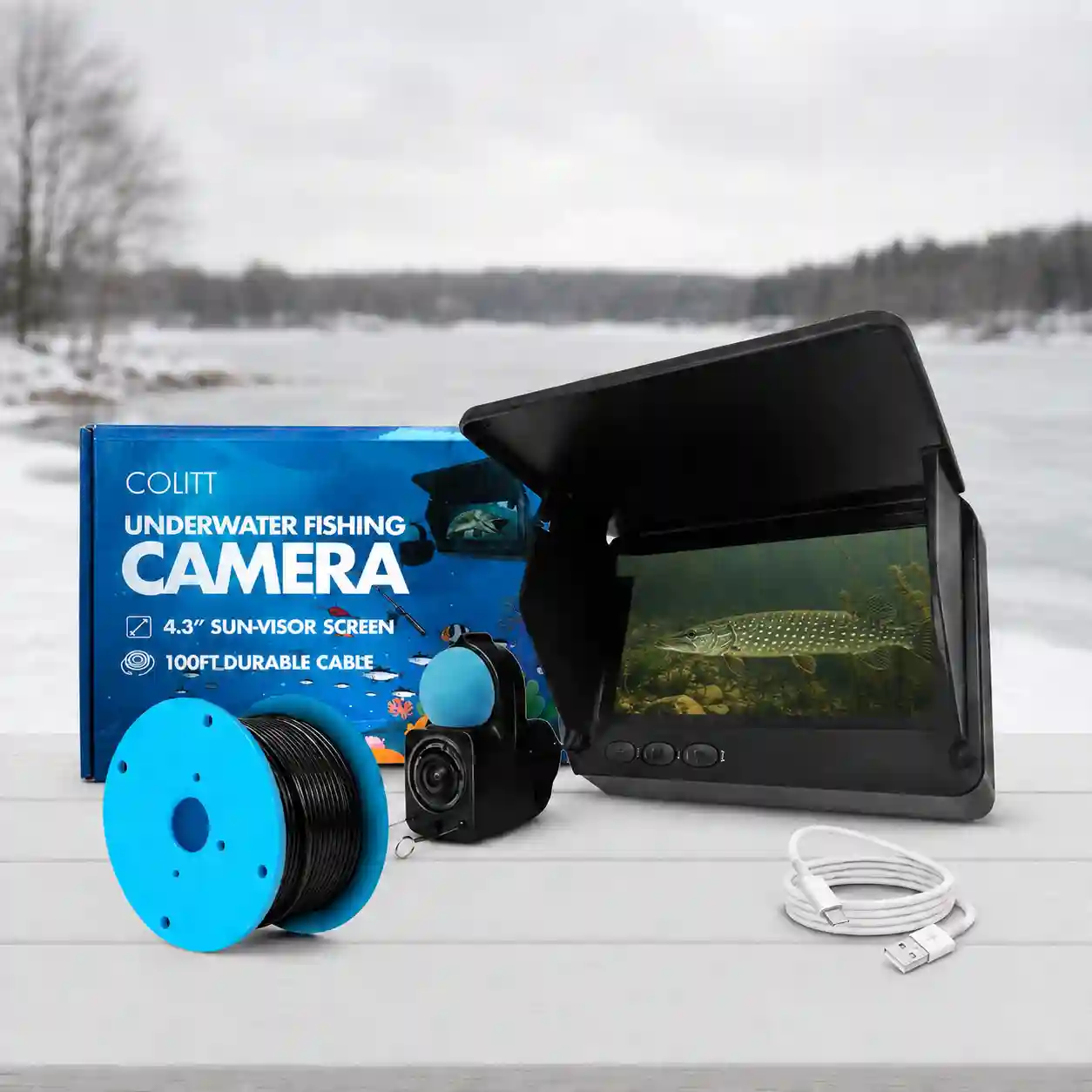
- COLITT Underwater Fishing Camera — Best for Beginners and Families: no app, no pairing — just power it on and watch.
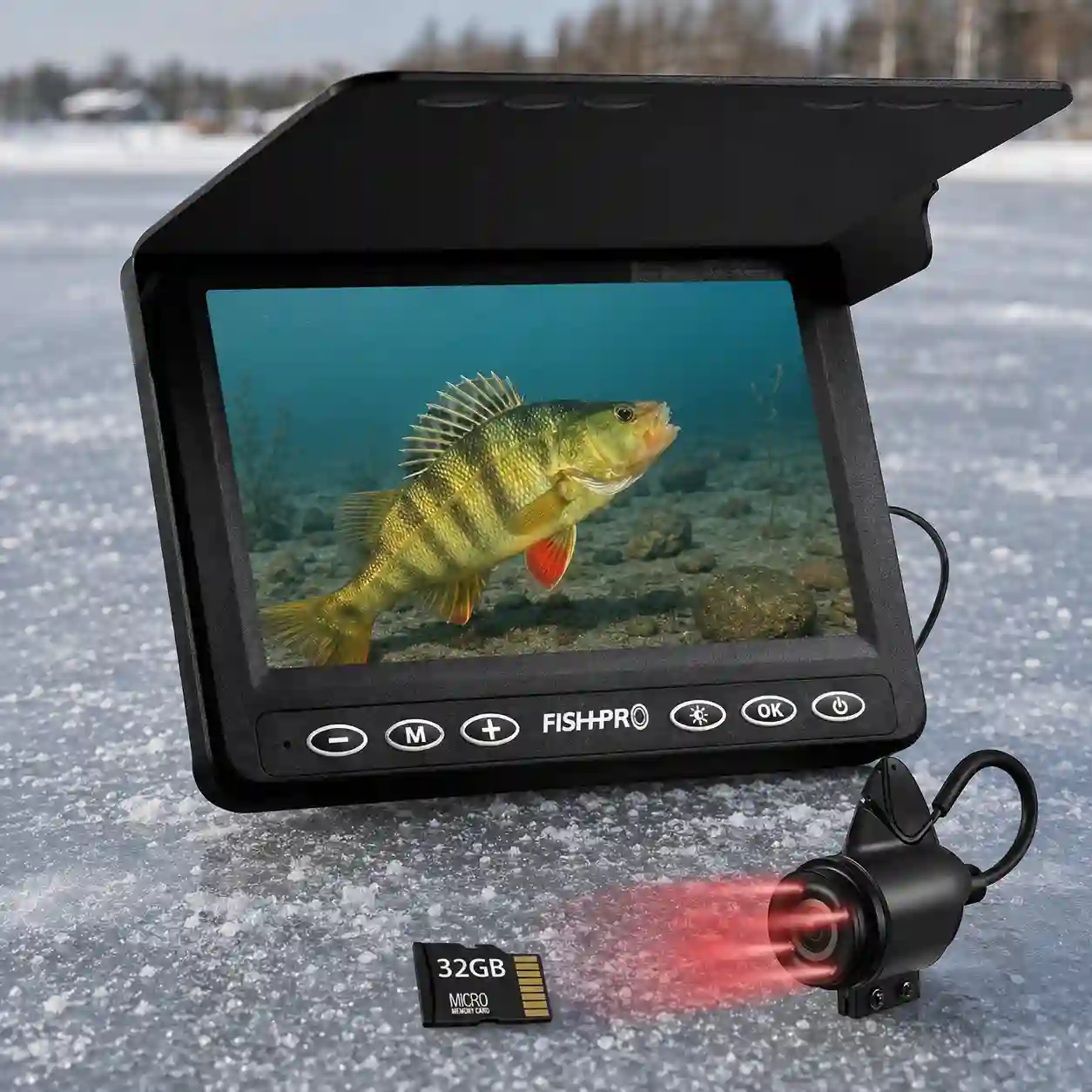
- FishPRO “The PRO” 4.3″ DVR — Best Compact Camera: a pocket-sized system that’s fast to move between holes.
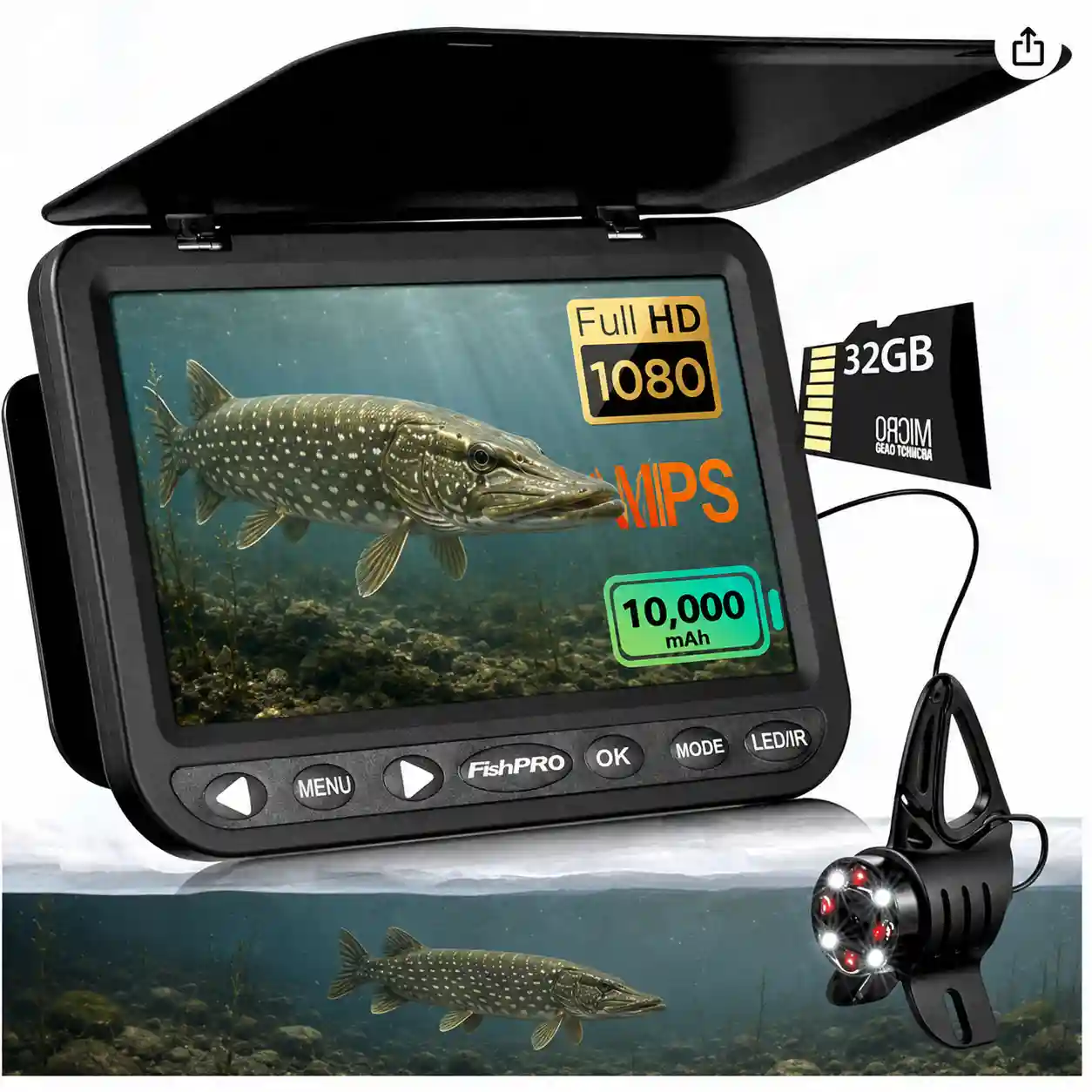
FishPRO NO.1 HD 1080P DVR — Best Overall
Key specs: 7″ IPS monitor · 1080p camera · DVR with 32GB card · 83 ft magnetic-spool cable · 10,000mAh battery · IR and white LED lighting
We drilled a hole over a hard-bottom transition, dropped the camera, and immediately understood why pike had been holding there all week without touching a single presentation. The 7-inch IPS monitor showed a shelf of rock giving way to soft mud within a few feet — exactly the kind of ambush edge pike favor, tied closely to where pike hold at different points in winter, and something the flasher return hadn’t revealed clearly. We’d been fishing the wrong six feet of that hole for three days.
What made this the camera we kept reaching for wasn’t just the 1080p picture—it was the DVR. We set it to record in 5-minute segments and left it running while we worked a jig in the adjacent hole. Reviewing the footage that evening, we spotted a pike following the lure for nearly 40 seconds before peeling away. We missed the entire interaction while watching the rod instead of the monitor. That recording showed us more than whether fish were present; it revealed how long one stayed interested and exactly when the presentation lost it.
The included 32GB card is ready to record out of the box, while loop recording automatically replaces the oldest clips once the card is full. Storage can also be expanded up to 256GB if you want to save longer sessions. Video transfers through the USB-C connection, so reviewing footage doesn’t require a proprietary app.
The 10,000mAh battery lasted through our full eight-hour day with charge remaining, even in single-digit temperatures. Its 83 ft cable covered every depth we fished, and the magnetic spool kept the monitor and cable together during transport without permanently locking them into one bulky unit. Switching among infrared, white LED, and normal viewing took one button press: IR produced a black-and-white view in darkness, while the white LEDs restored color when water clarity allowed it.
In open water, we lowered the FishPRO beside the boat and followed a weed line until it broke into scattered rock. The large monitor made that transition easy to recognize without leaning over the screen, and the DVR let us keep moving while the camera recorded the pass for a closer look afterward. The magnetic spool was just as useful in the boat as it was on the ice, keeping the long cable contained instead of leaving loose coils across the deck when we moved to the next section.
The adjustable fin supports 45°, 90°, and 180° viewing positions, making it possible to look down, across the bottom, or back up toward the lure. Combined with the large display, straightforward DVR controls, replaceable storage, and all-day battery, that versatility gives the FishPRO the best overall balance of image quality, recording, runtime, and ease of use among the six cameras we tested.
The trade-off: the glossy 7-inch screen becomes harder to read in direct sunlight, so it performs best inside a shelter or with the monitor shaded. The fin works for basic positioning, but holding an exact viewing direction in deeper water or current takes practice; FishPRO’s rotating tripod provides better control but is sold separately. This also costs considerably more than a live-view-only budget camera, so the premium makes the most sense if you will actually use the DVR and larger screen.
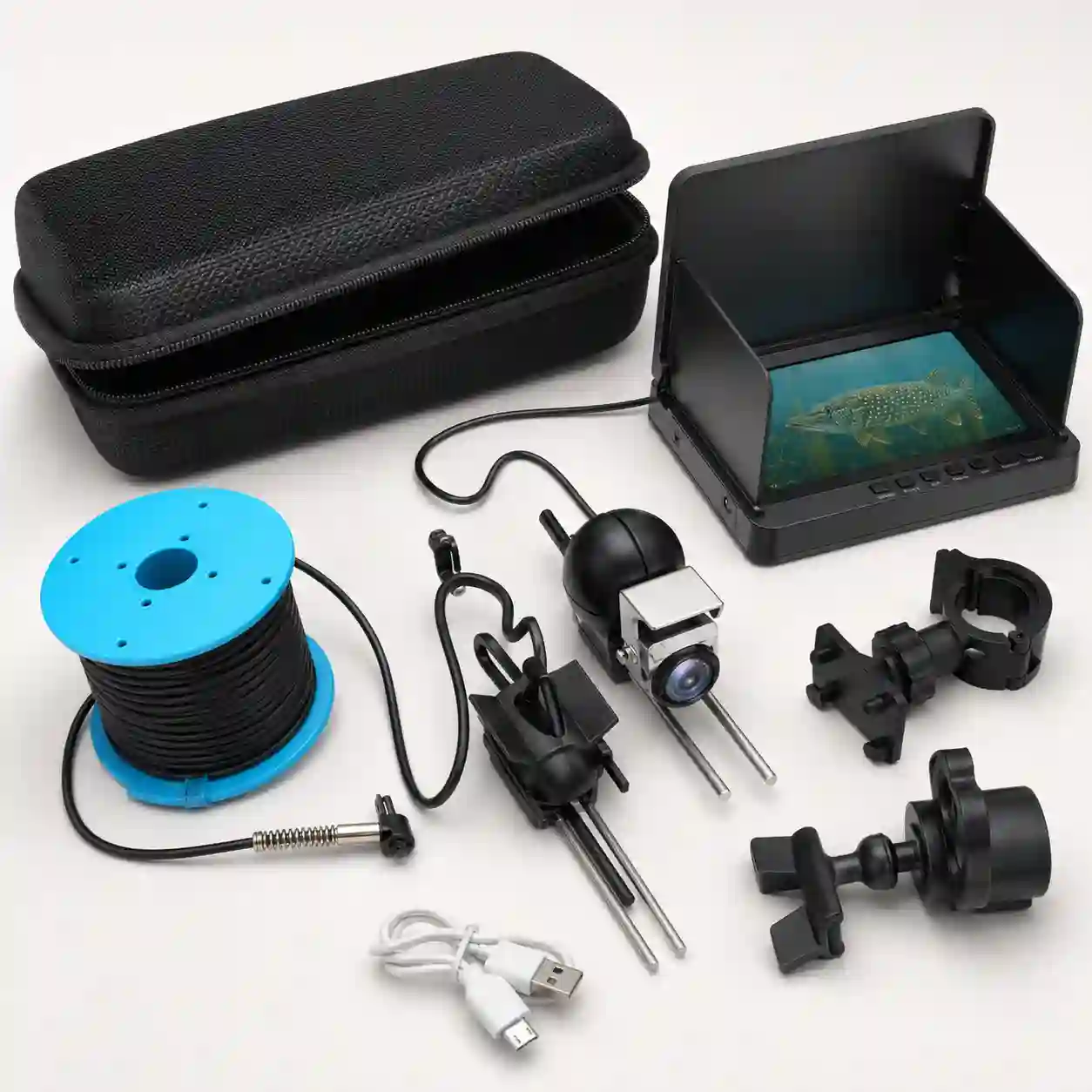
ZXBVSU Underwater Fishing Camera — Best Budget
Key specs: 5″ IPS monitor · 100 ft cable · 6000mAh battery · 220° wide-angle lens · IR lighting · Live viewing only
We almost didn’t bring this one, expecting the usual budget-camera compromise of a washed-out picture and a cable too short to matter. Instead, we dropped it into 20 feet of stained water off a rocky point, and the 5-inch IPS monitor showed a clear, stable view of the bottom the whole way down — no noticeable lag, no dropout, and nothing that immediately gave away the price tag.
The 100 ft cable is the main reason this earns Best Budget over cheaper alternatives with shorter spools. We fished a hole where the drop-off ran deeper than expected, and instead of running out of cable and hauling the camera back up to move, we simply kept feeding line from the spool. That range is unusual at this price, and many similarly priced cameras come with shorter cables that limit deep-water scouting.
The infrared lighting held up better than expected once the sun dropped. We turned it on inside a shaded shelter to check a hole that had gone quiet. The 220° wide-angle lens gave us a broad view around the camera, picking up a pike cruising well off to one side rather than directly in front of it. The 6000mAh battery ran close to nine hours across a full day without needing a midday charge.
One thing worth knowing before you buy: this camera is for real-time viewing only — it does not record or save footage. If you want to review a fish’s behavior afterward, you’ll need one of the DVR-equipped picks on this list. For simply watching what is happening beneath the hole in real time, that limitation doesn’t cost you much. The submerged camera is IP68-rated, although the monitor still needs to be protected from water and slush.
The trade-off: the setup instructions are thinner than they should be for a first-time buyer, and the basic spool makes precise camera positioning harder than it is on more expensive systems. But for the price, the 100 ft cable, wide field of view, and near-full-day battery life make this the easiest budget recommendation on the list.
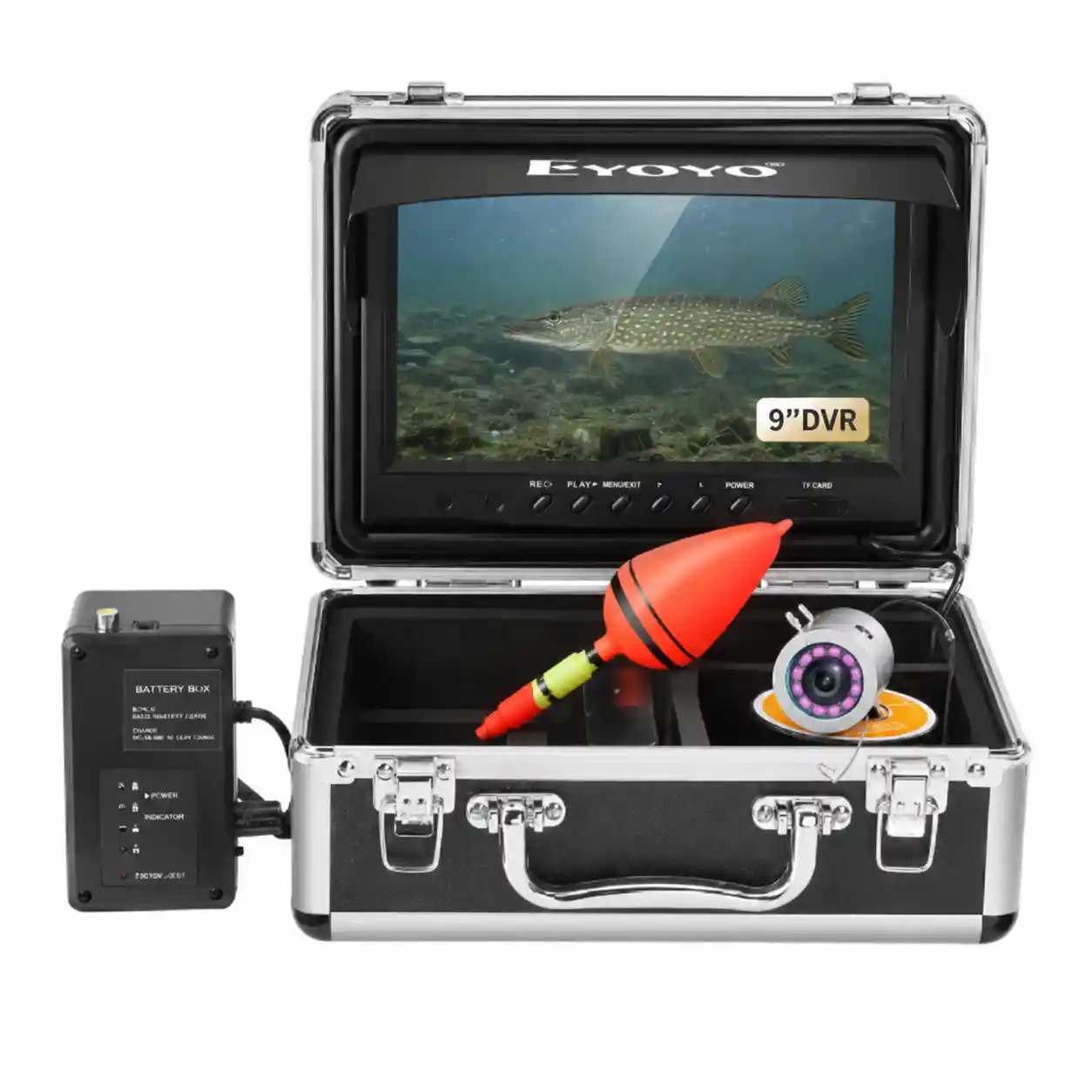
Eyoyo 9″ 1080P DVR — Best Large-Screen Camera
Key specs: 9″ 1024×600 IPS monitor · 1080p camera · DVR with 8GB card · 98 ft cable · 4500mAh battery · 92° lens · 12 IR LEDs
Three of us were packed into a shelter, and the first thing everyone noticed was how much easier it was to see the picture without hunching over a 4-inch display. The 9-inch monitor is the largest in this lineup, and that extra screen space made an immediate difference once more than one person wanted to follow what was happening below the hole.
We ran it along a weed edge in about 15 feet of stained water, where the 1080p camera showed a pike sitting tight against the vegetation. The 92° lens covered enough of the weed line to show how the fish was positioned, while the 12 infrared LEDs kept its outline visible after ambient light began to fade. IR mode switches to a black-and-white picture, but we could still separate the pike clearly from the surrounding vegetation.
The real advantage of the 9-inch monitor is that several people can watch the same detail at once. Instead of passing a smaller display back and forth, we could point to the weed edge and follow the pike’s reaction together. That makes the Eyoyo particularly useful for anglers who fish with a partner, bring kids onto the ice, or want to show someone else how fish respond to a lure.
The 98 ft cable gave us enough reach to explore a deeper basin edge without running short. Its built-in DVR records and replays footage using the included 8GB card, letting us revisit short encounters instead of relying on what we noticed in real time. The controls were straightforward, and having recording built into the system meant we didn’t need an app or phone beside the hole.
Eyoyo rates the 4500mAh battery for up to eight hours, enough for most single-day sessions when fully charged. The removable sun visor improved visibility in brighter conditions, while the protective carrying case kept the monitor, battery, camera, and long cable together between trips. It’s a more substantial package than the compact models, but it also feels like a complete shelter-ready system rather than a camera built only for quick scouting.
The one frustration we encountered was the limited screen-angle adjustment inside the carrying case. We occasionally had to reposition or prop up the case to get the most comfortable view. Once positioned, however, the large display was easier to watch than anything else we tested. For anglers who spend most of the day inside one shelter and want a screen that friends or family can enjoy together, that is a small compromise.
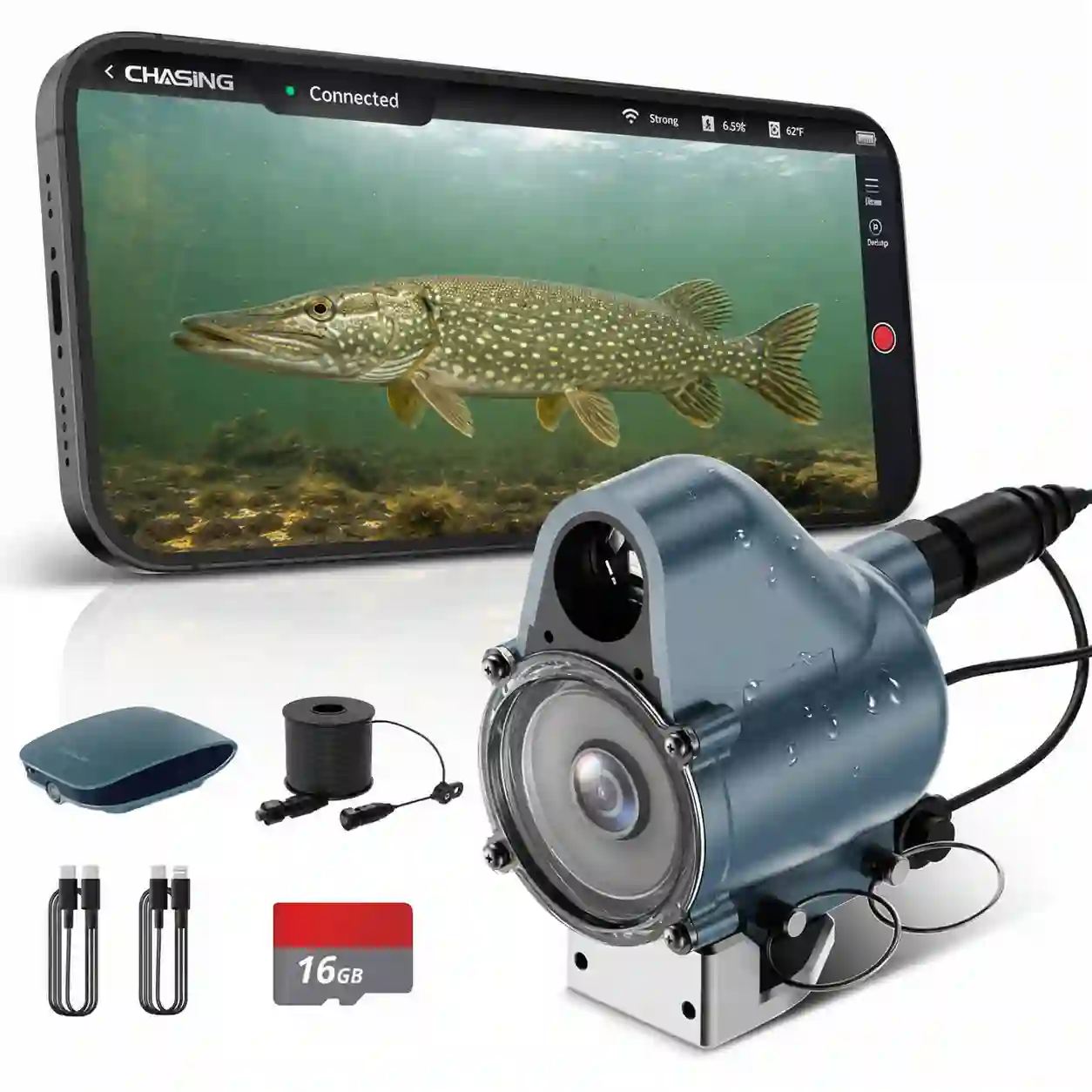
CHASING CanFish CF1 — Best App-Connected Camera
Key specs: 1080p camera · CHASING GO2 phone app · Wi-Fi or USB connection · DVR with 16GB card · supports up to 256GB · 98 ft cable · 41.04Wh battery · up to 6 hours · AI fish alerts
We left the phone propped against the shelter wall and kept jigging with both hands free, looking over only when the app alerted us that a fish had entered the frame. That’s what separates the CanFish CF1 from every conventional camera here: instead of adding another monitor to your gear, it turns the phone you already carry into a live underwater display.
The camera connects by cable to its powered repeater, which creates a local Wi-Fi network for the CHASING GO2 app. No cellular signal or mobile data is required, so we could use the live feed normally on a lake where phone coverage was unreliable. The picture looked sharp on the phone’s display, and having the screen separate from the cable spool made it easy to position where we could see it without crowding the hole.
That separation proved even more useful when we lowered the CF1 beside the boat in open water. We placed the phone on a dry seat away from the gunwale and watched the feed while moving the camera along the outside edge of a weed bed. With no dedicated monitor attached to the spool, one of us could manage the cable while the other followed the picture and called out openings in the vegetation. The local connection continued working without cellular coverage, and we finished the pass with the footage already available through the phone.
The AI fish alerts were the feature we expected to treat as a novelty but ended up using throughout the session. Instead of dividing our attention between the rod and a mostly empty screen, we continued fishing until the app detected movement. One alert brought our attention back just as a pike that had passed through the frame began circling toward the lure again. We likely would have missed that second approach if we’d only checked the feed every few minutes.
Recording is another strength. Clips can be recorded and downloaded through the phone, while the built-in DVR saves footage to the included 16GB card. The system supports cards up to 256GB, giving anglers who record full sessions plenty of room to expand. From the app, we could also prepare clips for sharing without removing a card and transferring everything through a computer first.
The 1080p camera remained useful as the light faded, with infrared night vision providing a clear black-and-white view when the natural color image became too dark. Its 98 ft cable reached every depth we fished and is rated for up to 40kg of pulling force, giving it enough strength for regular use around ice, boat edges, and underwater structure.
The 41.04Wh battery is rated for up to six hours, which covers most single fishing sessions, while the repeater can also supply power to a connected phone when using USB. That wired connection is more than a backup charging option—it also provides a stable alternative when you don’t want to rely on Wi-Fi.
The one frustration we encountered was occasional Wi-Fi lag when the phone was farther from the repeater or buried beneath clothing. Moving it closer restored the feed, and switching to USB provided a dependable alternative. For anglers comfortable using a phone app, that is a small compromise for AI alerts, a sharp screen you already own, expandable recording, and footage that’s immediately ready to save or share.
COLITT Underwater Fishing Camera — Best for Beginners and Families
Key specs: 4.3″ monitor · IP67-rated camera · 100 ft cable · infrared viewing · up to 16 hours of battery life · included rod holder · no app or Wi-Fi required
We handed the COLITT to a friend who had never used an underwater camera, and within two minutes he had it below the ice and was calling out what he could see without asking a single question. There is no app to download, Wi-Fi network to join, or recording menu to configure. Connect the camera, switch on the monitor, and the live picture appears.
That simplicity is why it earns this category over cameras with longer feature lists. Two children fishing with us understood the system almost immediately, and their reaction was the best part of the test. Watching a perch swim toward the lens and inspect it turned “are we almost done?” into genuine excitement about what might appear next. For parents introducing their children to fishing, that immediate view beneath the hole can make the experience far more engaging than waiting for an unseen bite.
The 4.3-inch monitor is compact enough for smaller hands and simple enough to operate without constant help. Daytime image quality was clear enough for us to identify species and distinguish fish from weeds and bottom structure. When the natural light faded, switching on the infrared mode preserved a usable view without introducing additional controls for a beginner to learn.
Only the submerged camera is water-resistant; the monitor is not rated as waterproof. We kept it protected from falling snow, water, and slush while using it on the ice. That is a simple precaution, but an important one for families using the system around an open hole.
The 100 ft cable gives this straightforward system more scouting range than its compact monitor suggests. We used it along a deeper drop-off without reaching the end of the spool, while the included rod holder provided another way to support the system instead of managing everything by hand. COLITT rates the rechargeable battery for up to 16 hours, giving beginners and families plenty of capacity for a full outing without bringing another charger onto the ice.
Its compact monitor, long cable, and direct wired connection also make it easy to move between ice, docks, boats, and shoreline fishing. There is no phone to expose to water, no cellular signal required, and no separate app that could cause setup delays. For someone buying a first underwater camera, that straightforward operation is a genuine advantage rather than a missing feature.
The one functional issue we encountered was that the camera tended to point slightly downward when suspended in the middle of the water column. We got the most useful view by positioning it on or close to the bottom, where the picture stabilized and showed the surrounding area more consistently. That limitation matters less for beginners and families primarily interested in exploring the bottom and watching fish approach, which is exactly where the COLITT is most enjoyable.
FishPRO “The PRO” 4.3″ DVR — Best Compact Camera
Key specs: 4.3″ IPS monitor · 1000TVL camera · DVR with included 32GB card · supports cards up to 128GB · 66 ft magnetic-spool cable · 5,000mAh battery · three-level IR lighting · IP68-rated aluminum camera housing
We drilled six holes across a flat in under fifteen minutes, dropping this camera into each one for a quick look before moving on, and never felt weighed down by the setup. The monitor, cable spool, and camera form a compact system that is easy to carry in one hand. The magnetic connection lets the monitor snap securely onto the spool for transport and separate quickly when it is time to lower the camera.
That mobility is the main reason it earns our Best Compact Camera designation. Larger systems are better suited to watching one hole from inside a shelter, but this FishPRO is built for a faster routine: drill, drop, check, and move. We could pull it from one hole, secure the cable on the spool, and have it running in the next hole within minutes.
The picture from the 1000TVL camera was clear enough to identify fish, vegetation, and bottom transitions during our quick checks. When we moved from a sunlit hole to one shaded by the shelter, the three-level infrared control let us adjust the lighting with a button instead of stopping to work through a menu. The built-in sun visor also made the display easier to read when we used it outside the shelter.
Despite its smaller size, this is not a stripped-down viewing camera. The DVR records to an included 32GB card, with support for cards up to 128GB, so we could save the most useful passes rather than rely on memory after checking several holes. The 5,000mAh battery lasted through our mobile scouting session, while USB-C charging and power-bank support provide a practical backup for longer days.
The 66 ft cable reached every hole we checked, and the IP68-rated aluminum camera housing felt reassuringly solid as we repeatedly lowered it to the bottom and pulled it back through the ice. For anglers who move frequently, that combination of a protected camera, organized magnetic spool, and onboard recording offers far more capability than its compact dimensions suggest.
The trade-off: the 4.3″ monitor gives you less viewing area than the 7″ FishPRO or 9″ Eyoyo, so identifying fine details at a distance requires a closer look. That is the compromise behind its portability rather than a flaw in its picture quality. If you want a camera that can move through a series of holes without becoming another bulky piece of gear, this is the most convenient option in our lineup.
What Pike Actually Do When They See an Underwater Fishing Camera
Most articles about underwater fishing cameras answer whether fish get spooked and stop there. For pike, the more useful question is what the camera reveals about a fish that has already committed to investigating. Across dozens of sessions with these six cameras, pike commonly slowed as they entered the frame, held position several feet away, and studied the area before either moving toward the lure or drifting back toward cover — a pattern that lines up with how pike behavior shifts through the winter as the season progresses.
Not every fish reacted the same way. Bright lights, sudden cable movement, and a camera lowered directly in front of a pike could make it turn away. When we positioned the camera off to the side and left it still, however, most of the pike we observed were more cautious than frightened. They frequently remained within view long enough for us to watch how they responded to changes in the presentation.
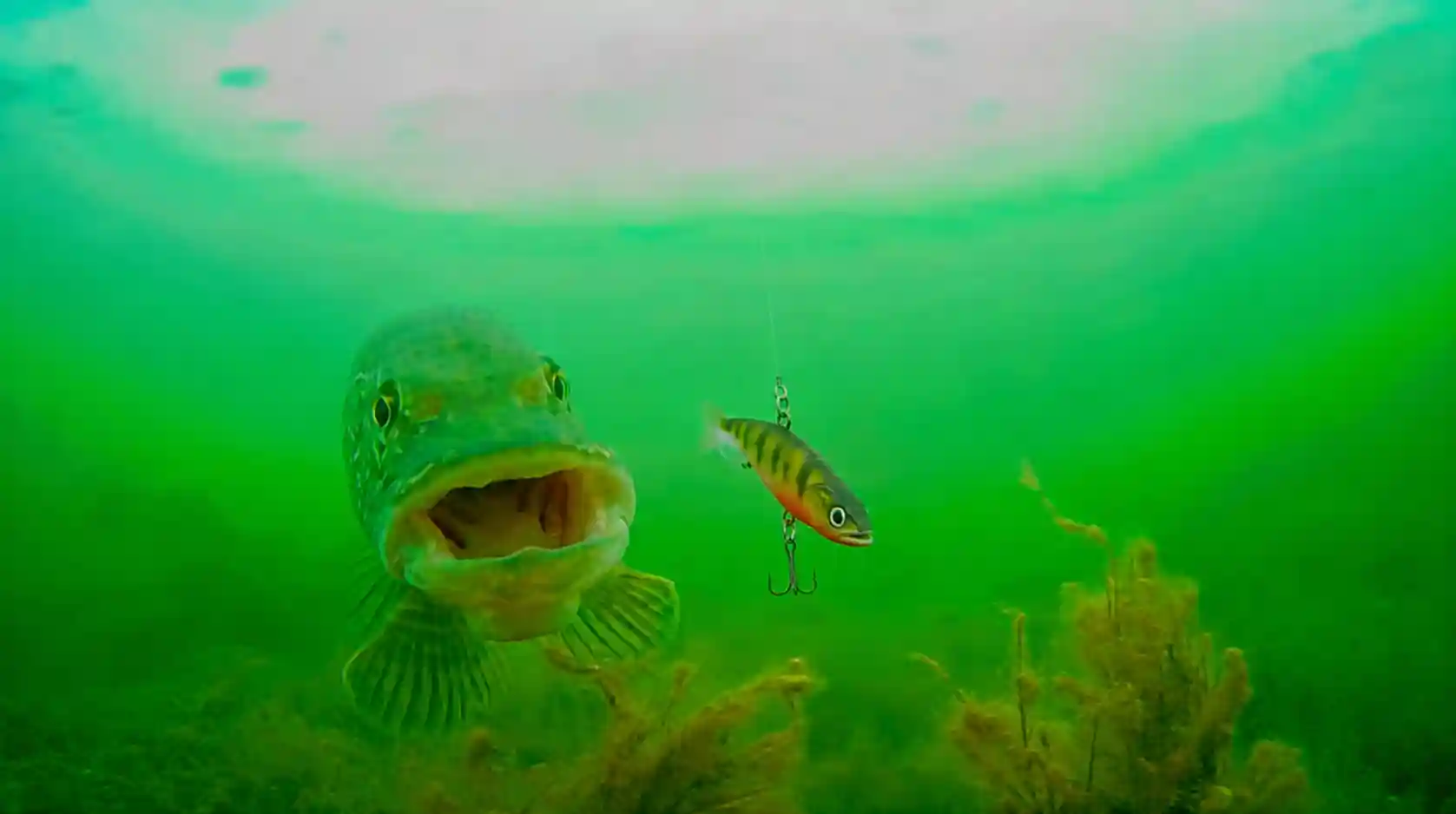
That behavior is why a camera works best alongside a flasher rather than replacing one. A flasher shows a mark rising or falling through the water column; the camera shows whether that mark is a pike tracking the jig, holding beside it, or already circling away. On the DVR-equipped models, we repeatedly recorded fish following for 20 to 40 seconds before losing interest—behavior that would have been difficult to interpret from a sonar mark alone.
When we saw a pike holding back without closing on the lure, we stopped repeating the same presentation. We usually changed the cadence first, replacing aggressive lifts with shorter movements and a longer pause. If the fish still refused to move closer, we adjusted the lure’s depth or switched to a different size. A pike that remains in view is still interested, but continuing with the same presentation rarely gives it a new reason to strike.
How to Choose an Underwater Fishing Camera
Match the Camera to How You Actually Fish
A large-screen DVR system makes sense when you stay in one shelter and watch a hole for hours; a compact camera is much easier to carry when you are constantly moving. For a permanent shelter or trips with several anglers, the 9-inch Eyoyo provides a screen everyone can see. For frequent hole-hopping, the smaller FishPRO “The PRO” is easier to carry and deploy. An app-connected camera such as the CanFish CF1 eliminates the separate monitor, but it also means relying on your phone throughout the session.
Don’t Judge Picture Quality by “1080p” Alone
A 1080p camera does not guarantee full HD detail on the monitor — the final picture also depends on screen resolution, lens, available light, water clarity, and viewing distance. A clear 1000TVL camera in good conditions can sometimes provide a more useful view than a higher-resolution camera lowered into stained or disturbed water. Screen size matters most when you want to identify small details or let several people watch at once — a 4.3-inch display is fine for checking structure and nearby fish, while a 7- or 9-inch screen makes it easier to study vegetation and bottom transitions farther from the lens.
Infrared Solves Darkness, Not Murky Water
Every camera on this list has infrared night vision, and it gave us a usable view once daylight disappeared. What infrared cannot do is see through suspended sediment or heavily stained water — the light reflects off particles the same way headlights reflect off fog, which is why the picture deteriorated quickly whenever the camera or cable stirred up soft bottom silt. If you regularly fish heavily stained water, expect the effective range to shrink to a few feet regardless of the camera’s advertised resolution.
Cold Weather Makes Battery Capacity More Important
Battery ratings are measured under favorable conditions, and runtime can drop when the screen is bright and infrared lights are running in severe cold. We wouldn’t choose a model on advertised runtime alone — a larger internal battery provides useful reserve for long sessions away from a vehicle, while a smaller battery is usually sufficient for shorter scouting trips. Starting every trip with a full charge is more reliable than expecting the advertised maximum on the coldest day of the season.
Check What the Waterproof Rating Actually Covers
An IP68 rating commonly applies to the submerged camera housing, not necessarily the monitor, connectors, or battery compartment. Keep the display protected from slush, snow, and standing water unless the manufacturer specifically rates the complete system for exposure — a waterproof camera does not automatically make everything above the hole waterproof.
Best Underwater Fishing Cameras Compared
| Camera | Best For | Screen | Cable | DVR | Ideal Scenario |
|---|---|---|---|---|---|
| FishPRO NO.1 HD 1080P | Best Overall | 7″ IPS | 83 ft | Yes (32GB) | All-day sessions needing our clearest overall view, DVR recording, and the longest battery reserve |
| ZXBVSU Underwater Camera | Best Budget | 5″ IPS | 100 ft | No | Deep-water scouting without paying extra for recording |
| Eyoyo 9″ 1080P DVR | Best Large-Screen Camera | 9″ IPS | 98 ft | Yes (8GB) | Shelter use and shared viewing with several anglers |
| CHASING CanFish CF1 | Best App-Connected Camera | Phone app | 98 ft | Yes (16GB) | Phone-based viewing with AI fish-detection alerts |
| COLITT Underwater Camera | Best for Beginners and Families | 4.3″ LCD | 100 ft | No | First-time users wanting a simple plug-and-view system |
| FishPRO “The PRO” 4.3″ | Best Compact Camera | 4.3″ IPS | 66 ft | Yes (32GB) | Fast hole-hopping without carrying a bulky setup |
Underwater Fishing Camera FAQs
Do underwater fishing cameras scare fish away?
Not typically, based on what we observed. Pike often slowed down and inspected a camera that was already hanging still, while sudden cable movement or a bright white light was more likely to make them turn away. We found infrared less intrusive when watching fish after dark, although positioning the camera off to one side and allowing it to settle made just as much difference as the type of lighting we used.
How deep can an underwater fishing camera see?
Cable length determines how deep you can lower the camera, but it does not determine how far the camera can see. The models in this guide provide roughly 65 to 100 feet of cable, while their useful viewing distance depends primarily on water clarity and available light. In clear water, we could see useful detail several feet beyond the camera; in stained water or suspended sediment, visibility sometimes dropped to only a few feet regardless of the advertised resolution.
Does cold weather affect underwater fishing camera battery life?
Yes. Battery ratings are measured under favorable conditions, and runtime can decrease in sub-freezing temperatures, especially when the screen is bright and infrared lighting runs continuously. We started each trip with a full charge rather than planning around the advertised maximum. For longer days, a larger battery or a model that supports power-bank charging provides a useful reserve.
Is a DVR-equipped underwater fishing camera worth the extra cost?
It is worth paying for if you want to study fish behavior or save footage. Recording allowed us to review pike following, holding beside, and turning away from a lure—details we sometimes missed while watching the rod. If you only need a live view to identify fish and inspect the bottom, a real-time-only camera provides the same immediate information for less money.