

Best Floating Ice Fishing Suits: 4 Tested for Warmth, Mobility & Staying Afloat
Floating ice fishing suits aren’t an optional extra for us — they’re something we plan around every time we step onto a frozen lake with 40 pounds of gear strapped to a sled. We’ve fished early ice on Devils Lake when the surface was still groaning underfoot, and we’ve pulled pike through eight inches of clear ice on Mille Lacs in conditions where a regular winter jacket would become heavy and waterlogged after an immersion.
That’s the purpose of a floating ice fishing suit: it combines cold-weather insulation with built-in flotation assistance you can wear throughout the day. We tested four complete jacket-and-bib suits over several ice seasons on Lake of the Woods, Devils Lake, and lakes closer to home — through single-digit mornings, slush-covered late ice, and the kind of wind that makes you question your life choices at 6 AM. Some handled -20°F conditions without leaving us underdressed. Others prioritized moving quickly between holes over maximum insulation. None made the cut without confirmed, built-in flotation, although manufacturers do not always publish exactly how that flotation is distributed between the jacket and bib.
As an Amazon Associate, we earn from qualifying purchases — no cost to you. That’s how we keep this site running. Read more ›
These suits are not substitutes for a USCG-approved life jacket, and flotation does not make unsafe ice safe. What it can do is provide additional buoyancy and make self-rescue more manageable if the ice fails.
Below are the four that earned a spot: the one we’d recommend without hesitation, the one that won’t wreck your budget, the one built for the coldest days of the season, and the one that won’t make you feel like you’re wearing a mattress while you’re jigging.
MFG Quick List: Best Floating Ice Fishing Suits
If you’re in a hurry, these four field-tested floating ice fishing suits cover four distinct priorities — overall performance, affordability, extreme-cold protection, and freedom of movement.
- WindRider Boreas Ice Fishing Suit — Best Overall: the strongest all-around balance of warmth, flotation, drainage, durability, and warranty coverage in our testing.
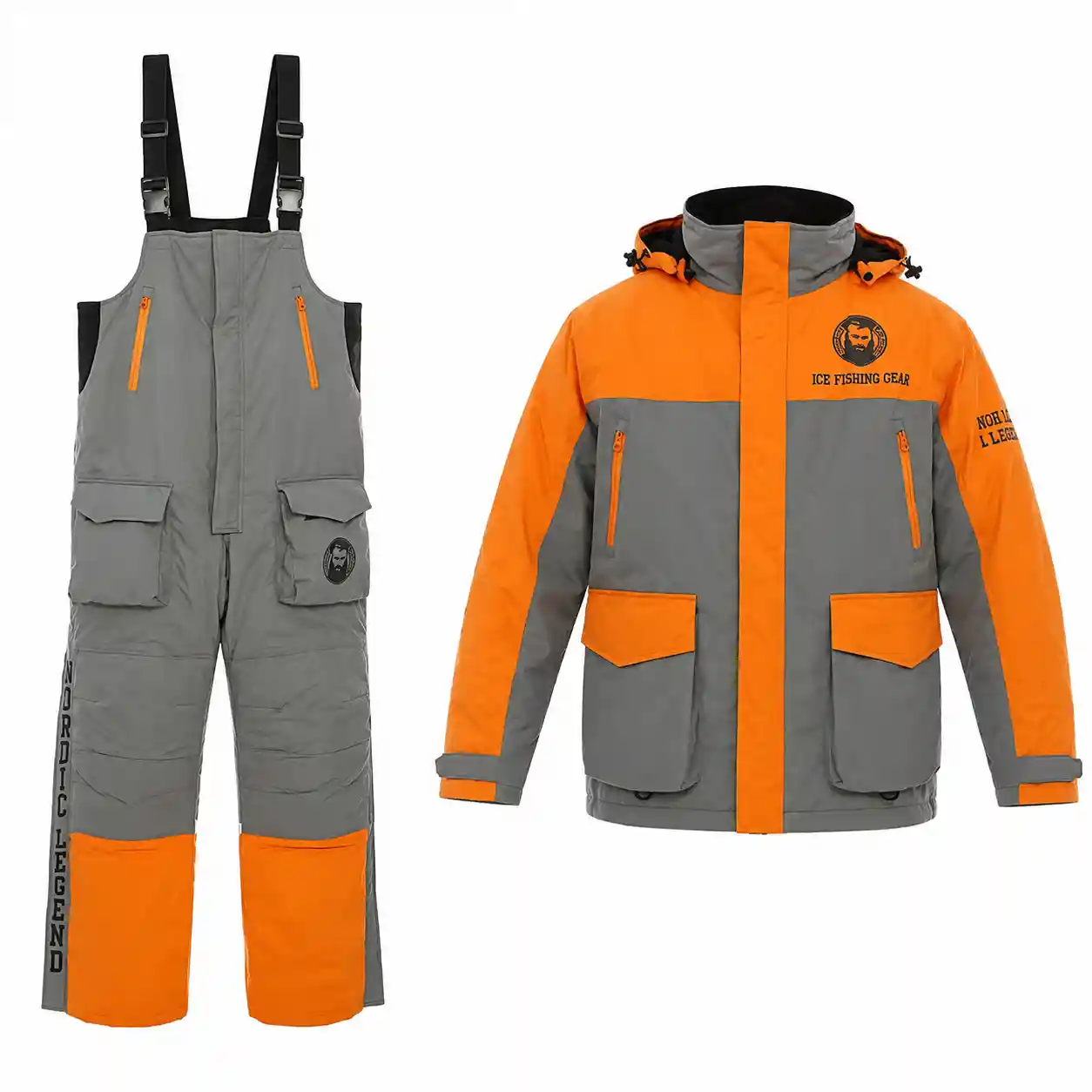
- Nordic Legend “Legendary Camo” Ice Fishing Suit — Best Budget: a complete jacket-and-bib package with Motion Float technology at a lower price than our premium picks.
- NORFIN Suit ELEMENT+ FLT — Best for Extreme Cold: 180g THERMOGUARD insulation and a published -20°F rating for long, stationary sessions.
- Nordic Legend Aurora Series Ice Fishing Suit with Floatation — Best for Mobility: the least restrictive complete suit in our testing for drilling, kneeling, and moving between holes.
Why no Striker, Eskimo, or IceArmor? This guide compares complete jacket-and-bib packages available together through the listings we evaluated. The options we found from those brands were sold as separate jacket and bib pieces, so they fall outside the scope of this complete-suit comparison.
How We Tested
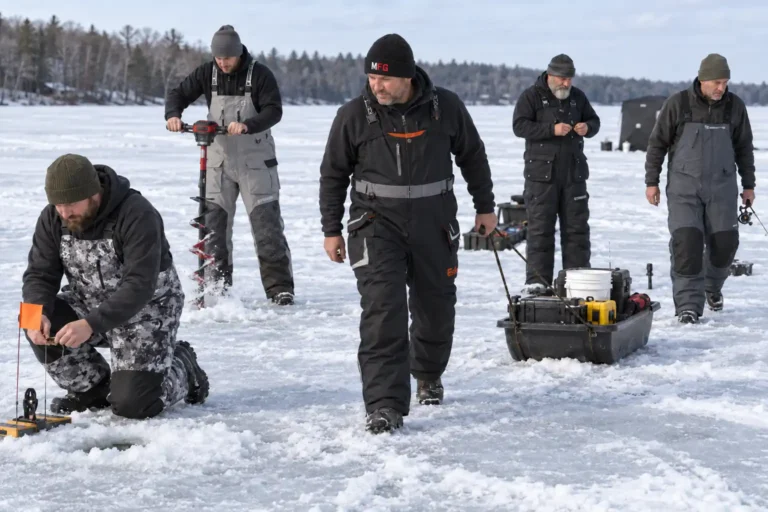
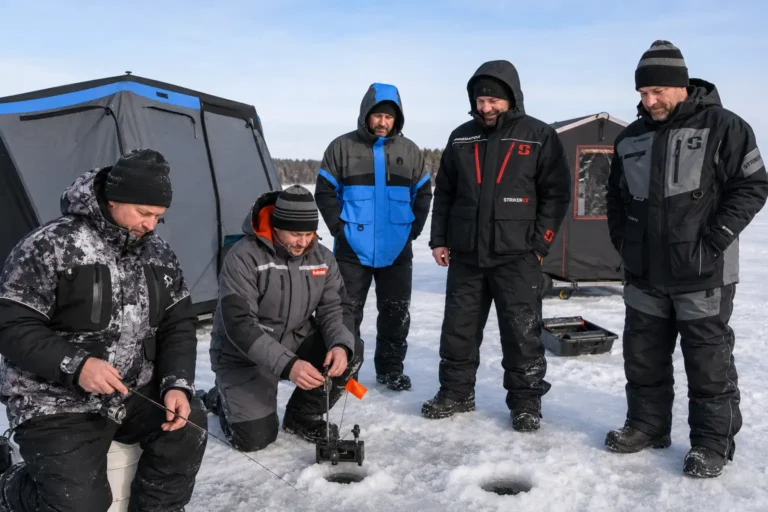
We wore each of these suits on real ice — not just around the yard for five minutes to check the fit. Testing took place over several seasons on Lake of the Woods, Devils Lake, and lakes closer to home, in conditions ranging from slushy days with temperatures in the low 30s°F to sustained single-digit mornings with a stiff wind sweeping across the ice.
We focused on four things with every suit: how the flotation was constructed and positioned within the garment, how the insulation performed during long stationary waits over a tip-up spread versus active jigging, how freely we could move while kneeling to clear a hole, reaching down to land a fish, or climbing in and out of a shelter, and whether moisture from slush, spray, or a soaked auger bit reached our base layers.
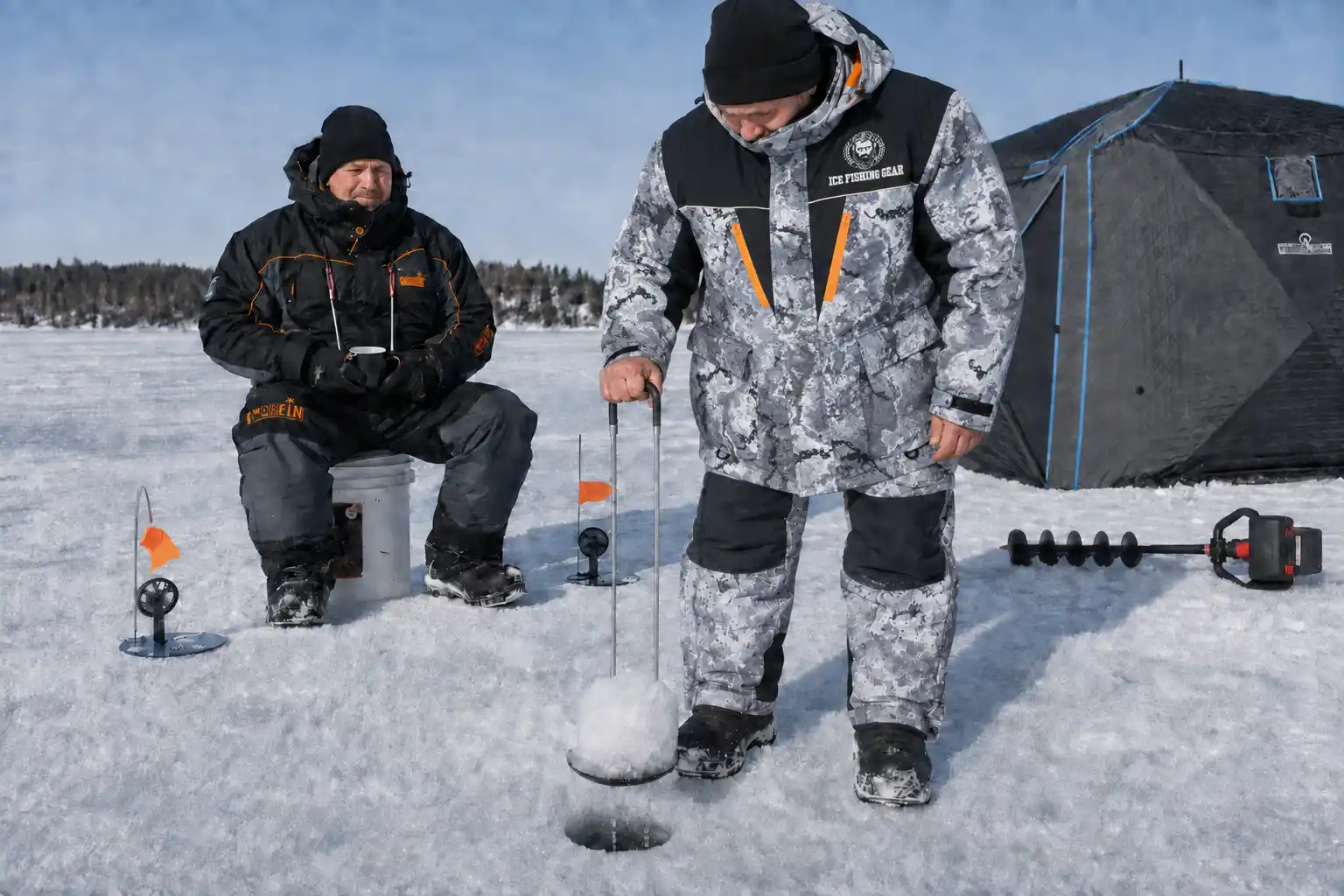
Ice conditions change quickly, and despite checking thickness at every new spot, each of these four suits was involved in at least one unplanned breakthrough over the seasons we wore it — with the ice giving way far enough for us to enter the water beyond boot depth and feel the suit’s buoyancy supporting us. These were not controlled tests, but they gave us a direct read on how each suit behaved in the water rather than leaving us to rely entirely on its specifications. We’ve described what happened with each suit individually below.
None of this replaces basic ice safety. We still carried ice picks and checked thickness before committing to a spot, just as we would in any other suit.
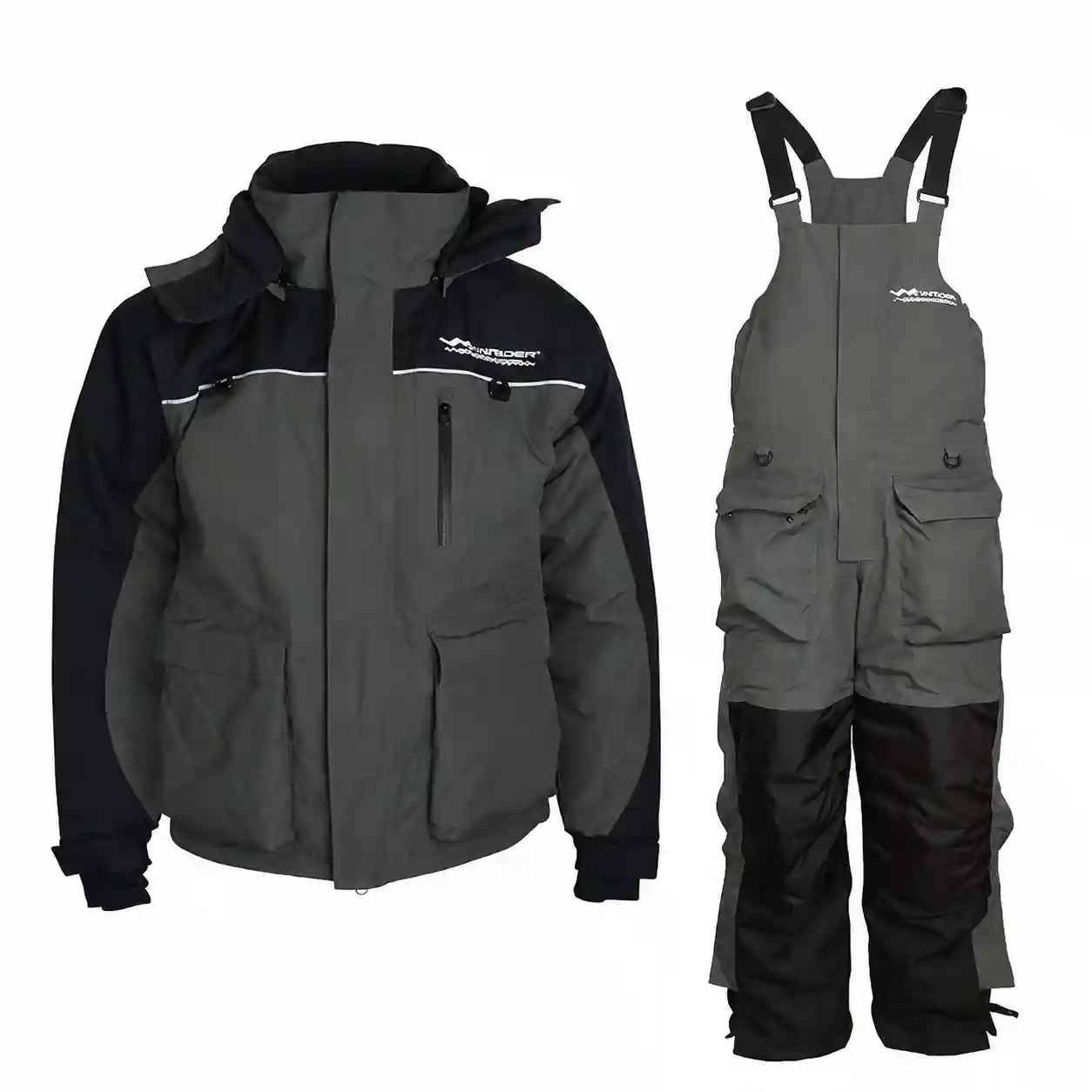
WindRider Boreas Ice Fishing Suit — Best Overall
This is the suit that gave us the clearest look at what built-in flotation actually means in practice, not just on a specification sheet.
The breakthrough happened during a late-afternoon crossing near a channel on Lake of the Woods. Nearby checks had shown roughly six inches of ice, but the current had weakened one section far more than the surface revealed. There was no cracking and no warning creak — the ice simply gave way, dropping our tester into the water to chest depth before he had time to react.
What stood out was how the Boreas supported him once he was in the water. The flotation brought his upper body high enough to reach the ice edge almost immediately and kept him closer to an upright position while he got the ice picks into place. It did not replace the need to control the initial shock, orient himself, and actively work his way out, but it reduced the effort required to keep his head and shoulders above the surface.
The exit mattered just as much as the buoyancy. Some insulated clothing becomes noticeably heavier and more restrictive after immersion, but the Boreas drained quickly enough that our tester could kick, pull with the ice picks, and slide his torso back onto the ice without the suit feeling like an anchor. Once he was out, the shell continued shedding water and remained flexible during the short walk back to the nearby sled. We still treated the immersion as an emergency and replaced the wet layers immediately; a floating suit provides buoyancy, not protection from cold-water shock or hypothermia.
The Boreas also comes with a lifetime warranty covering seam and zipper failure. Combined with flotation, reinforced wear areas, and the balance of warmth and mobility we experienced across the rest of the season, that warranty helped separate it from the other complete suits we tested. It is still not a substitute for checking the ice, carrying ice picks, fishing with another person, and keeping dry clothing accessible.
What We Like:
- Flotation supported our tester in a near-upright position and helped keep his upper body near the ice edge
- Quick drainage made the self-rescue less restrictive after full chest-depth immersion
- Outer shell continued shedding water and remained flexible during the return to the sled
- Lifetime warranty covers seam and zipper failure
What Could Be Better:
- Premium price compared with most complete suits on this list
- Bulkier fit than the lighter options, particularly when moving quickly between holes
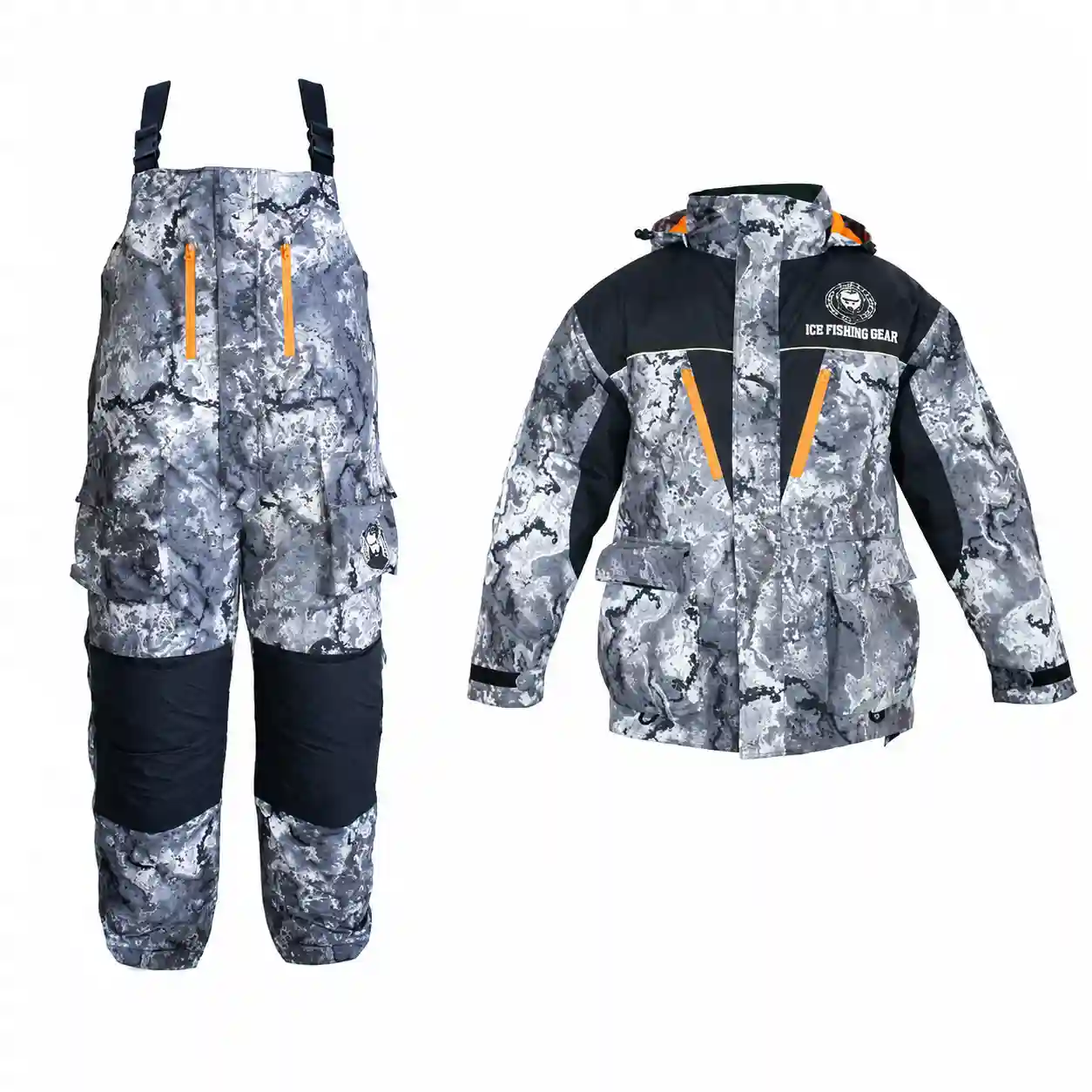
Nordic Legend “Legendary Camo” Ice Fishing Suit — Best Budget
The Legendary Camo showed us how much useful flotation and cold-weather protection a complete suit can provide without reaching the price of our premium picks.
Its breakthrough happened during an early-season trip on a smaller inland lake. We were working along the edge of a bay near a natural spring. Although the surrounding ice measured a solid five inches, moving water had weakened one localized section directly along our path. The surface collapsed underfoot and dropped our tester into the water beyond chest depth.
The suit’s Motion Float foam supported his upper body quickly and helped him remain near the ice edge while he brought the ice picks into position. The flotation felt firmer and more restrictive than the Boreas, particularly when he rotated his shoulders toward the ice, but it provided the buoyancy he needed without forcing him into an awkward position.
The self-rescue revealed the clearest compromise behind the lower price. Water collected around the lower bib cuffs, and the combination of the stiffer construction and added water resistance required more upper-body effort to slide his hips onto the ice. It did not prevent the rescue, but the difference was noticeable after testing the better-draining Boreas.
Once he was back on the surface, the Oxford shell continued to cut the wind during the return to the truck. We still removed the wet suit and base layers immediately. Built-in flotation can assist a self-rescue, but it does not make an immersed angler warm or eliminate the danger of cold-water shock and hypothermia.
For anglers who want a complete jacket-and-bib package with confirmed Motion Float technology at a lower price than the Boreas, the Legendary Camo covers the essentials. It is heavier and less flexible, but those compromises are easier to accept when affordability is the deciding factor.
What We Like:
- Complete floating jacket-and-bib package at a lower price than our overall pick
- Motion Float foam provided useful upper-body support during an unplanned immersion
- Oxford shell cut the wind effectively after the tester returned to the ice
- Durable construction held up well against rough ice and repeated kneeling
What Could Be Better:
- Stiffer construction restricts shoulder and torso movement more than the Boreas
- Lower bib cuffs collected more water during the self-rescue
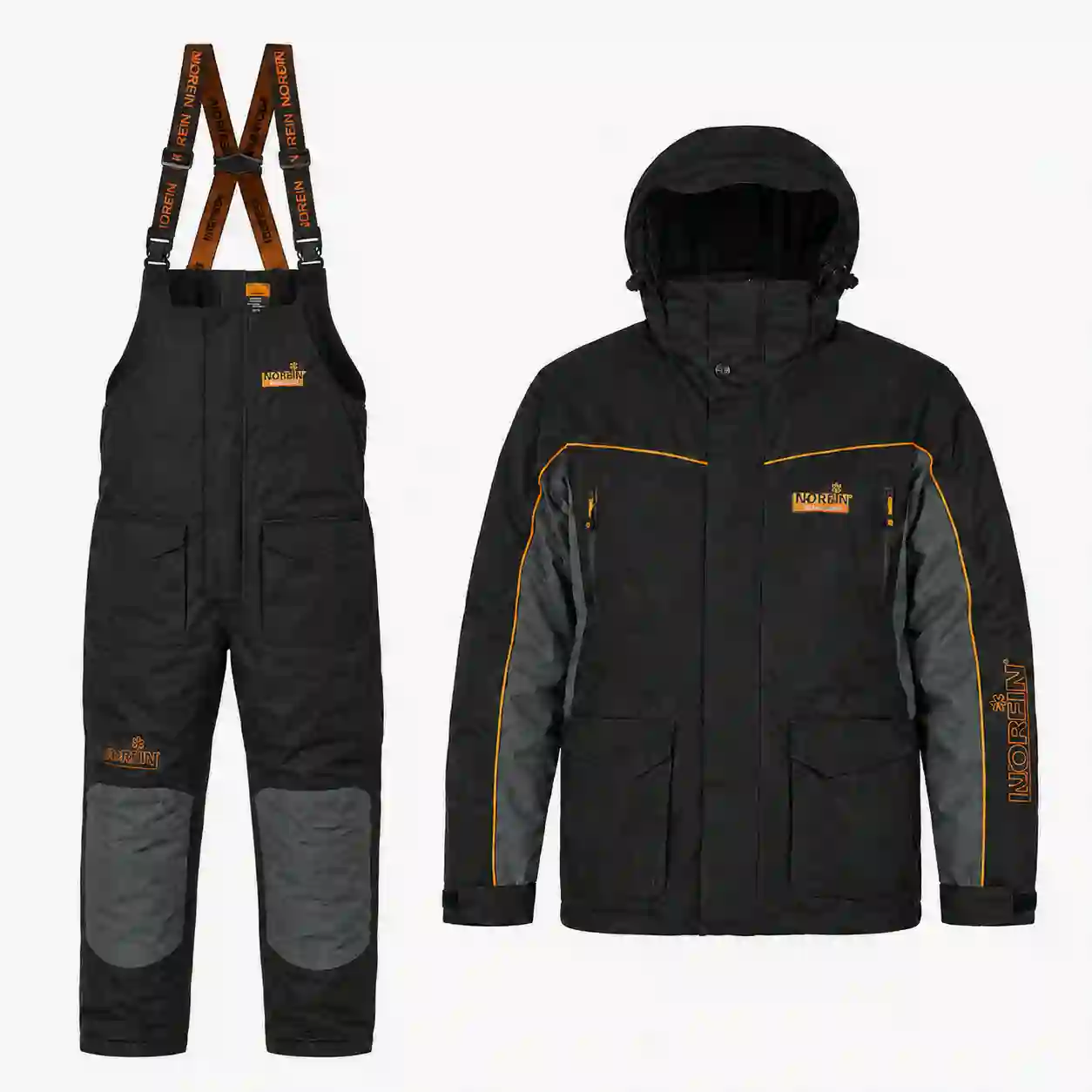
NORFIN Suit ELEMENT+ FLT — Best for Extreme Cold
This is the suit we reached for during the coldest stretches of the season, and its unplanned immersion showed both the value and the limitations of combining heavy insulation with built-in flotation.
The breakthrough happened on Devils Lake in the middle of January, during a stationary tip-up session that had already lasted more than two hours in a sustained subzero wind chill. Our tester was walking the spread when the ice beneath one foot gave way, dropping him into the water past his waist before he could shift his weight back.
The FLT foam supported his upper body quickly enough to keep him from going fully under while he regained his balance at the ice edge. The 180g THERMOGUARD insulation had kept him comfortable during the stationary session before the breakthrough, but it did not prevent the cold-water response once water entered the suit. The immediate value in that moment came from buoyancy keeping his upper body supported while he controlled his breathing and positioned the ice picks.
The exit revealed the tradeoff behind a suit built for this much warmth. The insulation and overall bulk created more resistance while he pulled himself onto the ice than we experienced with the lighter suits. NORFIN’s Quick Drain construction at the parka hem and bib cuffs released water effectively, but the ELEMENT+ FLT still required more deliberate movement during the rescue.
Once back on the surface, the windproof outer construction reduced direct exposure during the short return to the truck. We removed the wet suit and base layers immediately. Flotation can assist an exit and insulation can provide excellent protection before immersion, but neither eliminates cold-water shock or hypothermia after water enters the clothing.
For anglers who spend long, stationary hours in severe cold — the kind of sessions where a lighter suit leaves you shivering by the second hour — the ELEMENT+ FLT makes a clear trade: more bulk in exchange for stronger cold-weather insulation, while retaining built-in flotation and drainage if the ice gives way.
What We Like:
- 180g THERMOGUARD insulation provided the strongest stationary warmth in our test group
- FLT foam supported the tester’s upper body during an unplanned immersion
- Quick Drain construction released water through the parka hem and bib cuffs
- Manufacturer-rated for temperatures down to -20°F, the lowest published rating among the four suits
What Could Be Better:
- Added insulation and bulk required more effort during the self-rescue
- Less convenient for anglers who prioritize fast movement between holes
Nordic Legend Aurora Series Ice Fishing Suit with Floatation — Best for Mobility
This is the suit we reached for on days when we were drilling frequently and moving fast, and its unplanned immersion showed why freedom of movement matters during a self-rescue.
The breakthrough happened on a smaller lake closer to home during an active afternoon of run-and-gun jigging with our ice fishing rods. Our tester was stepping toward a freshly drilled hole when a weakened patch near a pressure crack gave way, dropping him into the water past his hips before he had time to brace.
The Aurora’s Motion Float technology provided enough buoyancy to support him at the ice edge while he regained his orientation. What separated it from the heavier suits was not a dramatic difference in flotation, but how little the suit resisted his movements once he began working his way out.
He could rotate his torso toward the stronger ice, kick his legs closer to the surface, and extend his arms without fighting the same bulk we experienced in the Boreas or NORFIN. That freedom of movement made the self-rescue feel faster and less physically demanding than it did in the more heavily insulated suits. The Aurora still required active use of the ice picks and a controlled kick; flotation assistance did not pull him out by itself.
The tradeoff was warmth. Once he was back on the surface, the lighter-feeling construction provided less protection from the cold than the NORFIN, and the wet layers became uncomfortable quickly. We had him changed within minutes. As with every suit here, Motion Float can provide buoyancy during an immersion, but it does not prevent cold-water shock or make wet clothing safe to remain in.
For anglers who drill frequently, jig actively with a reel built for the cold, and cover water on foot, the Aurora was the least restrictive complete suit in our test group. It gives up some stationary warmth compared with the heavier options, but its easier range of motion is valuable both during normal fishing and when climbing back onto the ice.
What We Like:
- Least restrictive complete suit in our testing during drilling, kneeling, and active jigging
- Motion Float technology provided useful buoyancy during an unplanned immersion
- Flexible movement made it easier to rotate, kick, and pull during the self-rescue
- Complete jacket-and-bib package at a mid-range price
What Could Be Better:
- Provides less stationary warmth than the more heavily insulated NORFIN
- No published breakdown showing exactly how the flotation foam is distributed between the jacket and bib
What Flotation Actually Does (And Doesn’t)
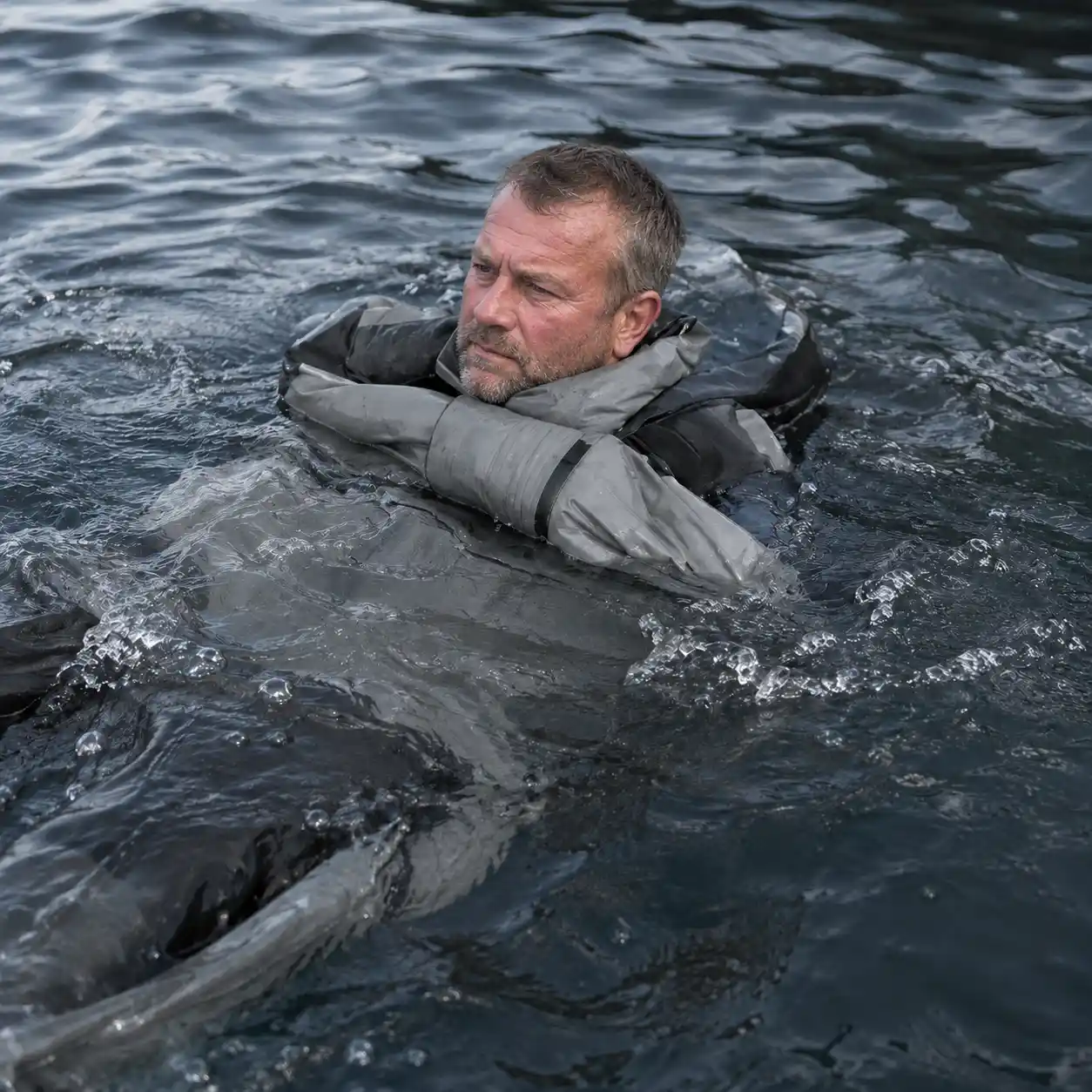
None of the suits on this list are substitutes for a USCG-approved life jacket. They contain foam that adds buoyancy during an unexpected immersion, but they have not necessarily passed the same approval and performance testing as a certified PFD.
What a floating ice fishing suit can do is reduce the effort required to keep your upper body near the surface while you control your breathing, turn toward stronger ice, and prepare to pull yourself out. The foam also contributes insulation during normal cold-weather use and may provide some thermal benefit in the water. It does not make the suit waterproof like a dry suit, prevent cold-water shock, or guarantee protection from hypothermia.
A float suit also cannot be assumed to turn an unconscious wearer face-up or keep the airway clear. Some USCG-approved life jackets are designed to provide that type of support, while others are intended primarily for conscious users. The suits in this guide should be treated as flotation assistance, not as automatic rescue systems.
Buoyancy only addresses part of the emergency. Smooth, wet ice is extremely difficult to grip, especially as cold water reduces strength and control in the hands. Ice picks worn where they can be reached immediately provide the traction needed to pull toward stronger ice. They do not guarantee an exit, but they can make self-rescue far more achievable than trying to grip the ice with bare hands.
The safest approach combines flotation, accessible ice picks, regular thickness checks, a partner or rescue plan, and dry clothing kept nearby. No individual piece of equipment makes questionable ice safe.
Floating Ice Fishing Suits Compared
| Suit | Best For | Insulation | Published Cold Rating | Flotation Location | Ideal Scenario |
|---|---|---|---|---|---|
| WindRider Boreas | Best Overall | 3M insulation | Not published | Jacket and bib | Anglers who want the strongest overall balance of warmth, flotation, drainage, and durability |
| Nordic Legend Legendary Camo | Best Budget | Motion Float foam; insulation weight not published | Not published | Exact distribution not published | Anglers buying their first complete floating suit without paying for a premium model |
| NORFIN ELEMENT+ FLT | Best for Extreme Cold | 180g THERMOGUARD + FLT foam | -20°F | Built into the suit; exact distribution not published | Long, stationary tip-up sessions during the coldest stretches of the season |
| Nordic Legend Aurora Series | Best for Mobility | Motion Float foam; insulation weight not published | Not published | Exact distribution not published | Anglers drilling frequently and covering water on foot instead of remaining stationary |
How to Choose a Floating Ice Fishing Suit
Temperature Rating
Published cold-weather ratings vary by manufacturer and testing method, so treat them as a comparison point rather than a guarantee. Your base layers, activity level, wind exposure, and the amount of time you spend sitting still can change how warm the same suit feels.
If you fish the Upper Midwest during the coldest part of winter — with sustained air temperatures between -10°F and -20°F and additional heat loss from wind on open ice — a heavily insulated suit such as the NORFIN ELEMENT+ FLT is better suited to long, stationary waits than a lighter option. If most of your season takes place in milder conditions, or you regularly drill and move between holes, a less bulky suit can provide better mobility and reduce overheating. How you spend the day matters as much as the thermometer — our complete breakdown of ice fishing for pike covers when a stationary tip-up spread or run-and-gun jigging makes the most sense.
Float Suit vs. Snowmobile Suit vs. Separate PFD
These options are not interchangeable, even when they look similar. Many traditional snowmobile suits prioritize insulation, wind protection, and abrasion resistance without including built-in flotation. Some crossover snowmobile and ice-fishing garments do contain flotation, so check the exact model rather than assuming based on its appearance or category.
A properly fitted, USCG-approved foam life jacket worn over winter clothing provides certified flotation and may offer more clearly defined in-water performance than a non-approved float suit. However, it must be sized for your chest while wearing your actual winter layers, fastened correctly, and checked to ensure it does not ride over your chin or face. Avoid assuming that a standard summer PFD will fit properly over bulky clothing.
A dedicated floating ice fishing suit integrates insulation and flotation assistance into clothing you can wear throughout the day, reducing the temptation to remove a separate PFD while drilling, walking, or fishing. Its main advantage is convenience and continuous coverage, not that it automatically provides more buoyancy than a properly fitted, approved life jacket.
Sizing and Layering
Float suits are generally designed with room for a base layer and, when conditions require it, a mid-layer. The correct fit should allow you to raise your arms, kneel, crouch, and rotate your torso without binding, while remaining close enough to the body that the garment and its flotation panels cannot shift excessively. A properly fitted suit works alongside the rest of your cold-weather layers, including a solid pair of winter boots and winter gloves rated for the same conditions.
Do not size down for a trimmer appearance, but do not automatically buy an oversized suit either. A suit that is too tight can compress insulation and restrict movement, while one that is too large can bunch, create drag, and move out of position in the water. Measure yourself over the layers you expect to wear and follow the size chart for the exact model. If your measurements fall between sizes, check the manufacturer’s instructions before sizing up.
Buying a Complete Suit vs. Building Your Own Setup
Every selection in this guide is available as a complete jacket-and-bib package, which is the simplest way to buy pieces designed to work together. A matched setup also makes it easier to compare coverage, insulation, sizing, and flotation features before purchasing.
Some anglers prefer to build a setup one piece at a time, pairing a jacket and bib from different brands to improve fit, warmth, or cost. That approach can work, but verify the flotation technology, sizing, and coverage of each piece separately rather than assuming that two floating garments have been tested together as one system.
If you’d rather build your setup one piece at a time, compare our floating ice fishing jackets and floating ice fishing bibs separately.
Frequently Asked Questions
Do floating ice fishing suits actually work?
Yes. Foam built into a floating ice fishing suit adds buoyancy that can reduce the effort required to remain near the surface during an unexpected immersion. Performance varies by design and fit, and a non-approved float suit should not be treated as a substitute for a properly fitted, USCG-approved life jacket.
Is a floating ice fishing suit the same as a life jacket?
No. A floating ice fishing suit provides buoyancy assistance, but it has not necessarily passed the same approval and performance testing as a USCG-approved PFD. Some approved life jackets are designed to turn an unconscious wearer toward a face-up position, while others are intended primarily to support a conscious wearer. Do not assume that a non-approved float suit will keep an unconscious person’s airway clear.
Do I need both a floating jacket and floating bibs?
Not necessarily, but a matched jacket-and-bib system can provide broader flotation coverage and is designed to work together. Flotation placement varies by product, and some manufacturers do not publish exactly how the foam is distributed. Check the specifications for both pieces rather than assuming that every complete suit provides the same in-water support.
How warm should my ice fishing suit be?
It depends on how you fish. Long, stationary waits over a tip-up spread in severe cold call for heavier insulation, while active jigging, drilling, and moving between holes generate more body heat and can make a lighter, more breathable suit more comfortable.
Can I wear a snowmobile suit instead of a floating ice fishing suit?
You can wear a snowmobile suit for warmth, but many traditional models do not contain flotation. Some crossover snowmobile and ice-fishing suits do include flotation assistance, so check the specifications for the exact model instead of assuming from the product category or appearance.
Do floating ice fishing suits run true to size?
Sizing varies by brand and model. Float suits are generally designed to accommodate base and mid-layers, but they should not fit tightly or hang excessively loose. Measure yourself over the layers you expect to wear and follow the manufacturer’s size chart instead of relying only on your usual jacket size.
Are ice picks still necessary if I have a floating suit?
Yes. Flotation can support you near the surface, but it does not provide traction on smooth, wet ice. Ice picks worn where they can be reached immediately give your hands something to grip and can significantly improve your chance of pulling toward stronger ice.
How long will a floating ice fishing suit keep me warm after getting wet?
There is no safe amount of time you should rely on. A floating suit is not a dry suit, and water inside the garment can quickly lead to cold-water incapacitation and hypothermia. After any immersion, get to a warm shelter, remove wet clothing, put on dry layers, and seek emergency assistance when needed.