

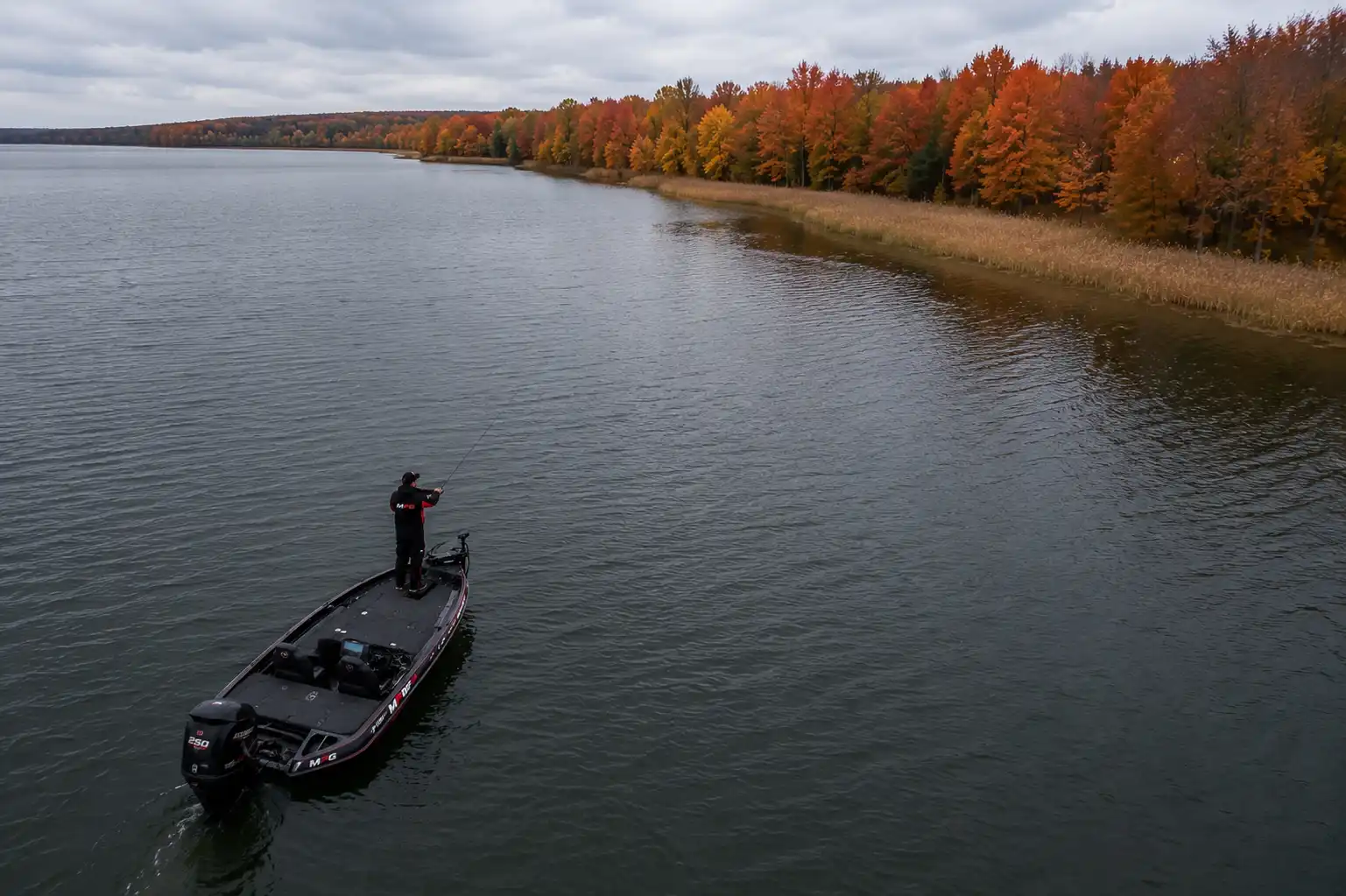
Where to Find Pike in Fall: Exact Locations by Water Temperature
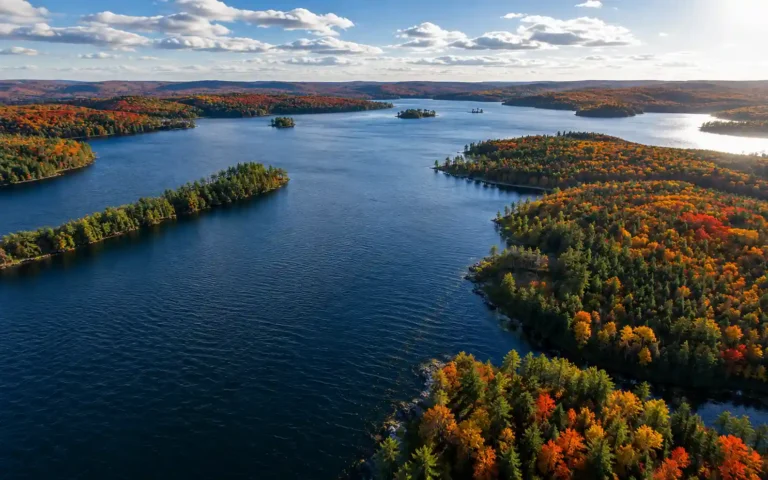
Where to find pike in fall comes down to one variable: water temperature. Not the month, not the date, not how many weeks have passed since summer ended. The temperature of the water on the day you launch tells you more about where pike are holding than anything else you can check.
Pike don’t migrate on a calendar. They follow perch, shiners, and roach — and those baitfish relocate as autumn progresses.
Shallow weed flats that held forage through July and August gradually empty out. Schools push toward weed edges, then points and drop-offs, then deeper basin structure as temperatures keep falling. Pike adjust their position to match every one of those shifts, sometimes within days of a significant temperature drop.
The practical result is that a lake fishes like three completely different bodies of water across a single autumn.
Above 60°F (16°C), pike behavior still overlaps with late summer. Through the mid-50s°F (12–14°C), many pike move toward weed edges, points, channels, and other transition zones between shallow feeding areas and deeper water.
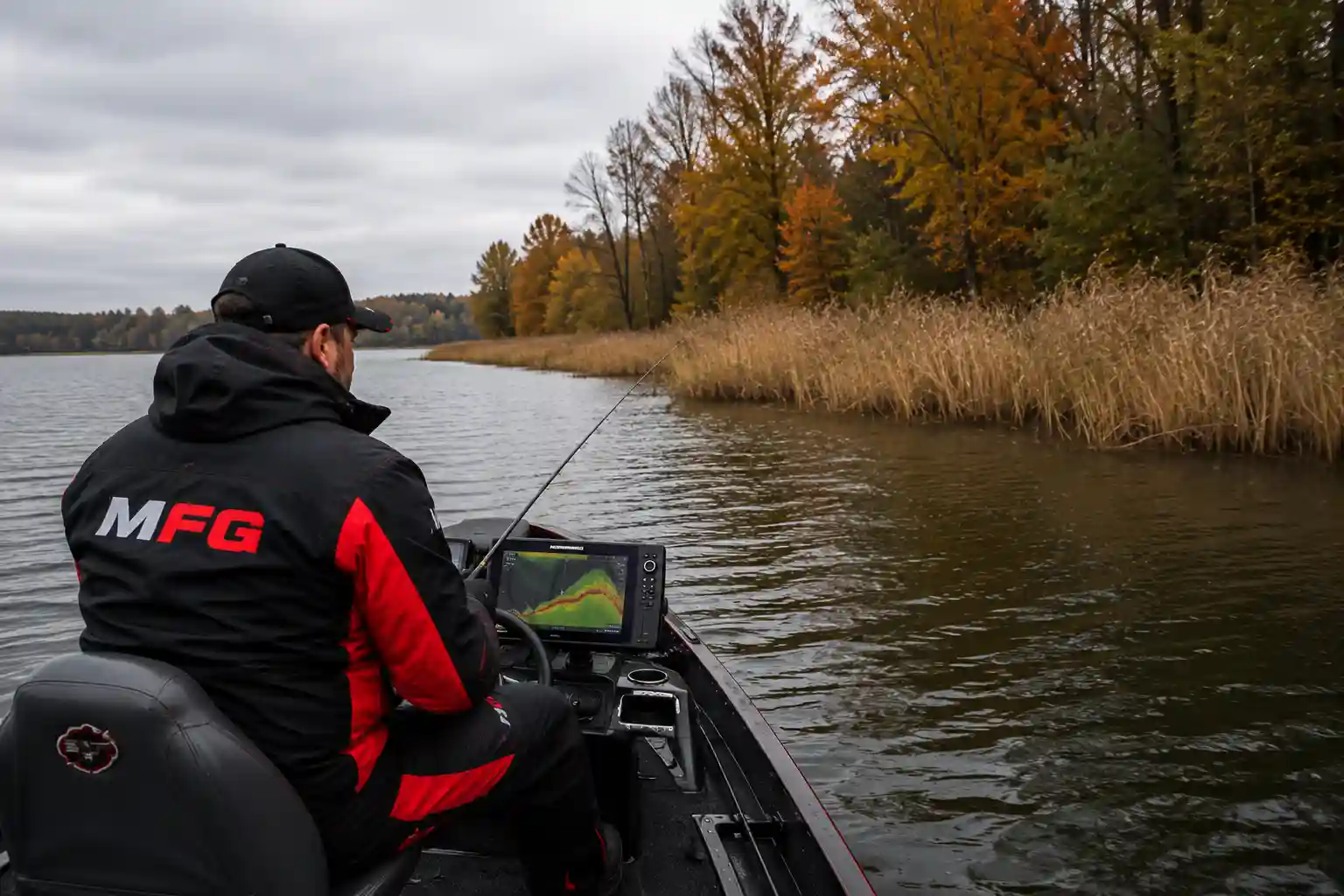
Once temperatures approach the low 40s°F (4–7°C), the fish that were working weed edges two weeks earlier are now parked along deep breaklines near open water.
Same lake, same fish — completely different locations.
By 52°F (11°C), many fish that spent early fall around shallow cabbage weeds are already using outside weed edges and nearby points. By 44°F (7°C), those same fish are often holding near deep breaklines, basin edges, and schools of perch in 18–22 feet (6–7 m) of water.
This guide maps those shifts precisely, so you know which structures to target at each stage of the season.
For everything else about autumn — feeding windows, lures, retrieves, and tactics — our complete fall pike fishing guide covers the full picture.
Fall Pike Locations by Water Temperature
| Water Temperature | Most Consistent Pike Locations |
|---|---|
| Above 60°F (16°C) | Green cabbage weeds, shallow bays, first breaklines near weeds |
| 55–60°F (13–16°C) | Outside weed edges, nearby points, transition zones |
| 50–55°F (10–13°C) | Main-lake points, underwater points, saddles, first drop-offs |
| 45–50°F (7–10°C) | Steep breaklines, channel swings, deep structural turns |
| 40–45°F (4–7°C) | Basin edges, deep weed lines near open water, late-fall holding areas |
Water temperature is the most reliable indicator of where pike will be holding during fall. As temperatures drop, forage gradually shifts from shallow weeds toward deeper structure, and pike follow the same progression.
Early Fall Pike Locations (Above 60°F / 16°C)
Start shallow. When water temperatures are still above 60°F (16°C), healthy weed growth remains the most reliable place to find pike on most lakes. Baitfish haven’t left yet, and pike are still using the same general areas they held through summer — just with longer feeding windows and more willingness to chase.
Healthy Green Cabbage Weed Beds
Cabbage weeds are the first place to check in early fall. As long as the vegetation stays green and holds perch or shiners, pike won’t move far from it. Focus on the inside weed edge in 6–10 feet (2–3 m) — the zone where shallow water transitions into the first significant weed growth.
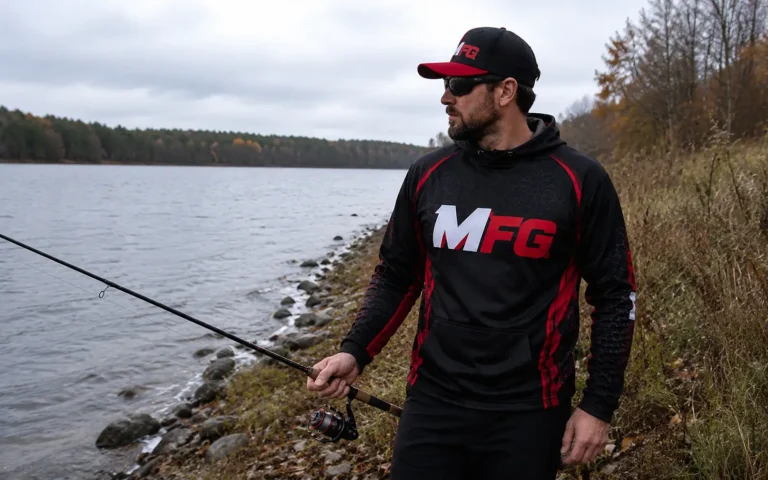
Don’t work the entire weed line at the same pace. Inside turns, isolated clumps set slightly apart from the main bed, and small pockets in dense cabbage consistently hold more fish than long uniform stretches of edge. On several early fall trips, multiple strikes came from a single inside turn no longer than 20–30 feet (6–9 m) while the surrounding weed edge produced nothing. When you find one of those spots, slow down and work it thoroughly before moving on.
If perch are flashing near the surface along the edge or baitfish are visibly pushed against the weed wall, stay. That activity tells you more about where the pike are than any other signal you’ll get on the water.
Shallow Bays Holding Perch and Shiners
Shallow bays that warmed quickly during summer often continue holding baitfish well into early fall. Perch and shiners linger in these areas as long as water temperatures stay comfortable and forage is available. Pike follow them in.
The most productive bays in early fall share a few consistent features: remaining weed growth along the edges, a gradual depth transition from 3 to 8 feet (1–3 m), and some form of wind protection that keeps baitfish from scattering. Look for inside corners of bays where perch tend to stack against the back wall, and pay attention to any visible baitfish activity near the surface before you make your first cast.
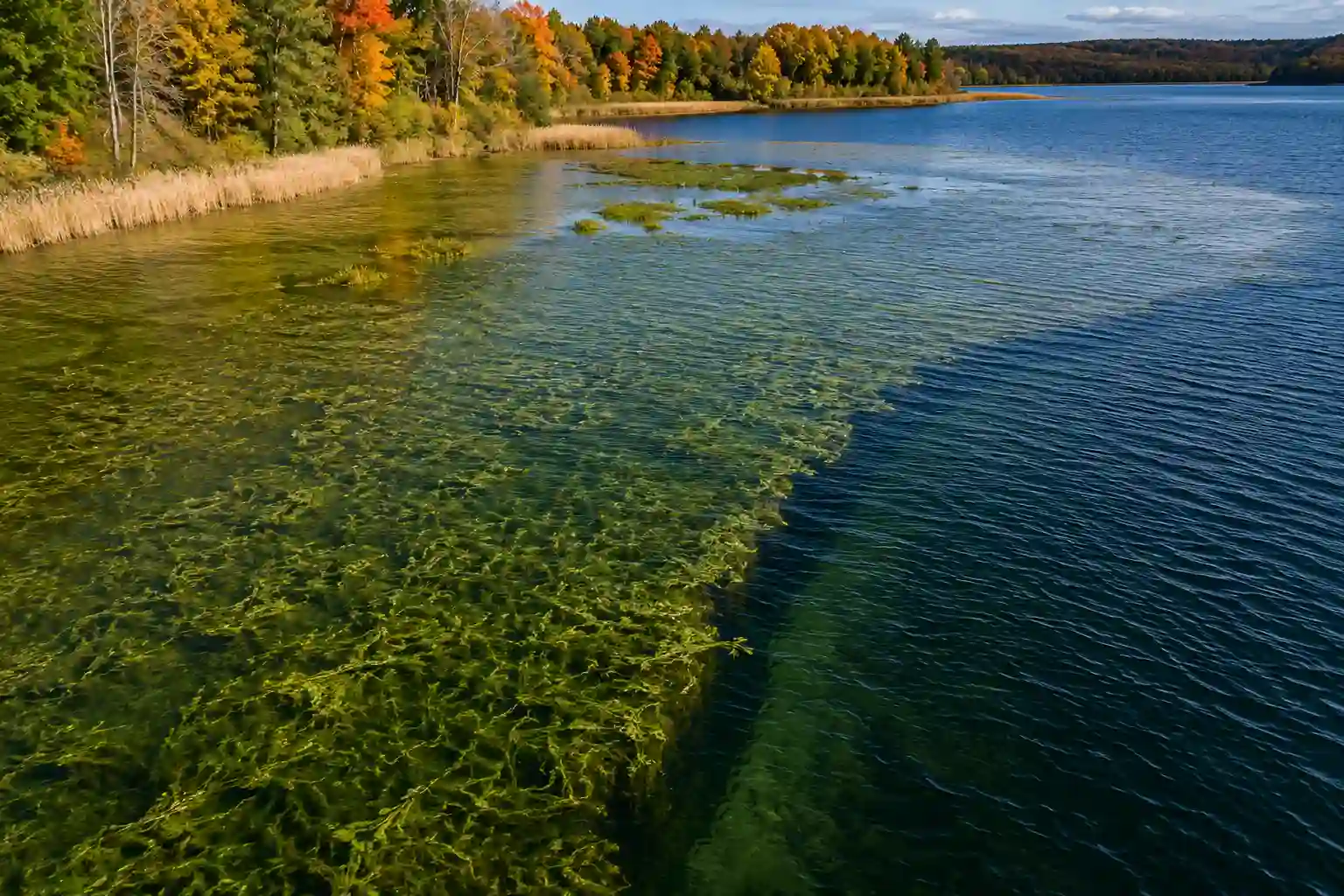
Wind-exposed bay mouths can also fire during early fall. A sustained wind pushing into a bay entrance concentrates shiners against whatever structure sits at the back — and pike position just inside that current break waiting for forage to come to them.
On smaller natural lakes, we’ve often found the biggest concentrations of baitfish in the last remaining green weeds at the back of a bay, especially after several days of stable weather. Those areas frequently hold multiple pike even when nearby shorelines appear empty.
First Breaklines Adjacent to Weeds
The first significant depth change adjacent to a weed flat is worth checking even when shallow areas are producing fish. Early fall pike make short feeding movements between shallow weed cover and the nearest drop — they don’t commit fully to deep water yet, but they use that transition edge as a quick retreat and an ambush position.
Focus on spots where the breakline runs close to healthy cabbage weeds — ideally within 10–20 feet (3–6 m) of the weed edge itself. Points where the weed flat narrows and the break comes in tight are especially high-percentage. Pike hold just off the edge in 8–12 feet (2–4 m), facing shallow, ready to push up when baitfish move.
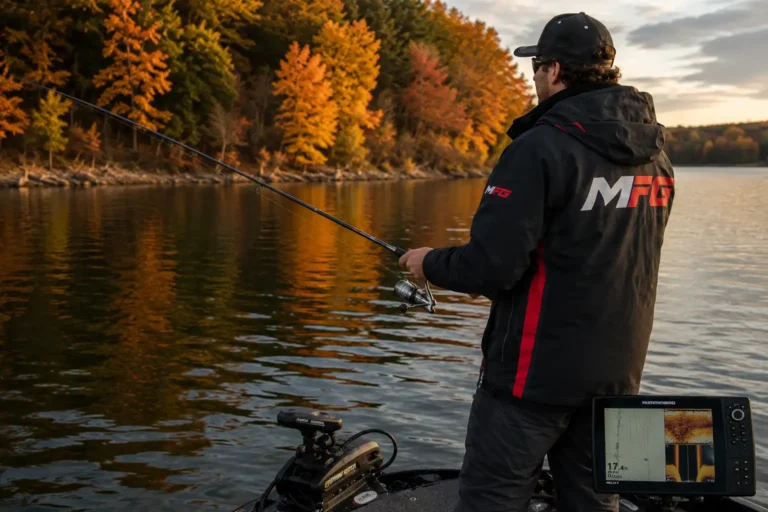
One setup we’ve seen repeatedly during early fall is a cabbage flat topping out in 6–8 feet (2–3 m) with a break dropping quickly into 10–12 feet (3–4 m). On several MFG trips, sonar showed perch schools positioned along the base of that first drop while pike held just off the edge rather than inside the weeds themselves. When the flat slowed down, that nearby break often continued producing fish.
If shallow bays and weed beds slow down during midday, this is the first place to check before moving to deeper structure.
Mid Fall Pike Locations (Mid-50s°F / 12–14°C)
Mid fall is when pike locations become the most predictable of the entire season. Baitfish have left many of their early fall areas, weed growth is thinning, and pike are actively covering water between shallow feeding zones and deeper structure. The fish are still aggressive — but they’ve shifted position, and the anglers who adjust find the most consistent action of the year.
Outside Weed Edges
As water cools into the mid-50s°F range, the outside weed edge becomes more productive than the inside edge that held fish earlier in the season. This is the deep side of the remaining healthy vegetation — where cabbage or other green weeds drop off into open water, typically in 8–15 feet (2–5 m).
Pike hold tight to this edge for two reasons: remaining green weeds still attract perch and shiners, and the drop gives fish quick access to deeper water when conditions change. Work parallel to the edge rather than casting into the weeds. The strike zone is usually within 3–5 feet (1–2 m) of where vegetation meets open water — not inside the weed bed itself.
During an October trip on a Minnesota natural lake, sonar repeatedly showed perch holding along the deep side of irregular weed features in 10–14 feet (3–4 m) of water. The pike weren’t buried in the weeds themselves — they were positioned just below the forage along the outside edge. Irregular sections of that edge — points where the weed line pushed out slightly, inside turns where it curved back toward the flat — held fish consistently while long straight stretches between them produced only follows.
Main-Lake Points and Underwater Points
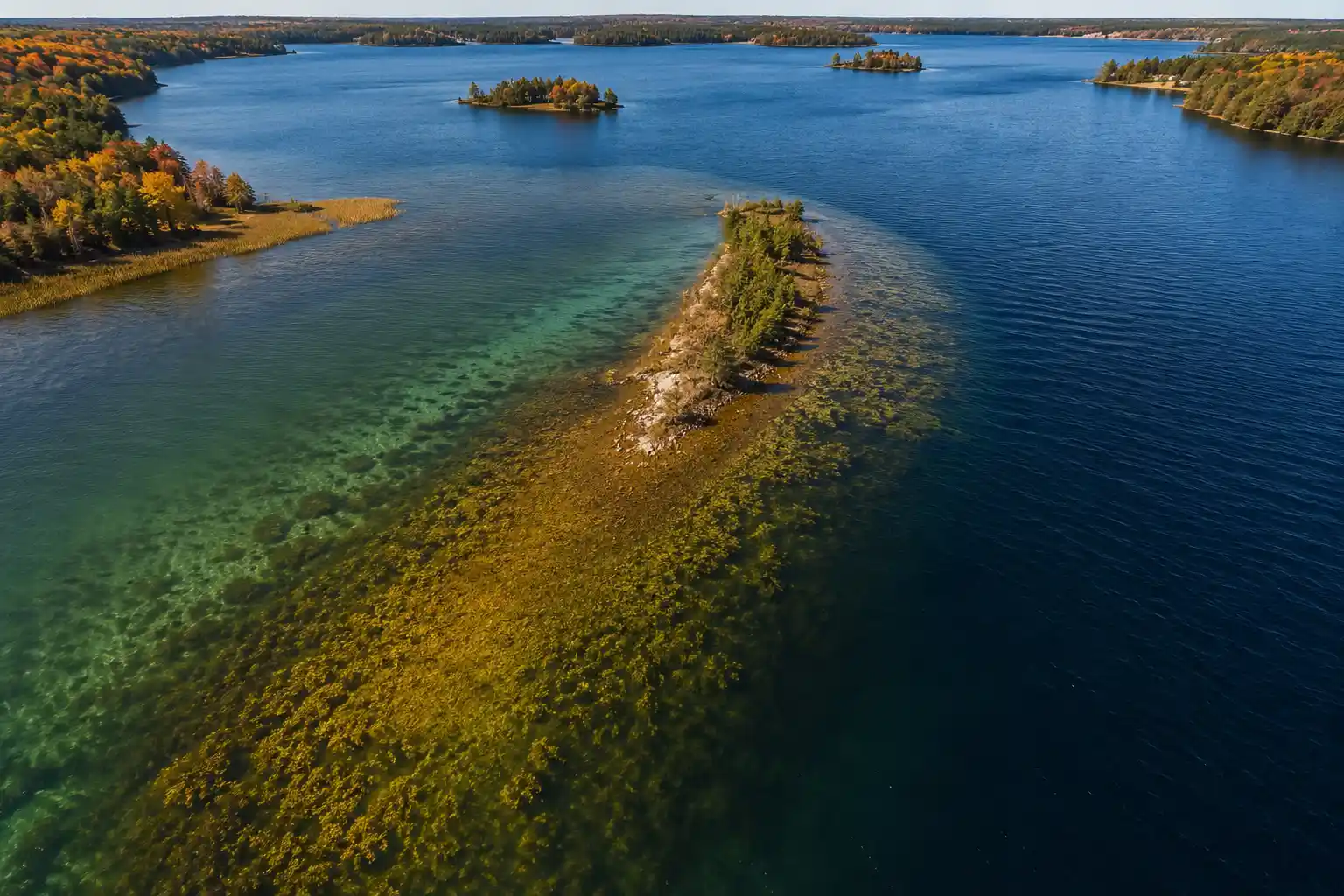
Points are among the most reliable mid fall structures on any lake because they serve two functions simultaneously: they act as travel routes for baitfish moving between shallow and deep water, and they give pike a compact ambush position with access to multiple depth zones.
Main-lake points that extend from a weed flat toward deeper basin water are especially high-percentage. Focus on the tip of the point and the first 10–15 feet (3–5 m) of depth on either side. Pike frequently position just off the tip rather than on top of it, facing the current or wind to intercept passing forage.
Underwater points — submerged structure that doesn’t reach the surface — are often overlooked and can hold fish with far less pressure. On lakes where you have access to detailed contour maps, look for underwater points adjacent to basin water in 12–18 feet (4–6 m). Perch schools regularly use these as staging areas before moving deeper, and pike are rarely far behind.
Channels, Saddles, and First Drop-Offs
Channels, saddles, and pronounced drop-offs function as natural movement corridors through mid fall. Baitfish use them to travel between shallow feeding areas and deeper wintering zones, and pike position along these routes to intercept forage rather than chase it across open water.
A saddle — the shallow connection between two deeper areas — is one of the most underrated mid fall structures. Perch moving between basin areas are funneled through these narrow high spots, and pike stack on both edges waiting. Look for saddles in 8–14 feet (2–5 m) with deeper water on both sides. A single saddle on a mid-lake hump can hold multiple fish when surrounding structure appears empty.
Channel bends and first drop-offs adjacent to remaining weed growth follow the same logic. The bend in a channel creates a current break and a depth change in one spot — both of which concentrate baitfish and attract pike. If you find a channel bend where one bank has remaining green weeds and the other drops sharply into deeper water, fish that intersection carefully before moving on.
Areas Holding Concentrated Perch Schools
By mid fall, forage location often matters more than structure type. A steep breakline with no baitfish will produce far less than an unremarkable flat holding a school of perch. When you locate concentrated forage on sonar, stay in that area regardless of how the structure looks on a map.
Perch schools in mid fall tend to stage along depth transitions — the edge of a weed line, the base of a drop-off, or the top of an underwater point. They move slowly and predictably, which makes them easy for pike to track.
On one late-October outing, sonar showed a dense perch school suspended near the base of a breakline in 14–16 feet (4–5 m) of water. Several pike were holding just below the school, even though the surrounding structure looked far more attractive on the map. If sonar shows a dense baitfish mark suspended in open water near a depth transition, make multiple passes around the edges of that school before deciding to move. Pike often hold just below or just outside the baitfish concentration rather than inside it.
Late Fall Pike Locations (Low-40s°F / 4–7°C)
Late fall is where most fishing advice stops at “go deeper.” That’s not wrong — but it’s not useful either. When water temperatures approach the low 40s°F (4–7°C), pike don’t just move deeper. They move to specific deep structures adjacent to concentrated forage, and the difference between productive and empty water at this stage can be as little as 50 yards (45 m) on the same breakline.
Basin Edges
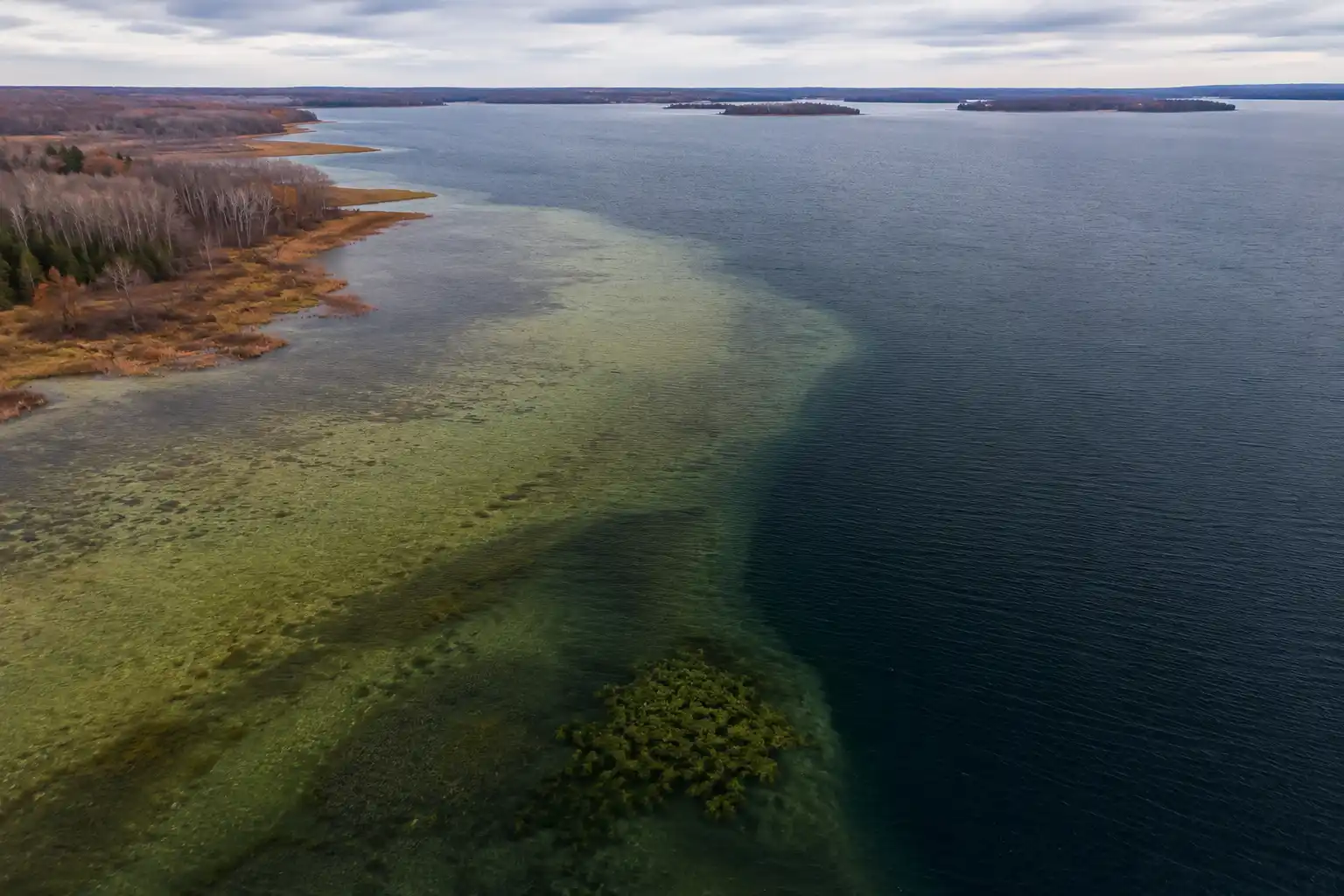
Basin edges — where the gradual slope of a lake transitions into the flat, soft-bottomed deepest section — are one of the most consistent late fall holding areas for both baitfish and large pike. Perch schools that have been moving progressively deeper through autumn often stage along these edges before committing fully to basin water for winter.
Focus on the upper edge of the basin transition, typically in 18–22 feet (6–7 m), rather than the flat basin bottom itself. Pike rarely hold on the featureless bottom — they position along the edge where the slope levels off, facing up toward the water column where forage is moving. During a late-October outing, our team located a large concentration of perch holding along this transition zone in roughly 18–22 feet (6–7 m) of water. The pike were positioned just off the same edge rather than farther up the break. Moving shallower produced nothing — the fish had fully committed to that depth range.
During a late-October trip to Lake Balaton, water temperatures dropped from 48°F (9°C) to 44°F (7°C) over four days. A weed edge that had produced pike consistently earlier in the week suddenly stopped producing. Sonar showed perch had shifted deeper toward the basin transition, and the pike followed. Once we moved to nearby basin-adjacent breaklines in deeper water, fish activity returned almost immediately. It was a clear reminder that even a small temperature drop can reposition fall pike surprisingly fast.
On lakes with multiple basin areas, check the basin closest to late-season baitfish concentrations first. Pike in late fall rarely travel far from food.
Steep Breaklines
Steep breaklines — drops of 5–8 feet (2–3 m) or more over a short horizontal distance — concentrate late fall pike because they offer immediate access to both shallow feeding shelves and deep safe water within a single position. A fish holding on a steep break doesn’t need to travel to adjust its depth. It moves a few feet up or down the same piece of structure.
The most productive steep breaklines in late fall have two things in common: they’re adjacent to basin water, and they have some form of irregularity — a small point, a subtle inside turn, or a section where the break intensifies slightly before leveling off. Uniform steep walls produce fewer fish than broken ones. Target depths of 15–25 feet (5–8 m) along these breaks, with the most active fish often holding in the upper third of that range during stable weather.
Channel Swings and Deep Structural Turns
A channel swing — the outside bend of a river channel, creek channel, or lake channel — creates a depth concentration and a current break in the same location. In late fall, these bends consistently hold both baitfish and pike because they offer exactly what both species need: stable depth, some current deflection, and a predictable travel route.
The outside bend of a channel swing is almost always deeper than the surrounding bottom, which means it offers more stable conditions as surface temperatures continue falling. Look for channel swings in 15–20 feet (5–6 m) that connect to or run adjacent to basin water. The intersection of a channel swing and a nearby basin edge is one of the highest-percentage late fall locations on any lake that has both features.
Deep structural turns — inside curves on a breakline or basin edge where the contour changes direction — follow the same logic. These turns create a pocket of slightly deeper water surrounded by shallower structure on two sides, which concentrates forage and makes ambush positions more efficient for pike.
Deep Weed Lines Near Open Water
Not all vegetation dies at the same rate. On many lakes, isolated patches of cabbage or other hardy weeds survive well into late fall in 10–14 feet (3–5 m) of water, particularly along deep weed lines where light still penetrates. These remaining green patches are significant in late fall because they may be the last available cover between shallow structure and open basin water.
Pike that would normally have moved fully to deep structure sometimes hold near these late-surviving weed patches longer than expected — especially if perch or shiners are still using them. Check deep weed lines before committing entirely to basin edges and breaklines. A small remaining green patch adjacent to deep water on an otherwise bare bottom can hold fish that have no other nearby cover to use.
The most productive late fall weed patches are those positioned on or near a depth transition — a deep weed line that sits directly above a basin edge, or a remaining cabbage clump on the upper edge of a steep break. Those locations combine the last available cover with immediate access to deep water, which is exactly where late fall pike want to be.
Where to Find Pike in Fall: Best Structures to Fish
| Structure | Best Fall Stage | Typical Depth | Why It Holds Pike |
|---|---|---|---|
| Green Cabbage Weeds | Early Fall | 6–10 ft (2–3 m) | Holds perch, shiners, and remaining summer forage. |
| Outside Weed Edges | Mid Fall | 8–15 ft (2–5 m) | Transition zone between vegetation and open water. |
| Main-Lake Points | Mid to Late Fall | 10–18 ft (3–5 m) | Natural travel routes for baitfish. |
| Saddles | Mid Fall | 8–14 ft (2–4 m) | Funnels perch movement between deeper areas. |
| Basin Edges | Late Fall | 18–22 ft (5–7 m) | Concentrates forage before winter. |
| Channel Swings | Late Fall | 15–20 ft (5–6 m) | Combines depth, travel routes, and forage. |
If you’re fishing a new lake in fall, these six structures should be your starting point. The exact depth may vary from lake to lake, but pike consistently position around the same combination of forage, depth transitions, and nearby access to deeper water.
Common Fall Location Mistakes
Abandoning Healthy Weeds Too Early
The most consistent early fall mistake is leaving weed areas before the fish do. As soon as air temperatures drop, many anglers move offshore and target deeper structure — while active pike are still holding in green cabbage weeds in 6–10 feet (2–3 m) of water. Until vegetation loses its color and baitfish disappear from it, those areas remain worth fishing.
A simple check before moving: look for perch activity along the weed edge. If baitfish are still present, pike are unlikely to have moved far.
Following the Calendar Instead of Water Temperature
Fall doesn’t arrive on the same date every year, and lakes transition at different speeds depending on size, depth, and geography. Deciding where to fish based on the month rather than actual water temperature is one of the fastest ways to fall behind the fish.
A warm September can keep pike on shallow weed flats well into what most anglers consider “mid fall.” A cold snap in early October can push fish to basin edges two weeks ahead of schedule. Water temperature determines how far that seasonal movement has progressed. The calendar doesn’t.
Ignoring Forage Movements
Structure without baitfish rarely holds pike for long in fall. A classic late fall mistake is anchoring on a textbook steep breakline or basin edge and wondering why the sonar shows no life — while a nearby but less obvious depth transition is holding a dense perch school with pike stacked below it.
Before committing to a location, confirm that forage is present. A breakline with baitfish will nearly always outperform a better-looking breakline without them.
Fishing Shallow All Fall
Early fall success in shallow bays and weed flats can create a pattern that anglers stick with too long. As water temperatures drop through the mid-50s°F (12–14°C) and into the low 40s°F (4–7°C), fish that were accessible in 6–10 feet (2–3 m) gradually move to outside weed edges, points, and eventually basin edges in 18–22 feet (5–7 m). Continuing to fish the same shallow areas produces fewer and fewer fish — not because pike aren’t biting, but because the fish simply aren’t there anymore.
Frequently Asked Questions About Where to Find Pike in Fall
Where do pike go when water reaches 55°F (13°C)?
When water reaches the mid-50s°F range, pike usually move away from shallow weed flats and start using outside weed edges, main-lake points, saddles, and channel drop-offs. The best starting depth is usually 8–15 feet (2–5 m), especially where perch or shiners are holding near the edge.
Do pike stay in weeds during fall?
Yes, but only as long as the weeds stay green and hold baitfish. In early fall, healthy cabbage weeds in 6–10 feet (2–3 m) can still hold active pike. Once the weeds die back and forage moves out, pike shift toward outside edges, points, breaklines, and basin structure.
Where are big pike found in late fall?
Big pike in late fall are usually found near basin edges, steep breaklines, channel swings, and deep weed lines close to open water. Focus on areas with concentrated perch schools, especially around 15–25 feet (5–8 m) and basin transitions near 18–22 feet (5–7 m).
How deep are pike in fall?
Pike depth changes as fall progresses. In early fall, they often hold around green weeds in 6–10 feet (2–3 m). In mid fall, many fish move to weed edges, points, and transition zones in 8–15 feet (2–5 m). In late fall, larger fish often use breaklines and basin edges in 15–25 feet (5–8 m) or deeper.
What structures hold pike in October?
October pike locations depend on water temperature. Early in the month, outside weed edges, points, saddles, and first drop-offs are usually strong. Later in October, basin edges, steep breaklines, channel swings, and deep weed lines become more important as baitfish move deeper.
What baitfish do pike follow in autumn?
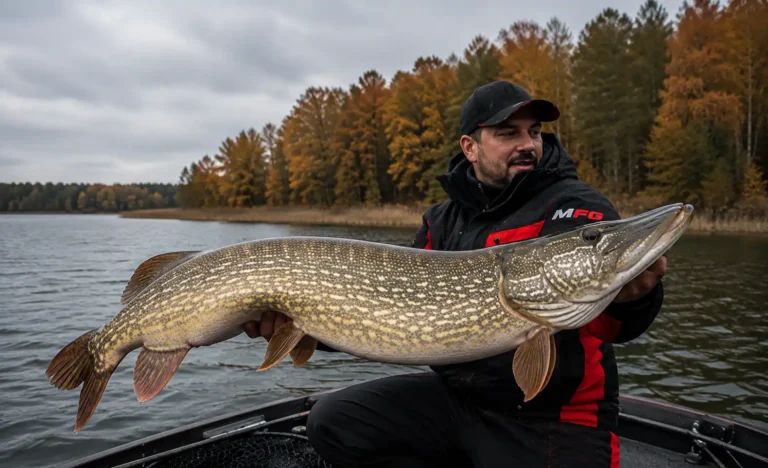
Pike commonly follow perch, shiners, and roach during autumn. Perch are especially important on many natural lakes because they move from shallow weed flats toward weed edges, points, breaklines, and basin edges as the water cools. Finding perch often means finding pike nearby.
Fall Pike Don’t Hide — They Move
Fall pike location comes down to one repeating pattern: find the forage, find the depth transition closest to it, and adjust both as temperatures keep dropping. Green cabbage weeds in early fall, outside weed edges and points in mid fall, basin edges and steep breaklines in late fall — the fish move through that sequence on every lake, every season.
The anglers who consistently find pike in autumn aren’t guessing. They’re reading water temperature, watching sonar for perch schools, and adjusting position as the season progresses rather than returning to the same spots that worked a month earlier.
For scientific background on northern pike distribution and habitat across North America, the USGS Nonindigenous Aquatic Species Database — Northern Pike is a reliable government resource. For everything else about fall — feeding windows, lures, retrieves, and tactics — our complete fall pike fishing guide covers the full picture.