

How to Choose a Pike Fishing Rod: Length, Power & Action Explained
Learning how to choose a pike fishing rod looks simple at first — until you spend enough time on the water and realize how much the wrong rod can cost you. Sometimes during the cast. Sometimes while working a lure that never feels quite right. And sometimes beside the boat, when a heavy pike surges under the net and the rod is either too soft to control the fish or too stiff to keep treble hooks pinned.
After 20 years of pike fishing from both shore and boat, across shallow spring bays, deep summer weed edges, and cold late-autumn sessions, one thing becomes obvious quickly — the wrong rod always shows its weakness at the worst possible moment.
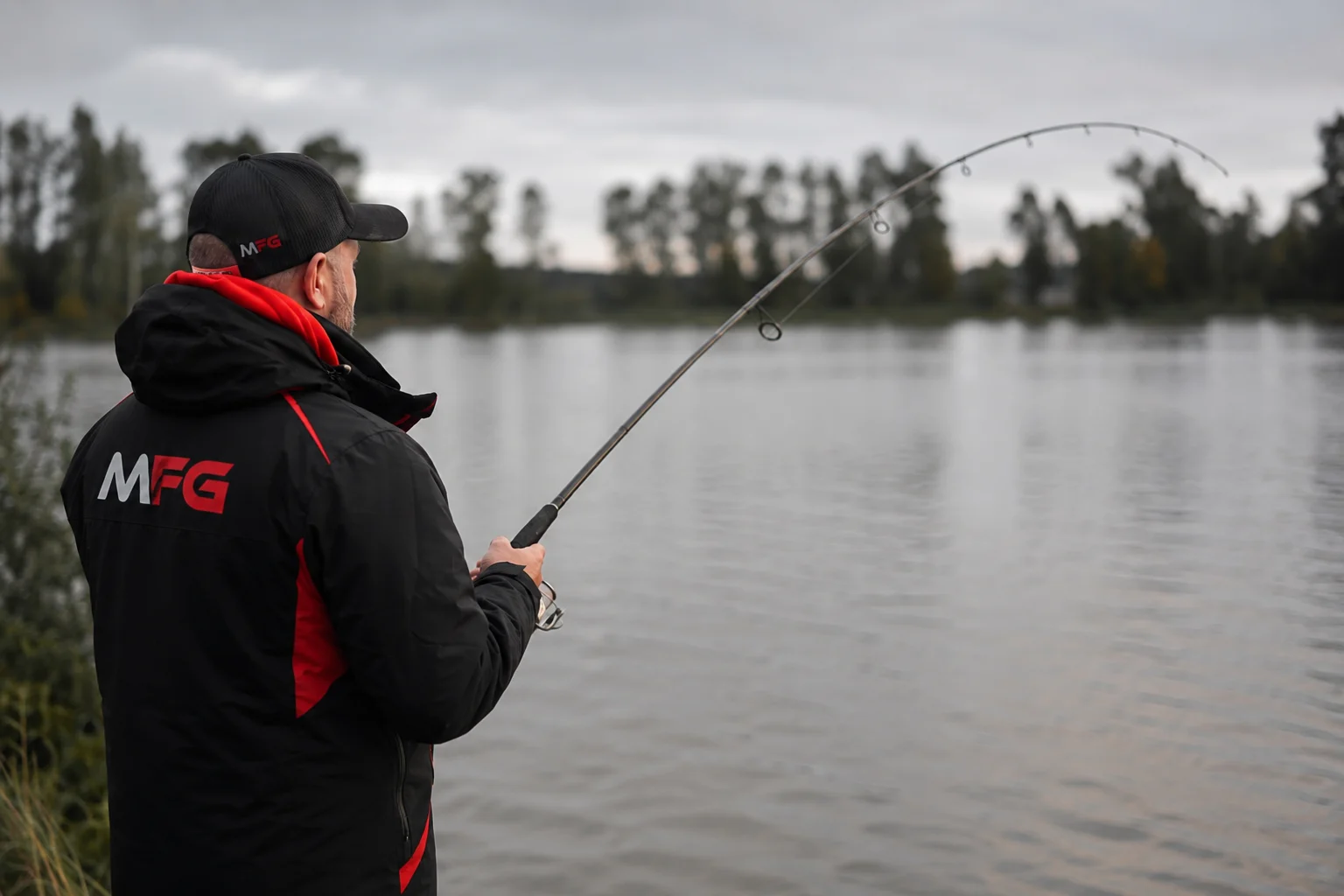
A proper pike rod needs to handle several jobs at once: enough backbone for solid hooksets through hard jaws, enough flex to absorb violent head shakes at close range, and enough casting power to throw heavier spoons, soft plastics, and jerkbaits without feeling overloaded after a full day of casting.
But there is no single best pike fishing rod for everyone. There is only the right rod for your fishing style, lure selection, and the type of water you fish most often.
In this guide, we break down how to choose a pike fishing rod based on length, power, action, lure type, and real fishing situations — so you can build a setup that feels balanced in your hands and performs when the fish finally commits.
Rod Length for Pike Fishing: What Actually Changes on the Water
Rod length affects three things in pike fishing: casting distance, leverage during the fight, and control over the lure during the retrieve. Most anglers focus first on distance — but leverage and lure control matter just as much, especially when a fish surges beside the boat or when you need to place a lure tight to a weed edge with precision.
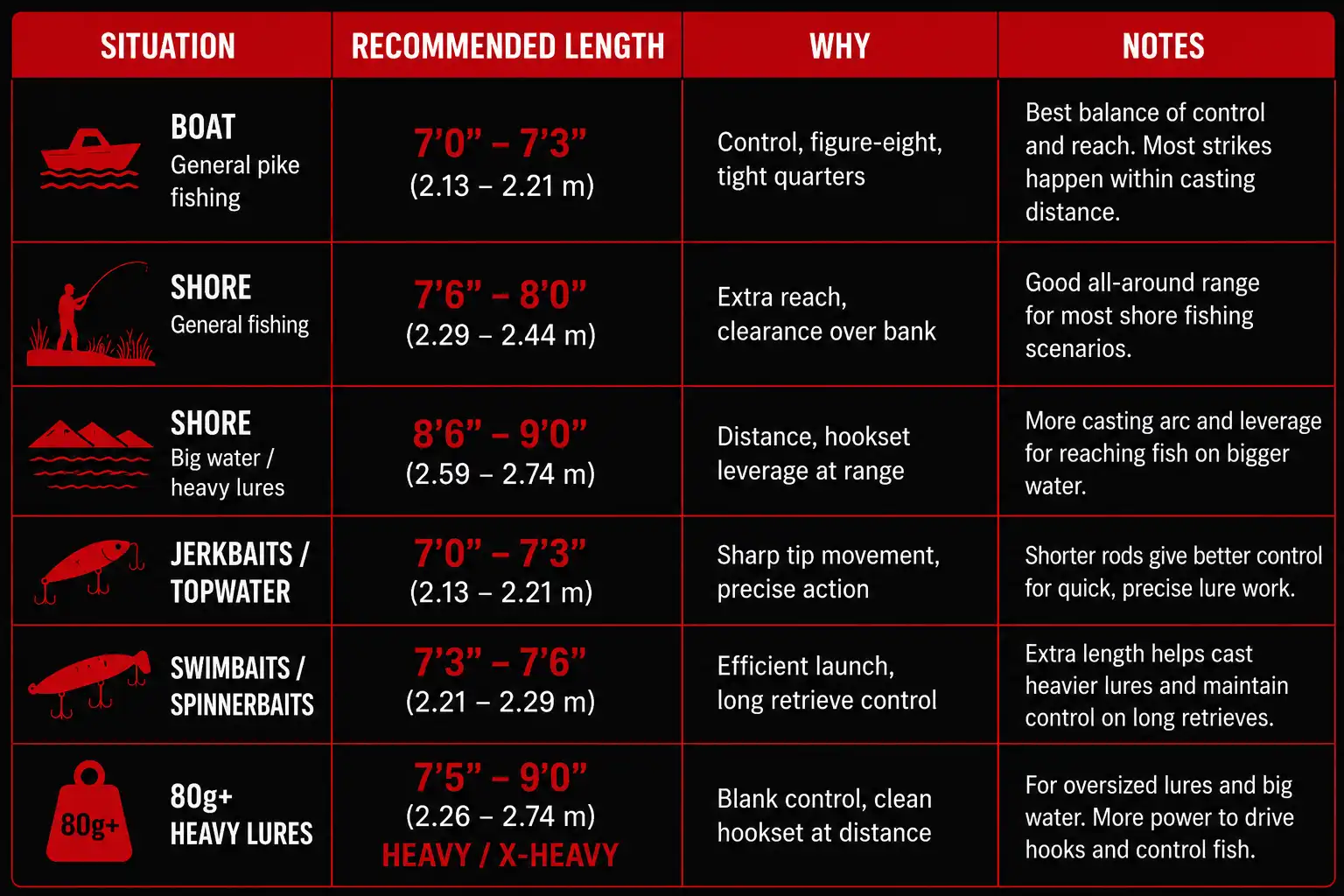
For most pike fishing situations, a rod between 7’0″ and 7’6″ (2.13–2.29 m) covers the majority of scenarios well. This range gives you enough reach for accurate casts along reed edges, enough backbone for strong hooksets through hard jaws, and enough maneuverability to control the fish from strike to net — whether you’re fishing from a boat or from shore.
Fishing from a Boat
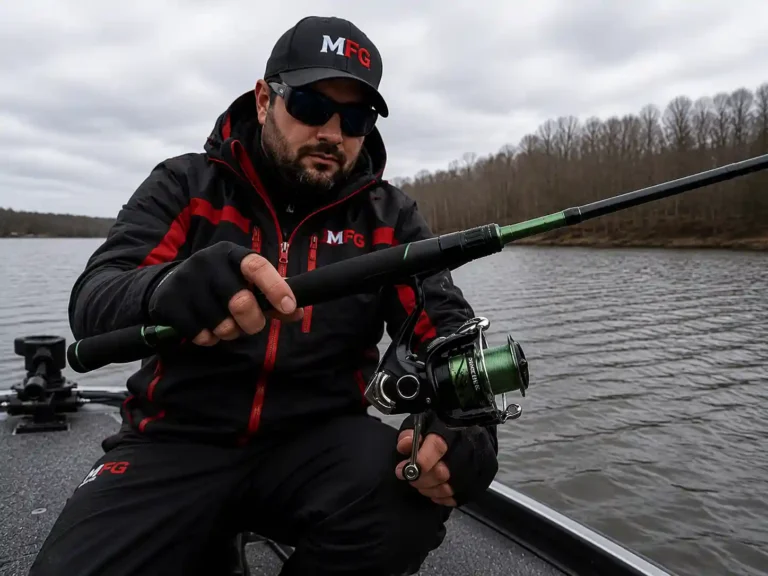
From a boat, 7’0″–7’3″ gives you the best balance of control and reach. You’re rarely fishing at maximum range — most pike strikes happen well within casting distance of the boat. What matters more is lure precision, figure-eight control beside the boat, and the ability to steer fish away from weeds quickly.
A rod over 8 feet becomes harder to manage in tight quarters, especially when the fish is directly beneath the hull and every degree of rod angle matters.
Fishing from Shore
Shore fishing is where rod length makes the biggest difference. When you’re fishing from a fixed position — a bank, reservoir edge, or open shoreline — you can’t reposition to close distance the way a boat angler can.
A longer rod becomes a practical advantage here. Rods in the 8’0″–9’0″ range give you more casting arc to reach fish holding beyond the first drop-off, more clearance over grass or bankside vegetation on the backcast, and more leverage during a sweeping hookset when you have a lot of line out.
For general shore fishing with standard pike lures, 7’6″–8’0″ works extremely well. On bigger water with heavier presentations, moving up to 8’6″–9’0″ gives you a noticeable advantage in both casting distance and control.
Heavy Rods: It’s About Lure Weight and Water Size, Not Season
Longer, heavier rods — typically 7’5″–9’0″ in Heavy or X-Heavy power — are not a seasonal choice. They are a lure weight, water size, and presentation decision.
When you’re throwing oversized spoons, big jerkbaits, or large swimbaits in the 60–80g range and above, a standard Medium Heavy rod starts losing blank control and struggles to transfer enough force on the hookset. A longer, heavier rod loads correctly under that weight and gives you the leverage needed to drive hooks cleanly at distance.
The same applies to big water — wide reservoirs, open channels, and large rivers where pike often hold far from shore and every cast covers more water.
It’s not the season that dictates rod length. It’s the lure you’re throwing and the water you’re fishing.
Lure Style Also Plays a Role
Jerkbaits and walk-the-dog topwaters usually feel better on shorter rods, where quick tip movements stay sharper and more precise on a 7’0″–7’3″ blank.
Larger swimbaits, spinnerbaits, and search lures worked in wide open water often feel better on a 7’3″–7’6″ rod, where extra length helps launch heavier lures more efficiently and maintain better control during a long retrieve.
The length itself is not the deciding factor — it’s how that length matches your platform, your lure weight, and the water you’re fishing. Start with the range that fits your fishing situation first, then fine-tune power and action around it.
Rod Power for Pike Fishing: Why Medium Heavy Is the Starting Point
Rod power describes how much force it takes to bend the blank. For pike fishing, this directly affects two things: whether you can drive hooks into a hard jaw on the strike, and whether you can control a heavy fish under pressure without the rod collapsing at the worst moment.
Medium Heavy is the standard power rating for pike fishing — and the right choice for the majority of situations. It gives you enough backbone for clean hooksets through bony jaws, enough resistance to handle common pike lures in the roughly 20–60g range without overloading the blank, and enough flex in the tip to absorb violent head shakes without tearing hooks free.
How rod power is marked on the blank
When you pick up a rod in a shop, the power rating is printed directly on the blank — usually as an abbreviation:
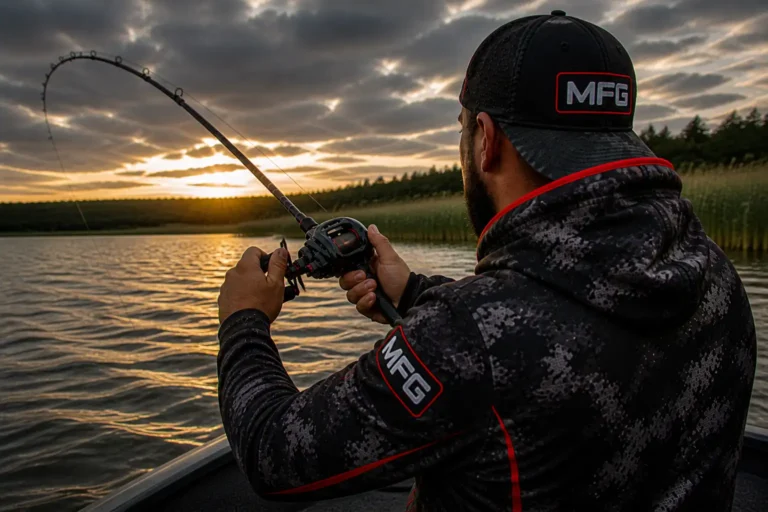
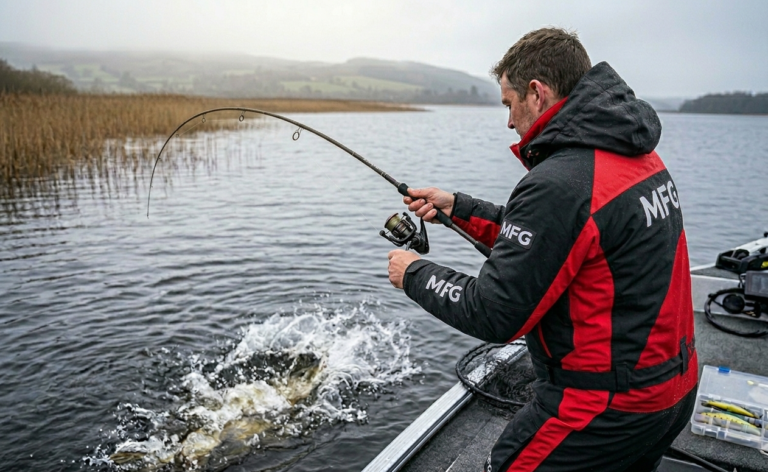
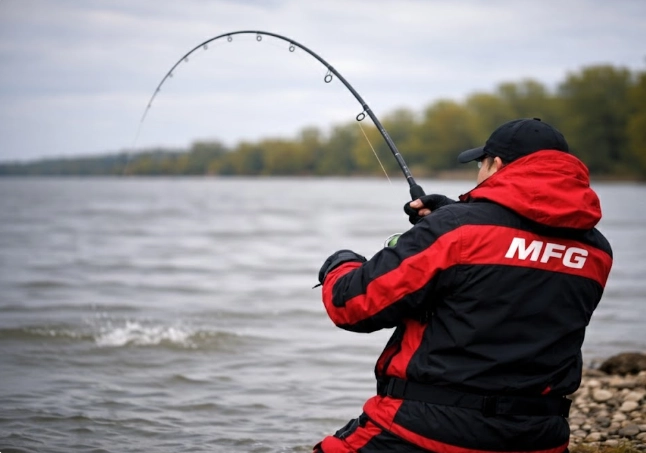
A Medium rod feels too soft the moment a big pike turns sideways and shakes hard at boatside. The blank flexes too much, tension drops, and hooks pull. That loss of control in the final seconds is exactly where most pike are lost — and it almost always comes down to a rod that doesn’t have enough backbone to hold the fight.
We’ve seen that happen more than once with lighter rods. The fish eats clean, everything feels under control for the first few seconds — then it turns broadside beside the boat, shakes once under pressure, and suddenly the hooks are gone. Those are the moments that teach you very quickly whether a rod has enough backbone for pike or not.
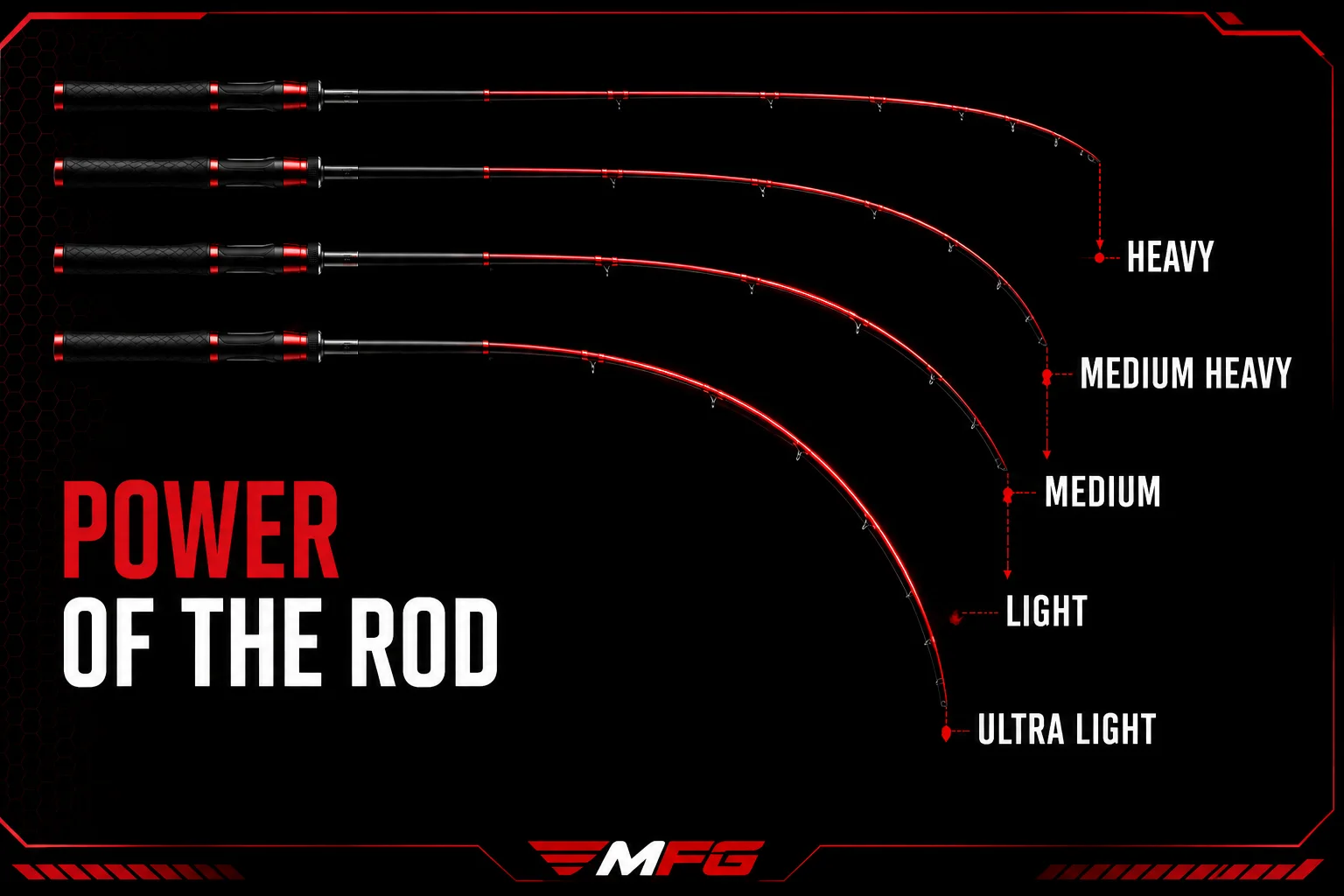
A Heavy rod solves that problem but creates another one. Too much stiffness kills lure action on smaller presentations, makes the blank unforgiving during the fight, and wears your wrist and shoulder down faster over a long session. Medium Heavy stays in the middle — powerful enough to control fish, sensitive enough to feel the lure working correctly on every retrieve.
When to Move Up to Heavy or X-Heavy
Heavy and X-Heavy power become the right choice when lure weight increases significantly or when fish size and water type demand more control. If you’re regularly throwing lures in the 60–80g range and above — large swimbaits, oversized spoons, musky-style jerkbaits — a Medium Heavy blank starts losing feedback and hookset power under that load. A Heavy rod handles that weight cleanly without the blank feeling overworked.
The same applies when targeting trophy pike in heavy cover. A big fish that buries itself in thick cabbage needs a rod with enough backbone to turn it before it reaches the weeds — Medium Heavy sometimes isn’t enough in that situation. Shore anglers working large open water with heavy presentations often find that Heavy power gives them both the casting control and the fish-fighting leverage they need from a fixed position.
Power is not about how strong you want to feel holding the rod — it’s about matching blank resistance to the lures you throw and the fish you’re targeting. Start with Medium Heavy, and move up only when lure weight or fishing situation genuinely demands it.
Rod Action for Pike Fishing: The Most Misunderstood Part of Choosing a Pike Rod
Rod action describes where the blank bends under load — and it’s the specification most anglers either ignore completely or get wrong. Power gets attention because it sounds important. Length is easy to measure. But action is what actually determines how the rod feels in your hand, how the lure moves in the water, and whether the hookset reaches the fish or dies halfway down the blank.
How rod action is marked on the blank
Action is printed on the blank alongside power — usually as a short abbreviation next to the power rating:
A rod marked MH / F on the blank is Medium Heavy power with Fast action — the most common pike fishing combination.
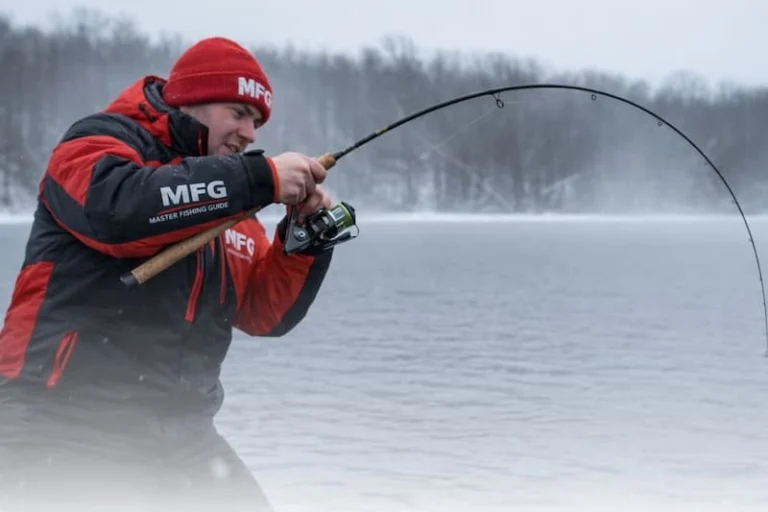
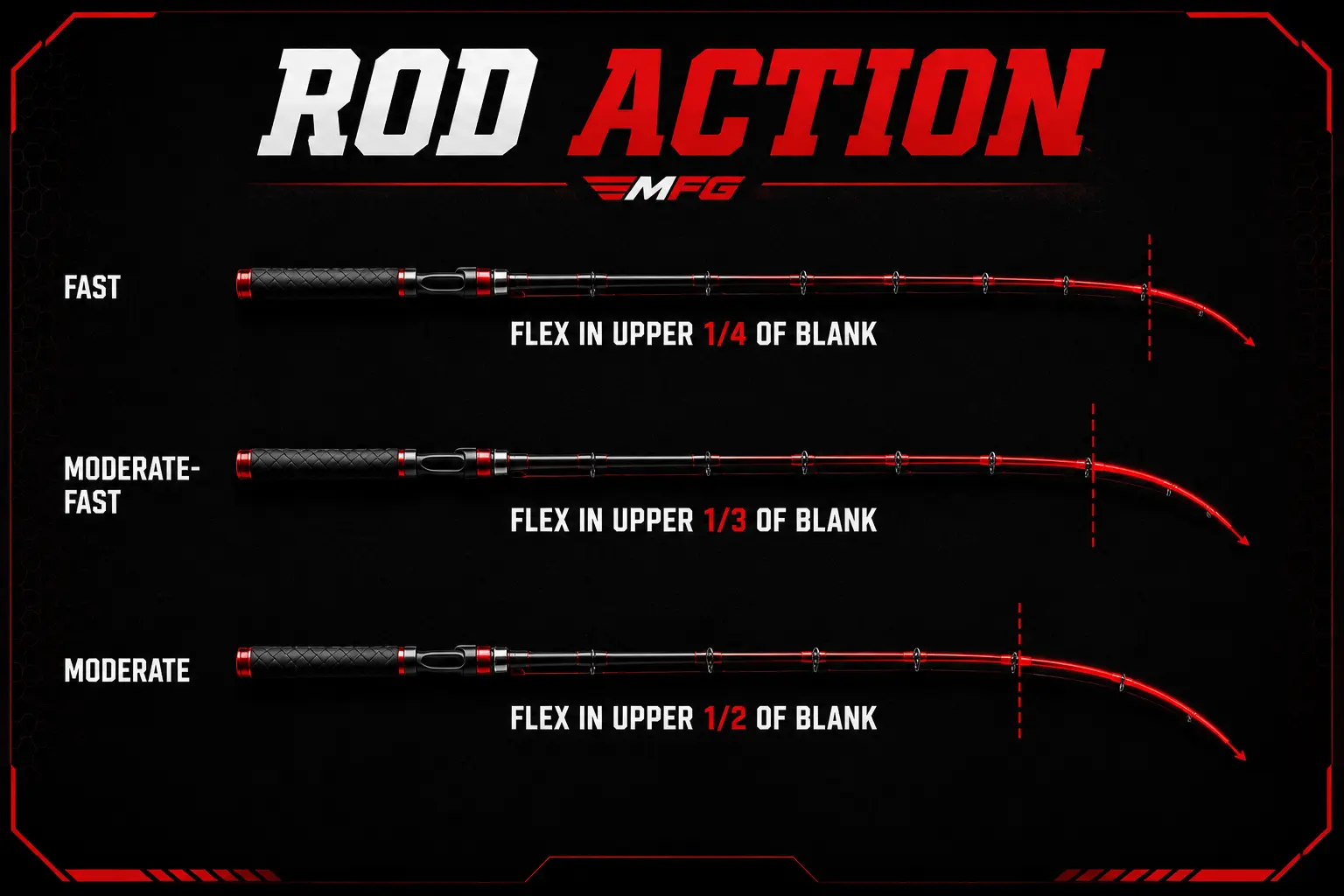
Fast action is the most versatile action for modern pike fishing setups. A fast action rod bends primarily in the top third of the blank. That stiff lower section gives you immediate power transfer on the hookset, direct feedback through the handle, and enough blank recovery speed to work lures aggressively without the rod lagging behind your movements.
Pike have hard, bony jaws. A hookset that loses energy in a slow, soft blank often fails to penetrate deep enough — especially on long casts where there’s more line stretch between you and the fish. Fast action keeps that energy transfer short and direct, which is exactly what pike fishing demands.
We learned that lesson the hard way years ago fishing jerkbaits over shallow spring weed edges. The strike came at the end of a long cast, we hit the hookset hard, felt weight for a second — then nothing. The hooks had touched the fish, but they never buried cleanly. After enough missed fish like that, you stop blaming the hooks and start paying attention to what the blank is actually doing during the hookset.
Why Moderate-Fast Has Its Place
Moderate-fast action bends through the top half of the blank rather than just the tip. This creates more flex overall, which can actually help in specific situations — particularly with treble hook lures like topwater baits and certain crankbaits, where a slightly softer tip absorbs the initial surge and reduces the chance of hooks pulling during a violent head shake.
For walk-the-dog topwaters, crankbaits, and some reaction baits where the fish has more time to fully commit, moderate-fast action gives you a small but real advantage in keeping hooks pinned through the fight. It’s not the default choice for pike — but it’s not wrong either when the situation calls for it.
What to Avoid
Slow and medium action rods are generally better suited to techniques that don’t depend on aggressive hooksets with heavy artificial lures. They load deeply, flex through most of the blank, and absorb shock well. For pike fishing with heavy artificials, that deep flex works against you. By the time the rod loads and recovers, the strike window is already closing and the hook has moved without enough force behind it.
Extra-fast action sits at the other end of the spectrum. The blank bends only at the very tip, which delivers exceptional sensitivity and an almost instant hookset response. The tradeoff is that extra-fast can become unforgiving during violent boatside fights, especially with treble hooks and tight drag settings. For most pike setups, fast action gives you the same hookset speed with enough flex to manage the fight without adding unnecessary risk at the net.
Fast action covers the majority of pike fishing situations well. It’s the right starting point for most setups — and the action you’ll find on almost every rod we recommend across our pike guides.
Spinning vs Baitcasting Rods for Pike: How to Choose the Right System
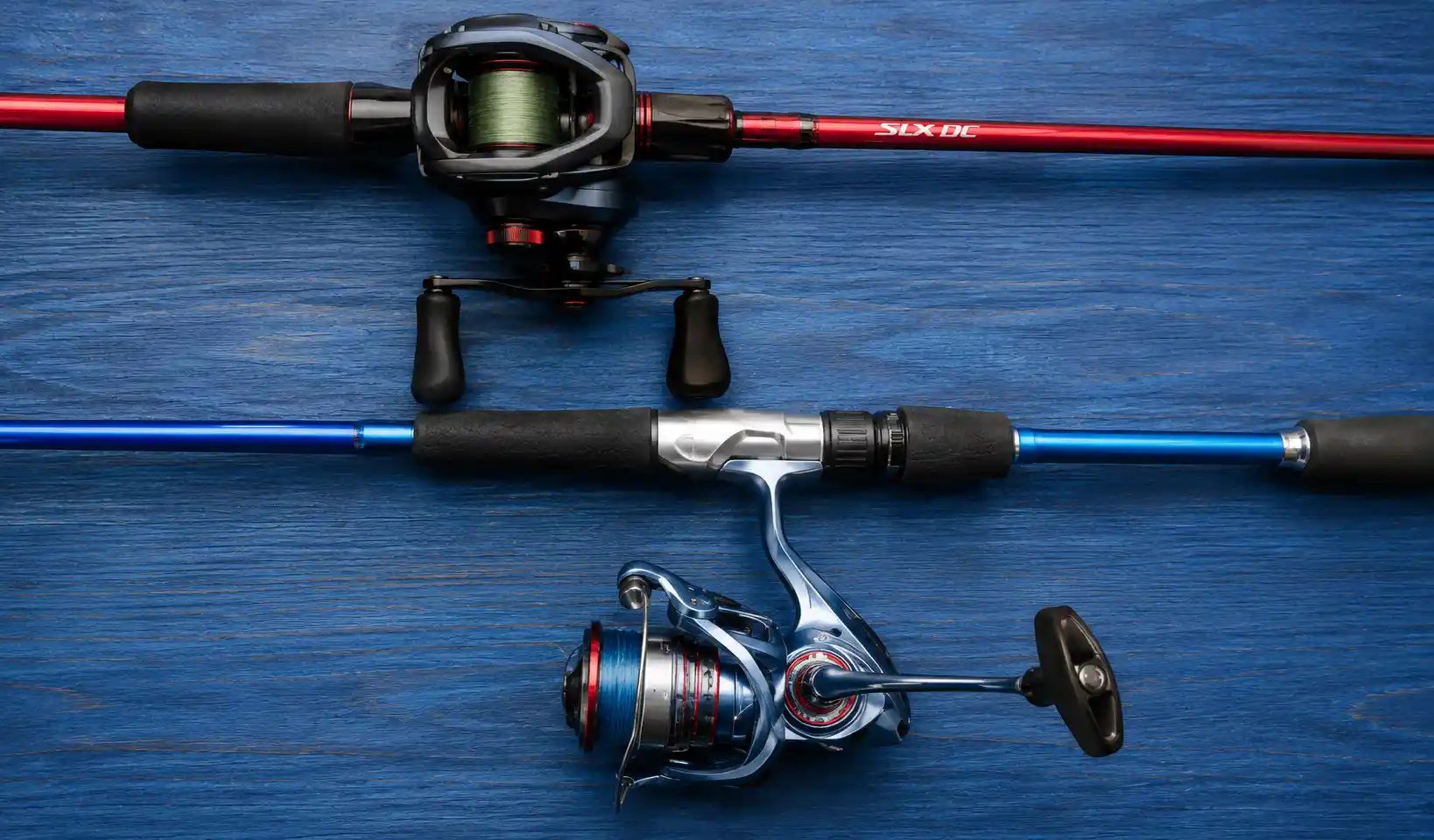
The choice between spinning and baitcasting is not about which system is better for pike — both work, and experienced pike anglers often run both depending on what they’re fishing. The real question is which system fits your lure selection, your casting style, and the specific water you’re on.
When Spinning Makes More Sense
Spinning setups adapt more easily to changing lure weights during a session. That versatility makes them the more forgiving choice — especially when you’re moving between different lure types or fishing in conditions where quick adjustments and consistent casting control matter more than maximum lure size.
Spinning setups work particularly well with lighter and mid-range pike lures — jerkbaits, smaller swimbaits, spinnerbaits, and soft plastics in the 15–40g range. The open-face reel gives you clean line release on the cast and smooth drag engagement when a fish runs. For anglers who fish a wide variety of techniques across different seasons, spinning is the easier system to learn and the more adaptable one day to day.
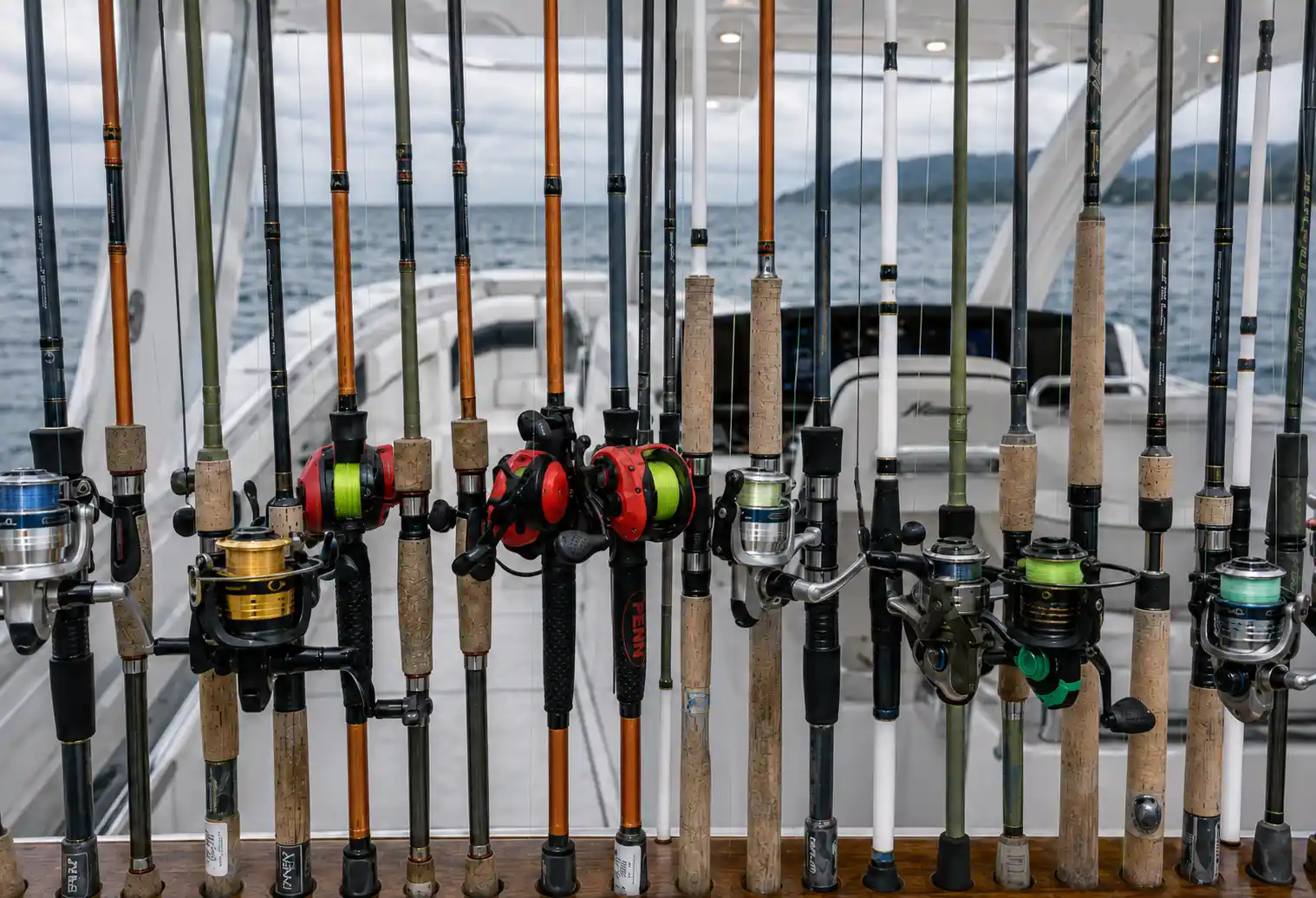
We switch between both regularly depending on the session. On some days we start with spinning rods covering water with smaller moving baits — then as soon as the lure size increases or we begin targeting tighter structure, a baitcaster comes out on deck. Most experienced pike anglers don’t really choose one system forever — they choose the one that fits what the fish are asking for that day.
When Baitcasting Makes More Sense
Baitcasting rods give you more direct control over the cast — thumb pressure on the spool lets you place heavier lures with more precision than most spinning setups can match. That accuracy becomes genuinely useful when you’re repeatedly dropping lures tight to a weed edge, casting into a specific gap in reed cover, or working large glide baits that need to land in exactly the right position.
Baitcasting setups handle heavier lures more cleanly — large swimbaits, musky-style jerkbaits, oversized spoons — where the reel design and direct spool control give you better leverage and lure control during both the cast and the retrieve. In heavy cover situations where you need to stop a fish immediately and turn it before it reaches the weeds, the direct connection of a baitcasting setup gives you a small but real advantage.
Which One to Start With
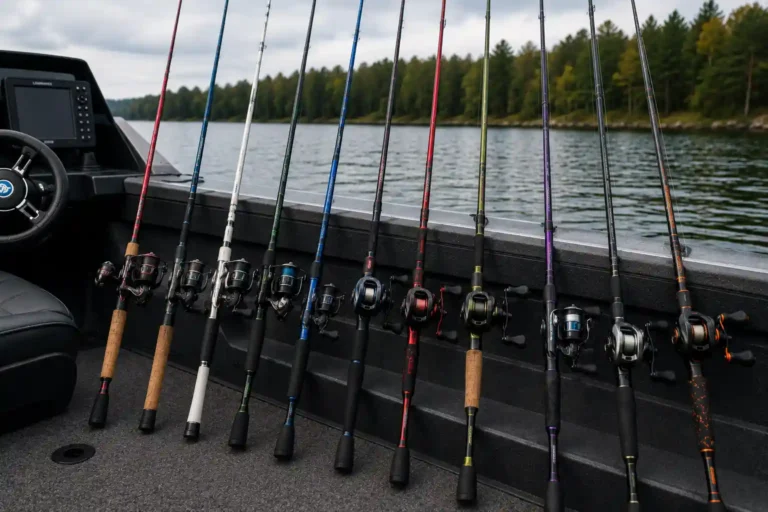
If you’re building your first serious pike setup, spinning is usually the more practical starting point for most anglers. It covers the majority of pike fishing situations without requiring the learning curve of baitcasting thumb control, and a quality spinning rod in Medium Heavy with Fast action handles most lures you’ll throw in a full season.
If you’re already comfortable with both systems, the smarter approach is to run spinning for your everyday presentations and baitcasting for heavier lures and situations that demand precision. Most experienced pike anglers end up with both on the boat — not because one is better, but because each does something the other handles less well.
For our full tested selections on both systems, see best spinning rods for pike and best baitcasting rods for pike — every model field tested and chosen for real pike fishing conditions.
How to Match Lure Weight to Your Pike Rod (Without Overloading the Blank)
Every rod has a casting weight range printed on the blank — and for pike fishing, that number matters more than most anglers realize. Throwing a lure that’s too light for the rod means the blank never properly loads on the cast, the lure feels dead in the water, and you lose the feedback that tells you what’s happening below the surface. Throwing a lure that’s too heavy overloads the blank, kills casting accuracy, and puts unnecessary stress on the rod under pressure.
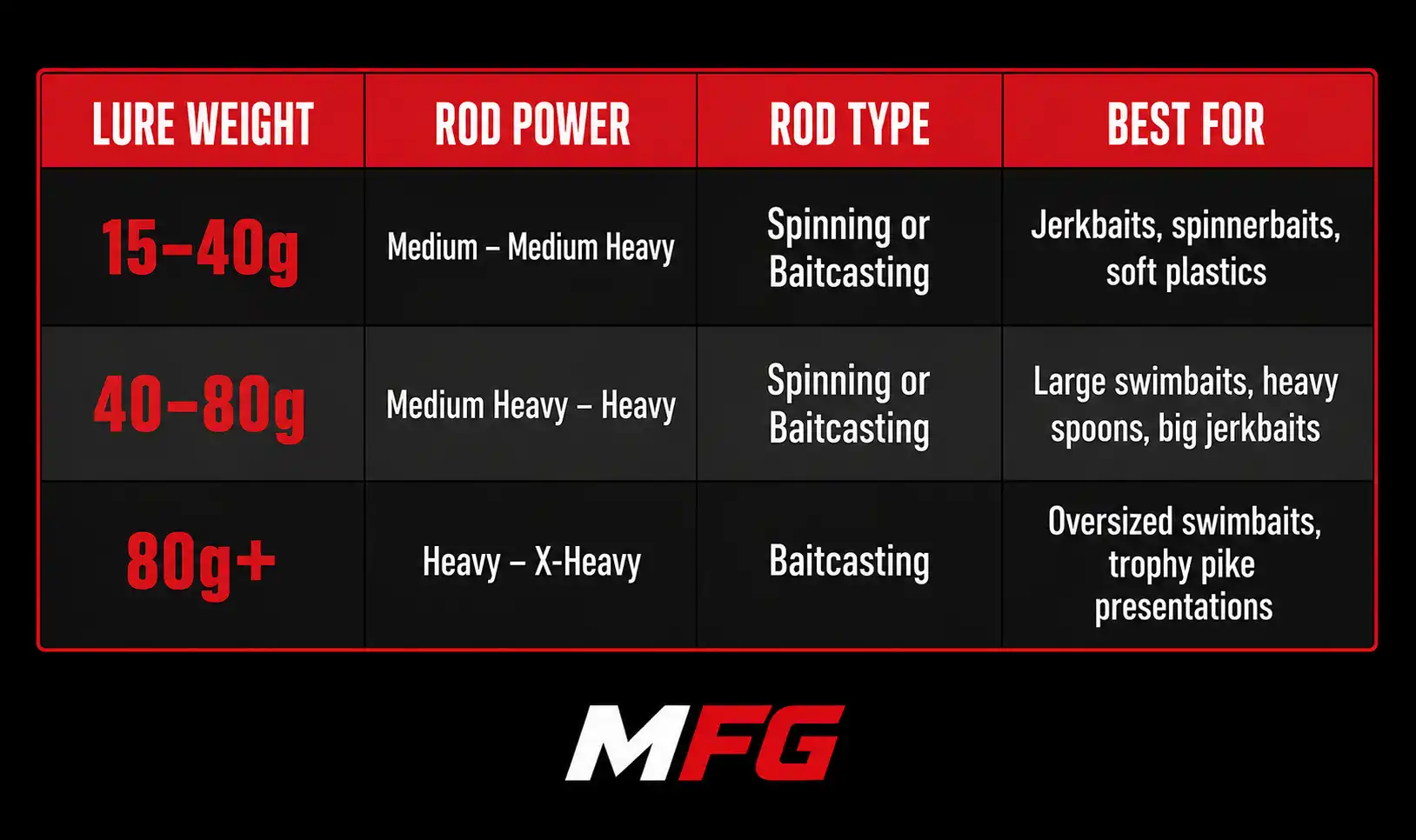
Matching lure weight to rod power is not about staying within a printed spec — it’s about making sure the blank loads correctly so you can feel the lure, control the cast, and transfer force cleanly when the fish strikes.
Light to Mid-Range: 15–40g
This is the everyday pike fishing range — spinnerbaits, jerkbaits, smaller swimbaits, and soft plastics. A Medium Heavy spinning rod handles this range cleanly, giving you enough blank flex to feel the lure working while maintaining the backbone to drive hooks on the strike. Most all-season spinning setups are built around this range, and for the majority of pike fishing situations — boat or shore, spring through autumn — it covers everything you need.
Standard Heavy Range: 40–80g
Once lure weight moves into this range — larger swimbaits, heavier spoons, bigger jerkbaits — a standard Medium Heavy rod starts working harder than it should. The blank loads well enough for the cast, but you begin losing feedback during the retrieve and precision on repeated presentations over a long session. A Medium Heavy rod with a heavier line rating or a step up toward Heavy power handles this range more comfortably — better blank response, cleaner hookset, less fatigue over a full day.
Big Lure Range: 80g and Above
Large swimbaits, oversized musky-style jerkbaits, and trophy pike presentations in the 80–150g range belong on Heavy or X-Heavy rods. At this weight, the lure itself generates significant resistance during the retrieve, and the hookset demands a blank that doesn’t compress under load. Trying to fish a 120g swimbait on a Medium Heavy rod is one of the fastest ways to lose both feedback and hookset power — the blank flexes too much before the force ever reaches the hook.
The practical takeaway is simple: build your setup around the lure weight you fish most often, not the heaviest lure you occasionally throw. A rod that’s perfectly matched to your everyday presentations will always outperform one that’s rated for occasional heavy use but feels overbuilt the rest of the time.
Pike Rod Questions We Hear Most Often
What is the best rod length for pike fishing?
For most anglers, the best all-around pike rod length sits between 7’0″ and 7’6″. This range provides a balance of casting distance, lure control, and fish-fighting leverage. Boat anglers usually prefer shorter rods for control, while shore anglers benefit from extra length when distance matters.
Is Medium Heavy enough for big pike?
Yes. A Medium Heavy Fast rod is more than capable of handling big pike in most situations. It offers enough backbone for solid hooksets and strong control during the fight while remaining versatile across a wide range of lure sizes. Heavy power is mainly needed for very large lures or extreme heavy cover.
What rod action is best for pike fishing?
Fast action is the most versatile choice for pike fishing. It provides direct hookset power, good sensitivity, and clean lure control during retrieval. Moderate-fast action can also work well with treble-hook lures and topwaters where slightly more flex helps keep fish pinned.
Can a pike rod be too heavy for smaller lures?
Yes. A rod that is too heavy for smaller lures may not load properly on the cast and can make presentations feel stiff or unresponsive. It is usually best to match rod power to the lure weight you use most often rather than the heaviest lure you occasionally throw.
Should I choose spinning or baitcasting for pike fishing?
Both spinning and baitcasting work very well for pike fishing. Spinning is generally more versatile and easier for most anglers, while baitcasting is more effective for heavier lures and precise casting around structure. Many experienced anglers use both depending on the situation.
If I could buy only one pike rod, what should it be?
A 7’0″–7’3″ Medium Heavy Fast rod is the most versatile all-around setup for pike fishing. It covers a wide range of lure weights, works from both boat and shore, and performs well across most fishing situations.
How to Choose a Pike Fishing Rod: The Short Version
For most pike fishing situations, a 7’0″–7’6″ Medium Heavy Fast rod covers everything you need — enough length for accurate casts, enough power for clean hooksets, and enough action sensitivity to feel the lure and react when the fish commits. Adjust length for your platform, move up in power when lure weight demands it, and let the water tell you the rest. If you have questions or want to share what’s working for you, join the conversation on the Master Fishing Guide Facebook page.