

5 Best Soft Swimbaits for Pike in Cold Water: Rigging and Slow Retrieves
Cold-water pike fishing often calls for a more controlled presentation. If the faster retrieves you used with your autumn pike lures are no longer producing, a soft swimbait gives you another way to work the same water: slow the retrieve, adjust the jig head weight, and keep the lure close to the depth where you are finding fish.
As an Amazon Associate, we earn from qualifying purchases — no cost to you. That’s how we keep this site running. Read more ›
Soft swimbaits are useful for this approach because you can adjust their running depth and retrieve speed without changing the basic baitfish profile. The important detail is choosing a bait whose tail still works at your intended speed. Rigging matters too: a straight body and a suitable jig head help the lure track properly when you fish it slowly.
For the broader seasonal picture, our winter pike fishing guide covers locations and tactics beyond lure choice. Here, the focus is on choosing and fishing soft swimbaits in cold, open water.
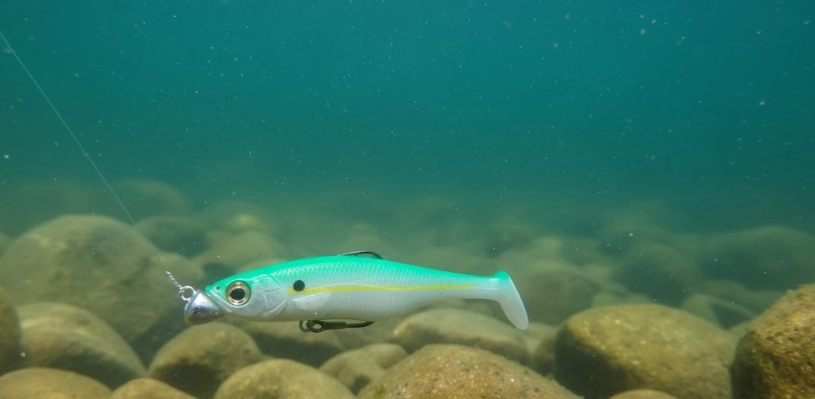
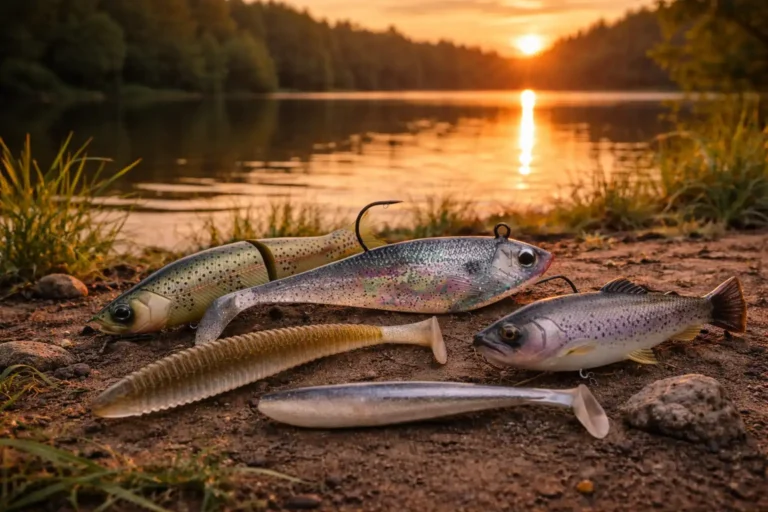
Below are five soft swimbaits for cold-water pike, with a breakdown of their action, useful fishing situations, jig head choices and slow-retrieve techniques. Each offers a different combination of profile, movement and durability, so you can choose the one that fits your water and presentation.
MFG Quick List: Best Winter Soft Swimbaits for Pike
If you’re short on time, these five soft swimbaits cover the main cold-water situations, from ultra-slow retrieves and stained water to clear water and long sessions on a single bait.
- Megabass Spark Shad 4″ Ayu — Best for Ultra-Slow Retrieves: a very soft paddle tail that keeps vibrating even when the reel handle barely turns.
- Keitech Swing Impact FAT 4.8″ Green Pumpkin — Best Vibration for Stained Water: a wide paddle tail with a heavy, low-frequency thump pike can feel in low visibility.
- Z-MAN DieZel MinnowZ 5″ Smelt — Most Durable Soft Swimbait: a stretchy ElaZtech body that resists tearing from repeated use and pike bites.
- Berkley PowerBait The Champ Swimmer 4.6″ Kit — Most Realistic for Clear Water: a detailed HD baitfish finish for pike that look a bait over before eating, with jig heads included.
- Savage Gear 3D Fat T-Tail Minnow 5″ Motor Oil — Best After a Cold Front: a fat-bodied minnow with a deep body roll and a belly rattle slot, for lethargic pike holding near the bottom.
Below you’ll find the full breakdown for each lure, including action, ideal locations, jig head choice and slow-retrieve technique.
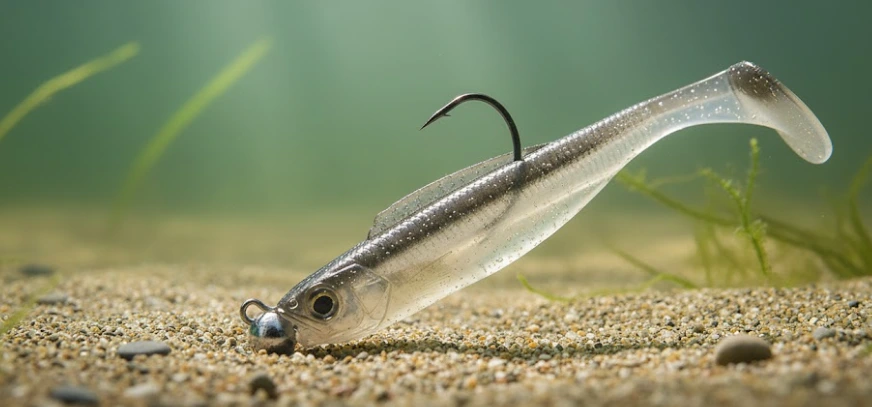
Megabass Spark Shad 4″ Ayu – Subtle Paddle Tail for Ultra-Slow Retrieves
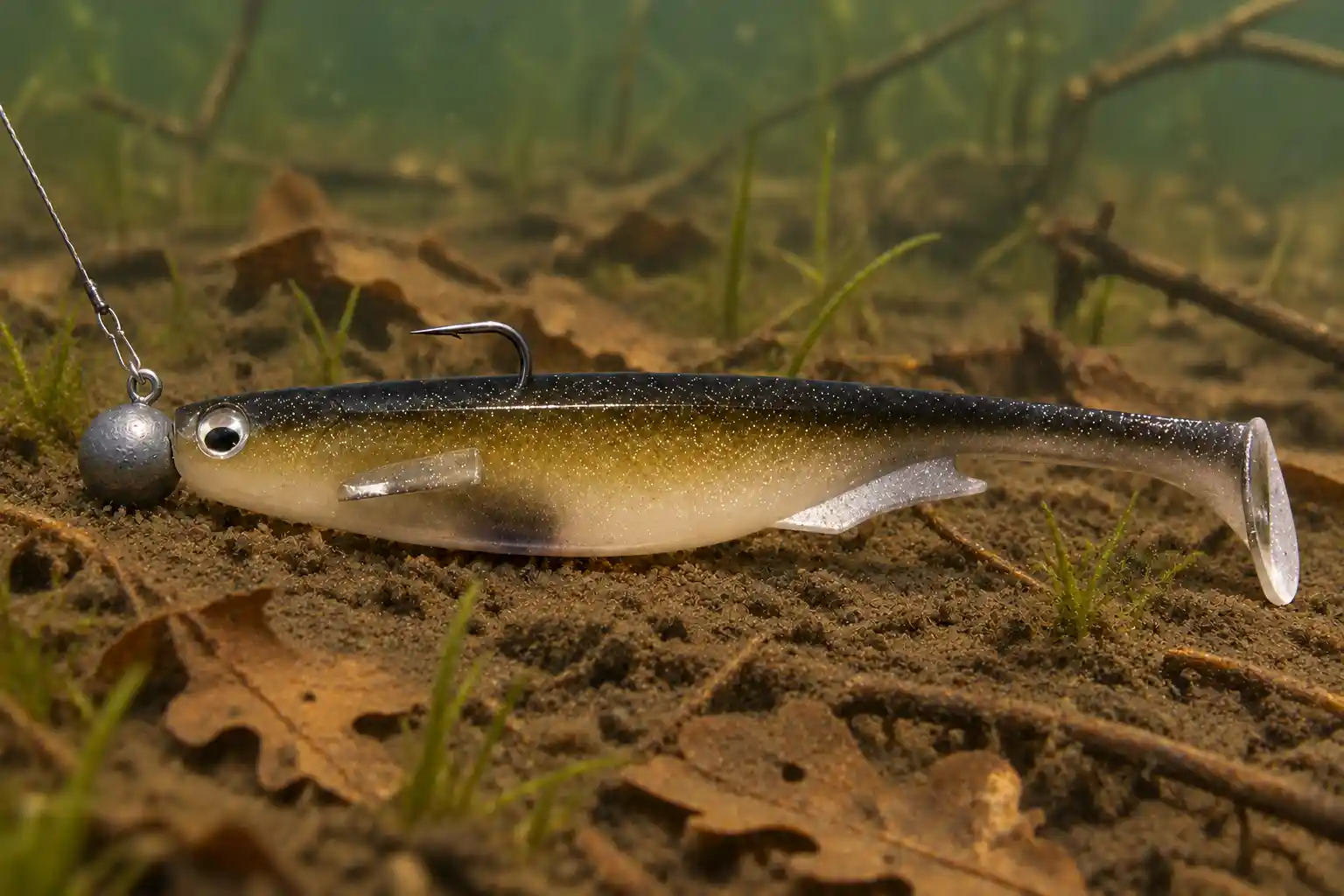
The Megabass Spark Shad 4″ Ayu is a soft swimbait built for slow retrieves in cold water, when pike refuse to chase anything fast. In our fishing, its tail starts working the moment the bait moves and keeps a fine, fast vibration even when we barely turn the reel handle. We have not seen it “die” and slide lifelessly at low speed the way stiffer soft plastics do.
Action & How to Retrieve
The thin tail joint is what makes the difference. Even on a crawl-speed retrieve, slow enough that you only just feel the bait working through the rod, the tail keeps producing a subtle vibration. Our usual approach is a slow, steady retrieve close to the bottom or just above the weeds, broken up with pauses:
- Retrieve slowly and steadily for several seconds
- Stop and let the bait sink toward the bottom
- Pick it up again and repeat
Most of our takes on the Spark Shad came during the steady, slow retrieve, but the hardest hits came on the pause. When the bait stops and starts to drop, the change of rhythm has often been enough to make a bigger pike take it without hesitation.
Best Locations (Where It Works Best)
We have fished it mostly at 2–4.5 m (7–15 ft), working transition zones, the edges of submerged weed and the shallows next to them, where pike sit in ambush. In cold water, pike are often reluctant to chase far, so a bait that stays low, slow and natural in front of them suits these spots well.
Recommended Jig Head
We have rigged it mainly on a round ball jig head with a 2/0 or 3/0 hook, which lets the point come out cleanly along the bait’s back groove. A weight of 10–15 g (about 3/8–1/2 oz) covered our depths, going heavier in wind or current. A reliable option is the Owner Ultrahead Round Jig Head.
Durability and Downsides
The soft plastic that gives the Spark Shad its action is also its weak point. In our experience, one bait usually lasts one to three pike before the teeth tear up the head. After the first solid fish, a drop of super glue helps keep the nose secure on the jig head. The small stick-on eyes also tend to come off after a few fish or a hard run through weeds. That does not change the action, but the bait quickly loses its factory finish. Given that the pack costs more than standard soft shads, expect to replace them often.
Keitech Swing Impact FAT 4.8″ Green Pumpkin – Heavy Thump for Slow Retrieves
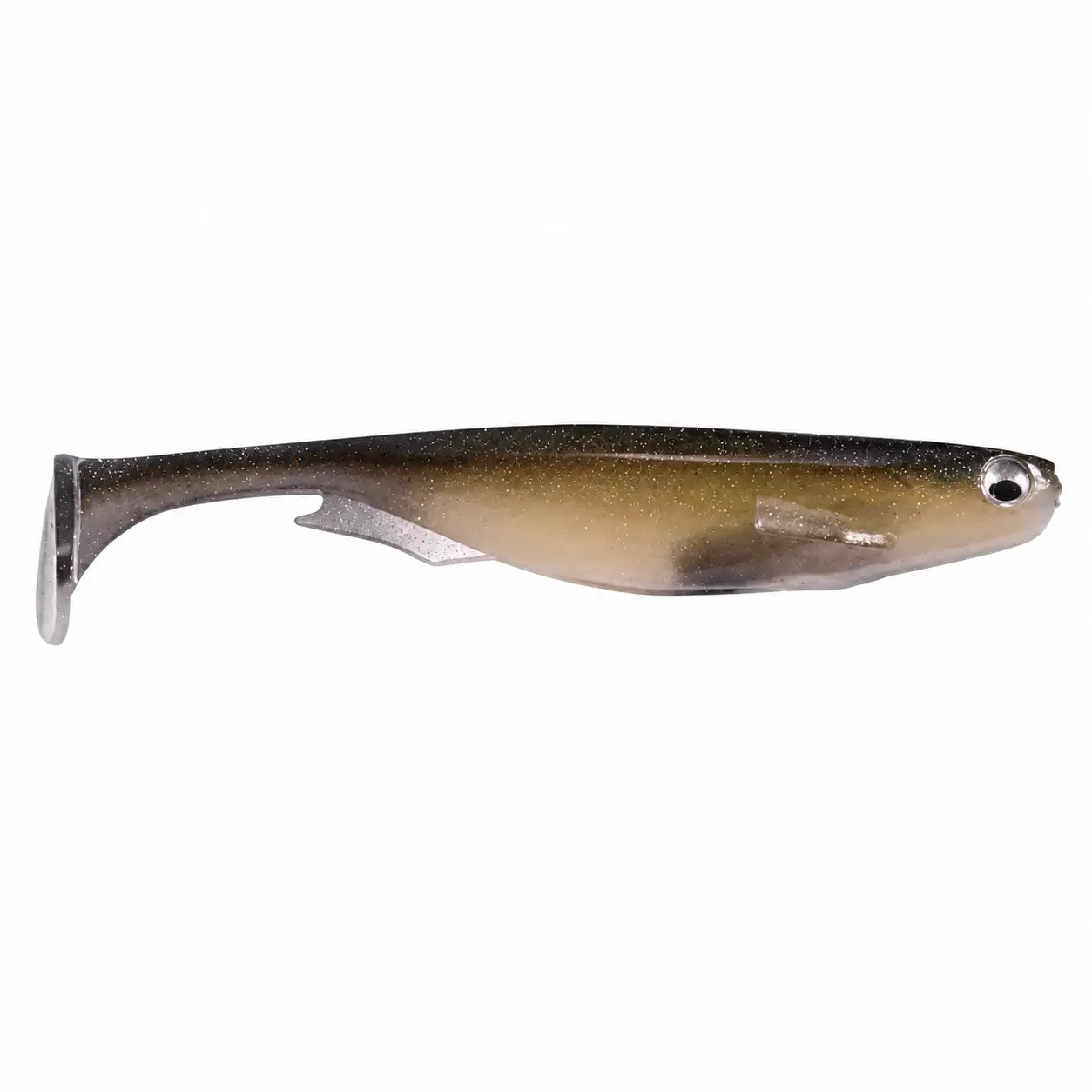
The Keitech Swing Impact FAT 4.8″ Green Pumpkin is the bait in this list that relies on vibration rather than subtlety. Its thick, ribbed body and large paddle tail produce a heavy, slow thump. Even when we turn the handle so slowly that the bait barely clears the weed tops, the tail keeps a full swing and we can feel every beat through the rod.

Action & How to Retrieve
Where the Spark Shad gives off a fine, fast vibration, the Swing Impact FAT moves more water. That makes a lift-and-drop retrieve its strongest presentation:
- Lift the rod tip to raise the bait off the bottom
- Let it sink back on a controlled line
- Start reeling slowly as it touches down, then repeat
Most of our takes came while the bait was sinking after a lift, or just as it began to rise off the bottom again. Several times a pike picked it up on the drop before we had even started reeling. A steady, slow retrieve also catches fish, but the most decisive strikes came on that change of rhythm. In stained or slightly murky water, the Green Pumpkin silhouette and the heavy thump have worked especially well for us.
Best Locations (Where It Works Best)
We have fished it mostly at 1.5–4 m (5–13 ft):
- edges of dying weedbeds
- submerged structure where pike hold close to cover
Recommended Jig Head
Because of the bulky body, it needs a bigger hook than most 4–5 inch swimbaits. We use a strong, wide-gap 4/0 or 5/0 hook, so the point comes out in the middle of the back with enough gap left to hook a pike. A head of 10–14 g (about 3/8–1/2 oz) gave us control over the fall and steady bottom contact. The Owner Ultrahead Round Jig Head comes in those hook sizes.
Storage and Durability
The plastic is very soft and heavily scented, which helps a pike hold on longer, but it pays for that in durability, even more than the Spark Shad. In our experience, the head usually splits where the hook comes out after one solid pike, or after two or three aggressive hits. A drop of super glue or a piece of toothpick through the head buys a few more casts, but after two or three fish the body is usually torn.
Storage matters too. Pressed against other baits in a tackle box, the body bends and then runs off-line in the water until you straighten it. The oily, scented plastic also sticks to other soft baits and picks up dirt, so keep these in their original bag, separate from the rest.
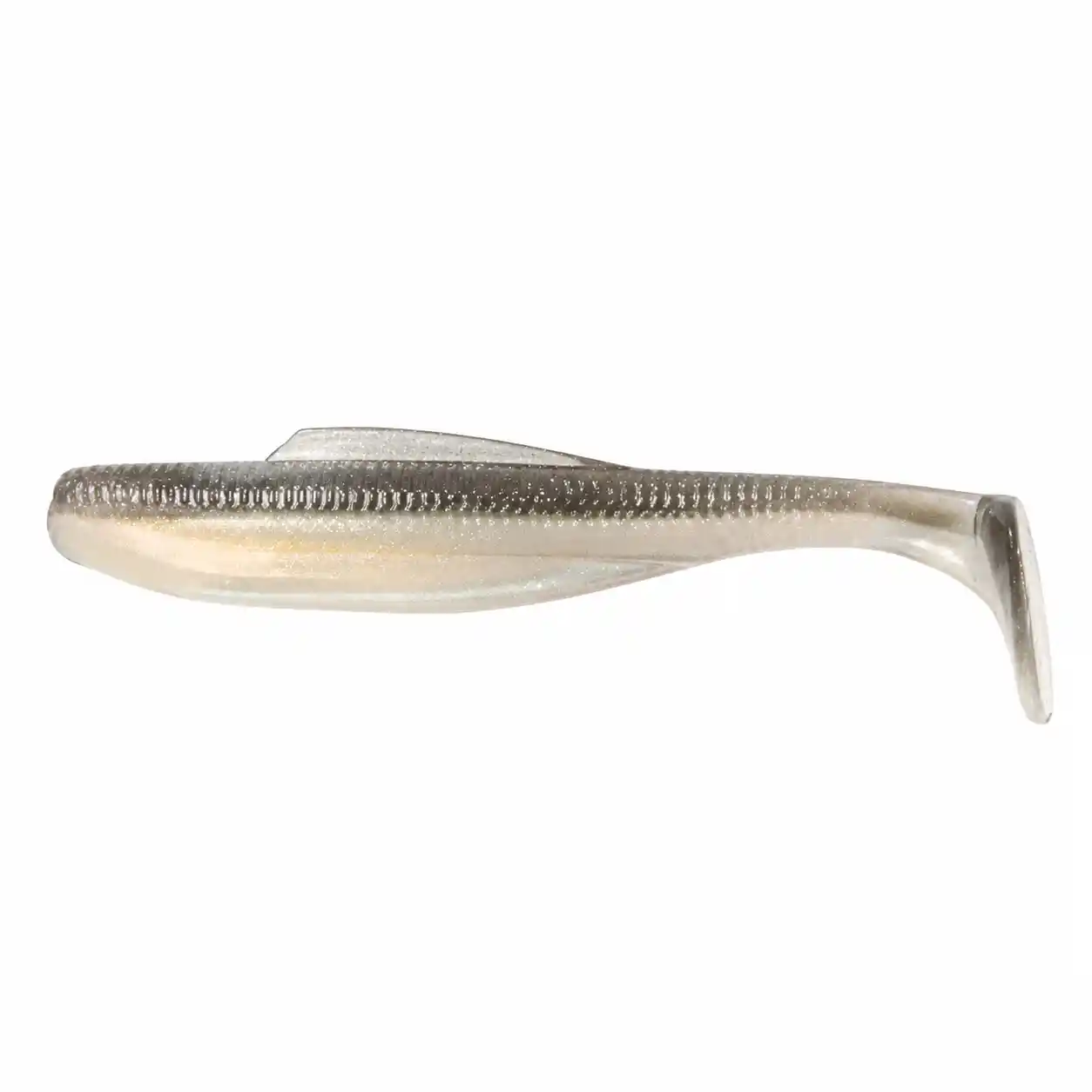
Z-MAN DieZel MinnowZ 5″ Smelt – The Swimbait That Lasts All Day
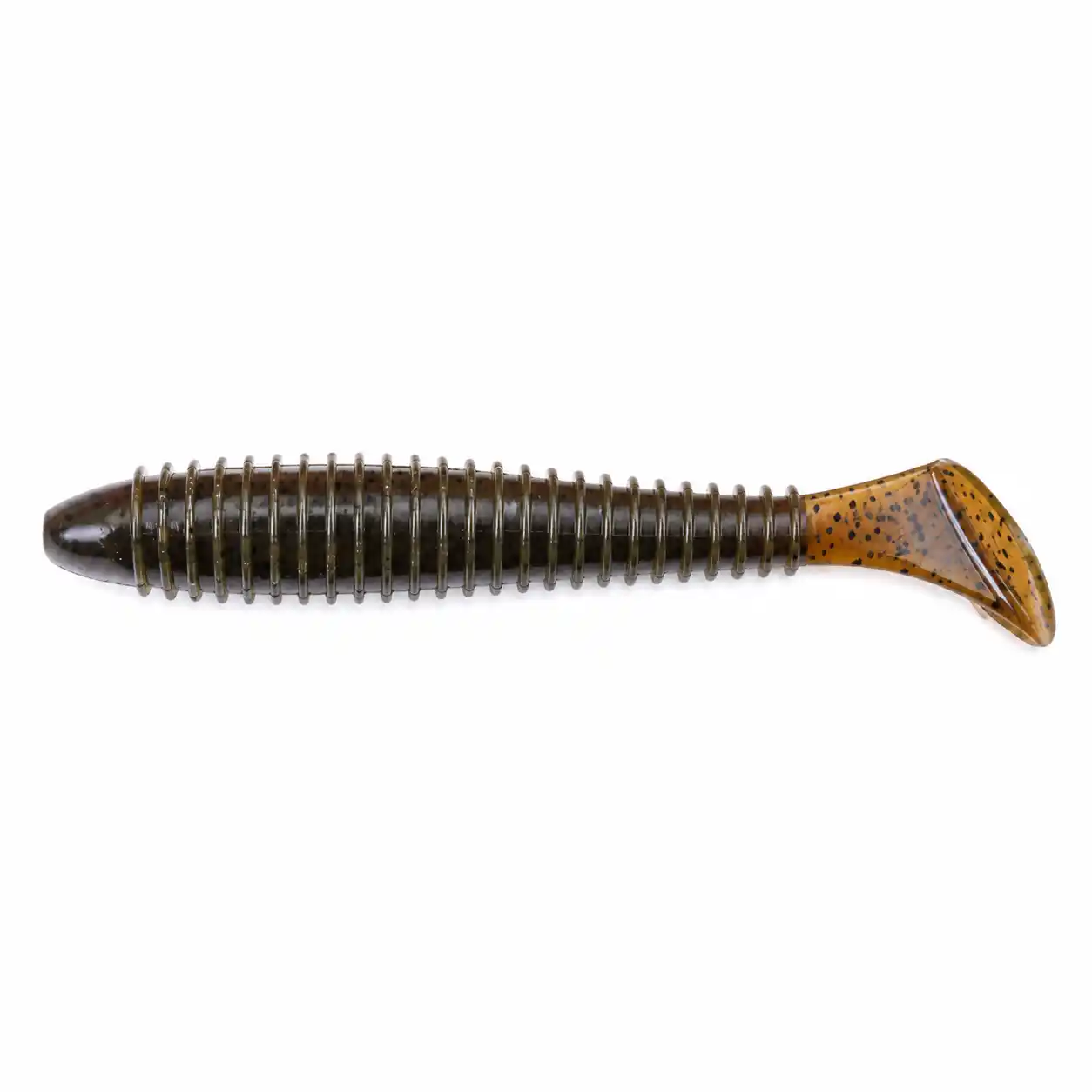
The Z-MAN DieZel MinnowZ 5″ Smelt is made from ElaZtech, a soft but extremely stretchy and tough material that behaves very differently from regular soft plastic. In our experience, one DieZel MinnowZ has lasted anywhere from 10 to more than 20 pike, chewed, scratched and punctured, yet still sitting straight on the jig head without tearing or glue.
Action & How to Retrieve
On a very slow retrieve, the large curved tail still works, but it produces a wider, heavier roll rather than the fine, fast vibration of the Spark Shad. In our experience it also needs a fraction more speed to get going: when we slow right down just above the weeds, it keeps swimming steadily, but it starts a moment later than the softest baits on this list.
Most of our takes came on a steady, medium-slow retrieve over weeds or while searching more open water. ElaZtech also floats, so when the bait rests on the bottom, the tail lifts and the bait stands up. That gave us extra takes on short pauses, with pike picking up the bait while it sat upright on the bottom.
Best Locations (Where It Works Best)
We have fished it mostly at 2–5 m (7–16 ft):
- transition zones between different bottom types
- submerged structure
- channel edges
Because one bait lasts so long, it is also our choice for covering water: you can keep casting through a long session without stopping to re-rig after every fish.
Recommended Jig Head
ElaZtech does not grip a standard lead barb collar well, so the jig head matters more here than with the other baits. We use a wide-gap 4/0 or 5/0 hook with a wire or pin-style bait keeper. Weights of 12–18 g (about 3/8–5/8 oz) covered our depths, depending on wind and the spot.
Rigging and Storage
Two things take getting used to. First, the stretchy material makes it awkward to rig straight on the first try. Once the hook is through, the bait is hard to slide and adjust, so take your time finding the center line before you push the point out.
Second, never store ElaZtech in the same compartment as regular soft plastics. The two materials react with each other, and both can melt, stick together and lose their shape. Keep these baits in their original packaging, away from your other soft plastics.
Berkley PowerBait The Champ Swimmer 4.6″ Kit – Realistic Swimbait for Clear Water
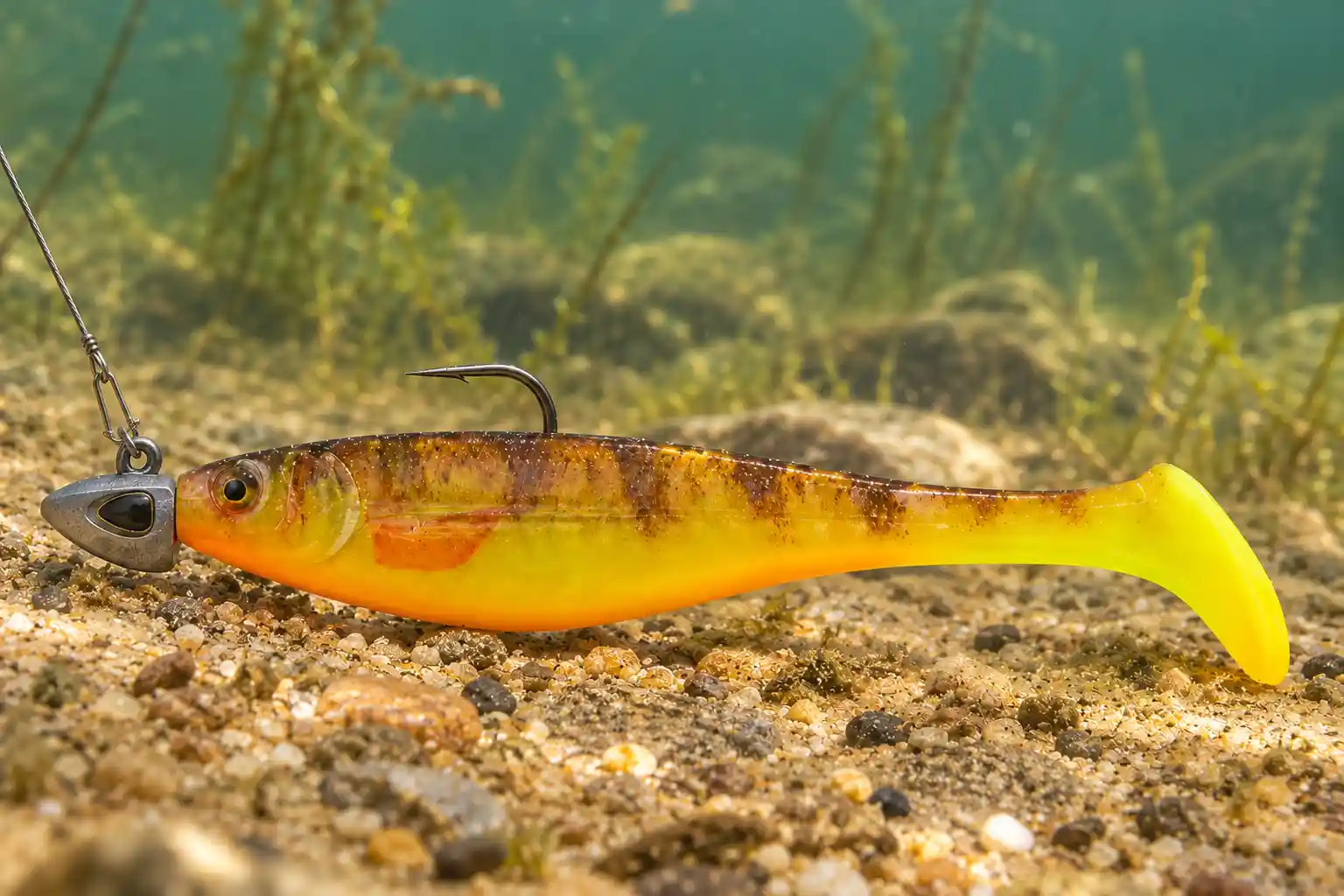
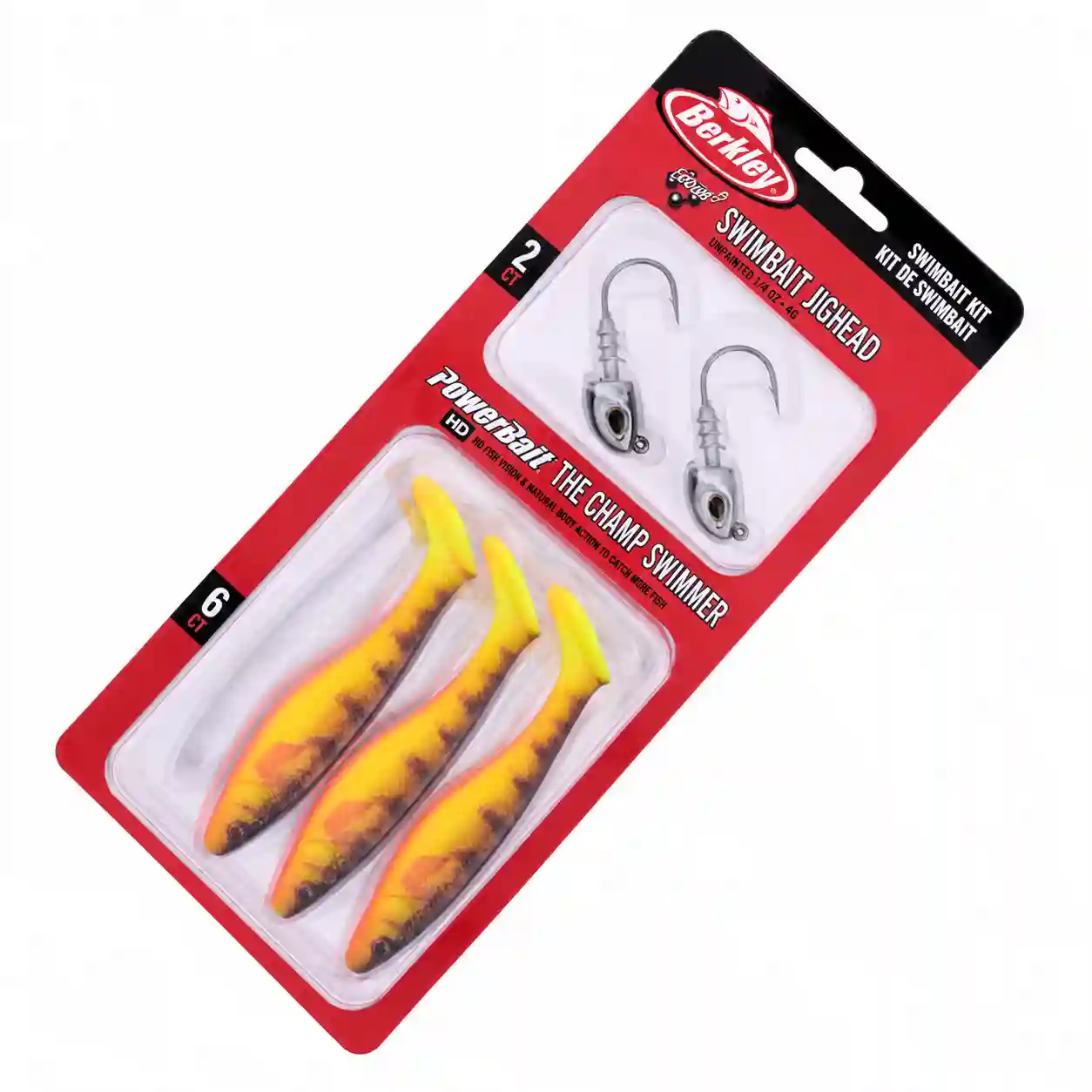
The Berkley PowerBait The Champ Swimmer 4.6″ Kit comes with baits in HD Fire Perch and HD Purple Smelt, plus two Berkley Fusion19 swimbait jig heads with 4/0 hooks. Its strength is realism: in clear water, when a pike has time to look the bait over, the detailed HD finish and natural profile have made a real difference for us. It sits between the very soft baits above and the Z-Man in both action and durability.
Action & How to Retrieve
The body is more compact and the head firmer than on the Spark Shad or Keitech, which helps it hold a jig hook. The trade-off is that at a barely moving retrieve, the tail is slow to start and lacks the sensitivity of the softest baits. At a normal slow retrieve, though, the large paddle tail kicks hard and rolls the whole body, with a very stable swimming action.
Most of our takes came on a steady, even retrieve through the middle of the water column or just over the weeds. The strikes on this bait have been confident, hard hits on the move rather than small taps. We put that down partly to the strong tail and partly to the PowerBait scent, which seems to make pike hold on rather than let go.
When It Works Best
Choose it for clear water and pike that still follow a moving bait. We have fished it mostly at 2–4.5 m (7–15 ft), on transition zones and open spots around submerged stumps and weeds. When the water is at its coldest and pike will only take a bait crawled along the bottom, the Spark Shad or Keitech is the better choice.
Jig Head
The flat back works well with both exposed and weedless hooks. We have used 4/0 hooks with heads of 12–16 g, depending on wind, which matches the 4/0 Fusion19 heads supplied in this kit.
Durability and Handling
The firmer plastic pays off here. In our experience, one Champ Swimmer survives three to five solid pike before the head starts to tear at the hook. That is well ahead of the Keitech, although nowhere near the Z-Man.
Two small things to know. After sitting in a cold tackle box, the plastic gets noticeably stiff, so it helps to keep a few in a jacket pocket before you rig them. And the PowerBait scent is strong and oily: after re-rigging, your hands will smell for hours, so bring wipes.
Savage Gear 3D Fat T-Tail Minnow 5″ Motor Oil – Our Pick After a Cold Front
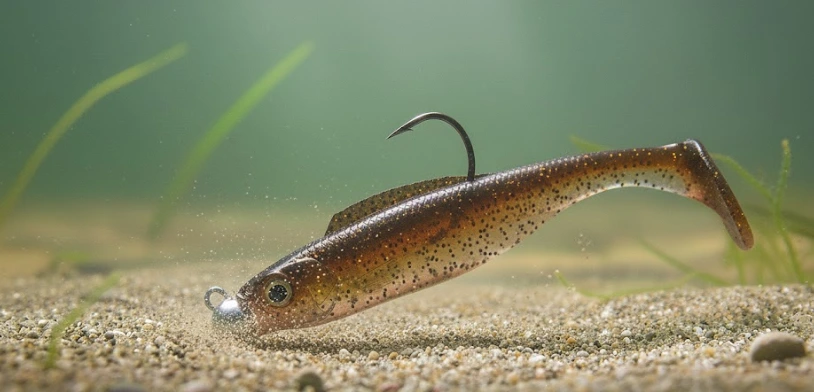
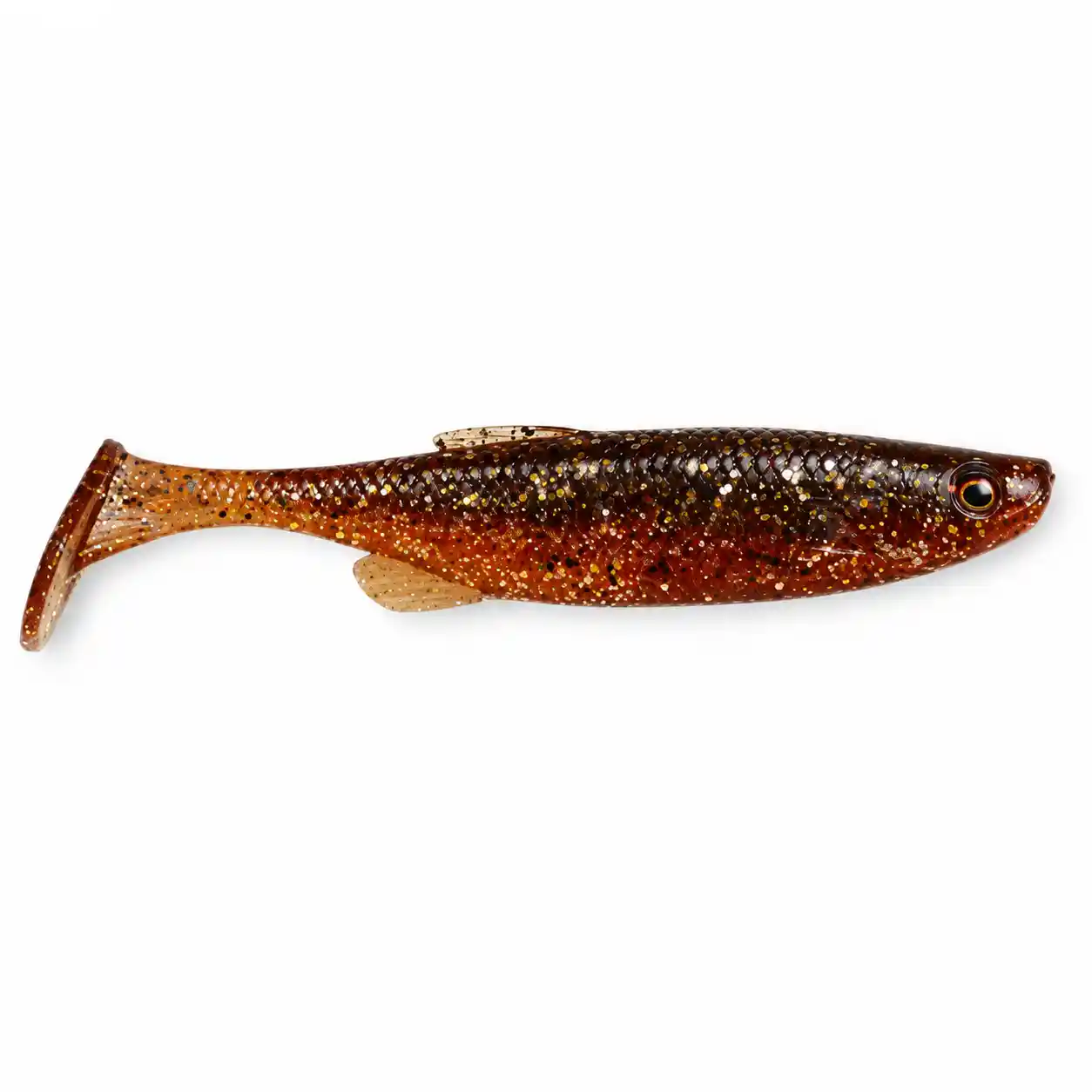
The Savage Gear 3D Fat T-Tail Minnow 5″ Motor Oil is the bait we reach for when a cold front has pushed pike tight to the bottom. In clear to slightly stained water after a front, its dark Motor Oil color, wide body and deep, slow vibration have repeatedly drawn takes from lethargic pike that ignored more aggressive presentations. It looks like an easy meal without looking like a threat.
Action & How to Retrieve
The fat body moves noticeably more water than slimmer shads. On a slow retrieve, the whole bait rolls from side to side while the tail beats more slowly but more deeply. It does need a minimum of speed: on a dead-slow crawl it can stall, but at a steady, moderately slow pace it swims with a strong action that pulls pike in from a distance.
The body also has a slot in the belly for a rattle insert. We fish it with a rattle in, and in murky water the added sound has made a real difference in helping pike find the bait.
Across all our sessions, most takes came on a steady retrieve through the middle of the water column or just over the weeds, and again as the bait started to rise after a pause. After a cold front, when pike sit close to the bottom, we slow down and keep the bait nearer to them. That moderate, slow pace still keeps the body rolling, and it is what has worked on those days. Because it moves so much water, the hits are rarely small taps. When a pike commits, the strike comes hard and straight into the rod.
Best Locations (Where It Works Best)
We have fished it mostly at 2.5–5 m (8–16 ft), deeper than the other baits on this list:
- deeper flats
- edges of old river channels
- submerged structure
Recommended Jig Head
The 5-inch body needs a strong, wide-gap 4/0 or 5/0 hook. Because the bulky profile catches water, we have used heavier heads than with the other baits: 14–20 g, going to the top of that range in wind or current to keep the bait under control.
What to Watch For
Durability sits in the middle of this list. In our experience, one bait handles two to four small or medium pike before the teeth do too much damage around the head. It does not split after the first fish like the Keitech, but it is nowhere near as tough as the Z-Man, and after a few fish a drop of glue helps keep it from sliding down the hook on the cast.
The thick back can tear when a pike clamps down from the side. The bait is also sensitive to rigging: if the jig head is not perfectly centered, it loses balance and rolls over on a faster retrieve. Take an extra moment to rig it straight.
Winter Soft Swimbaits for Pike Compared
| Swimbait | Best For | Jig Head We Used | Pike per Bait (Our Experience) | Ideal Scenario |
|---|---|---|---|---|
| Megabass Spark Shad 4″ Ayu | Ultra-Slow Retrieves | 10–15 g, 2/0–3/0 | 1–3 | Cold, inactive pike that only take a bait crawled near the bottom |
| Keitech Swing Impact FAT 4.8″ | Stained Water | 10–14 g, 4/0–5/0 | 1–3 | Lift-and-drop along weed edges when visibility is low |
| Z-MAN DieZel MinnowZ 5″ | Durability | 12–18 g, 4/0–5/0, wire keeper | 10–20+ | Long sessions covering water without re-rigging |
| Berkley Champ Swimmer 4.6″ Kit | Clear Water | 12–16 g, 4/0 | 3–5 | Steady retrieves for pike that inspect a bait before eating |
| Savage Gear 3D Fat T-Tail Minnow 5″ | After a Cold Front | 14–20 g, 4/0–5/0 | 2–4 | Deeper flats and channel edges when pike sit tight to the bottom |
No single swimbait covers every cold-water situation. We carry at least one very soft bait for the slowest days and the Z-Man for long sessions, then add the others to match water clarity. When pike want a more erratic presentation, switch to winter jerkbait lures, and when they sit deep, heavy spoons for pike get down faster.
Slow presentations also depend on your gear. A rod with a sensitive tip helps you feel a tail that is barely working, and a reel with a smooth drag in the cold matters when a pike hits close to the boat. Our winter pike rods and cold-water pike reels roundups cover both.
Frequently Asked Questions (FAQ)
Do soft swimbaits work for pike in cold water?
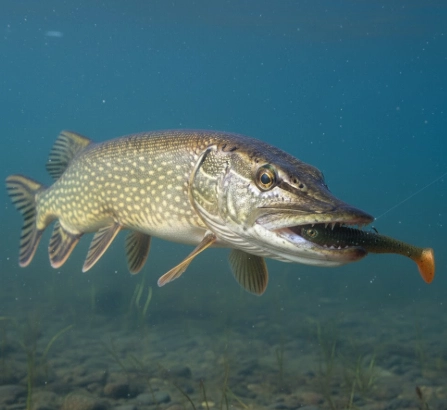
Yes. A soft swimbait lets you slow down and fish close to the bottom while keeping a natural baitfish profile. The key is matching the bait to your speed: some baits keep working at a crawl, while others need a steady, slow retrieve.
What size soft swimbait is best for winter pike?
We use 4–5 inch swimbaits in cold water. That size gives a clear profile without being too much for a slow, neutral pike. Bulkier 5-inch baits also move more water, which helps in stained conditions.
How slow should you retrieve a winter swimbait?
It depends on the bait. The softest baits, such as the Megabass Spark Shad, keep their tail working even when you barely turn the handle. In our fishing, the Z-Man, Berkley and Savage Gear performed best at a steady, moderately slow retrieve.
What jig head weight should you use for cold-water pike swimbaits?
In our fishing at roughly 2–5 m (7–16 ft), heads of 10–20 g covered most situations. Use the lighter end for slimmer 4-inch baits and calm water, and go heavier for bulky 5-inch baits, wind or current.
How many pike does a soft swimbait last?
It varies a lot by material. In our experience, very soft baits last one to three pike, mid-range plastics two to five, and Z-Man’s ElaZtech DieZel MinnowZ ten to more than twenty.
Do you need a leader with soft swimbaits for pike?
Yes. Pike teeth cut braid and mono easily, and a swimbait is often taken deep. Use a steel leader or a thick fluorocarbon leader of at least 0.80 mm (0.031 in) in front of the jig head.
Winter Swimbait Summary & Key Takeaways
Choose your cold-water swimbait to match the presentation. The Spark Shad is our pick for ultra-slow retrieves, the Keitech for stronger vibration, and the Z-Man for durability. The Berkley offers a detailed baitfish finish, while the Savage Gear gives us a broader profile and rolling action.
Start with the retrieve and jig head combinations described above, then adjust to your depth, water clarity and the response of the fish. Keep the tail working and fish at the depth where you are finding pike, whether that is near the bottom, above weeds or higher in the water column.
For general species information, see the U.S. Fish & Wildlife Service northern pike profile.
And when you land a good fish, feel free to share your catch with us on the Master Fishing Guide Facebook Page.