

How Far Do Pike Travel? What Tracking Studies Reveal
How far do pike travel? Northern pike often return to familiar areas, but they also move kilometers between habitats. How far depends on the season, the water and the individual fish. No single number fits every pike.
In a Canadian winter study, pike tracked for seven full days after catch and release covered recorded paths of 1.4–18.4 km (0.9–11.4 miles). In England’s River Bure network, the widest-ranging pike used a stretch of river longer than 26 km (16 miles). The two numbers measure different things, and we explain the difference below.
On an early-spring outing, we found active pike along shallow reed beds in 4–5 ft (1.2–1.5 m) of water during the morning. By midday, we were no longer finding fish there. Later, we located pike near a 12 ft (3.7 m) drop-off a few hundred yards away. We could not confirm they were the same individuals, but the session showed why we check neighboring habitats when a productive area goes quiet.
About this review: We compare published field studies and explain what each distance actually measures. Our practical interpretation for anglers is marked separately from the research findings. The tracking data come from the researchers we cite, not from an MFG tracking project.
Travel Distance, Home Range and Displacement: What Is the Difference?
A pike can swim a considerable distance without ending up far from where it started. To compare tracking studies correctly, we need to separate three measurements.
Cumulative Travel Distance: The Recorded Path
This is the sum of movements between successive recorded locations. Trips back and forth count each time. Tracking does not necessarily capture every turn between detections, so the recorded path may underestimate the actual distance swum.
The Canadian ice study measured this kind of distance. The 1.4–18.4 km (0.9–11.4 miles) figures are recorded paths from manual acoustic tracking over seven days, not the size of the area each pike used. Somers et al. (2021)
Home Range: The Space a Pike Uses
A home range describes the area a fish uses during a defined period. In rivers, researchers sometimes use the length of the occupied stretch as a proxy for home range. This does not mean the fish defends the entire stretch as its territory.
In the River Bure study, total range was the river distance between the farthest receivers that detected an individual pike. The longest span, 26.1 km (16.2 miles), was therefore a measure of spatial extent, not the total distance the fish swam. Cittadino et al. (2024)
Displacement: The Distance Between Locations
Displacement describes the separation between locations, such as a release point and a later detection. Researchers may measure a straight line or calculate a route through water. The distinction matters because a straight line can cross land.
The Baltic study calculated capture-to-recapture distances using the shortest available route through water. That measurement does not reveal every movement made between the two captures. Lukyanova et al. (2026)
One Fish, Three Different Numbers
Imagine a pike making five return trips between two points 1 km (0.6 miles) apart along a straight channel. It would cover 10 km (6.2 miles), use a 1 km (0.6-mile) stretch and finish with zero displacement from its starting point.
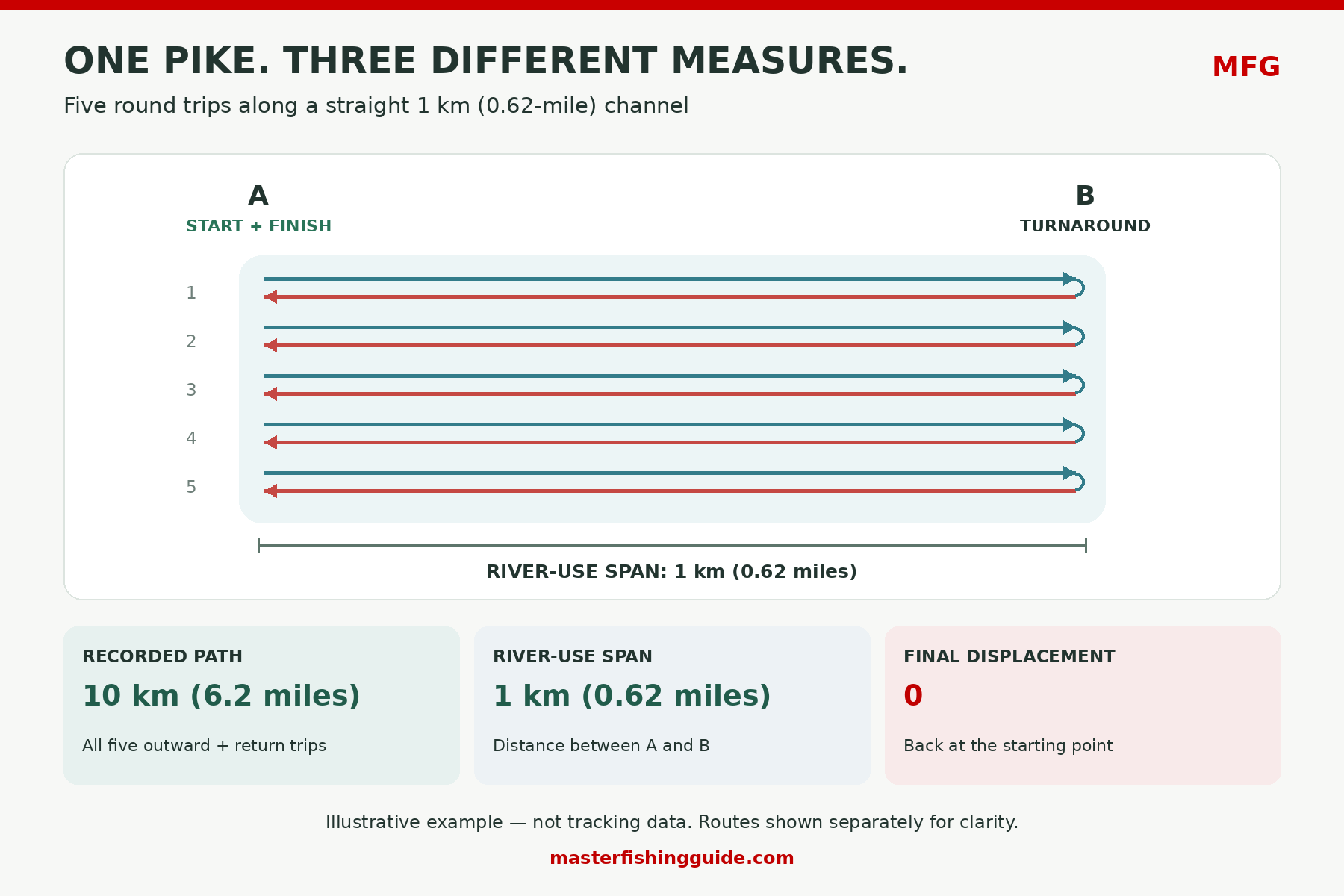
The River Bure study also illustrates why these measurements should not be confused. Across the analyzed fish, the maximum recorded river-use span was 26.1 km (16.2 miles), while the maximum cumulative movement estimate reached 1,182.3 km (734.6 miles). These are separate maxima, not necessarily measurements from the same fish. Tracking periods ranged from 3 to 931 days, so the cumulative figure should not be interpreted as a daily or annual travel rate. Cittadino et al. (2024)
When quoting a movement figure, include what was measured and over what period. A weekly path, a river-use span and a capture-to-recapture distance answer different questions.
Northern Pike Tracking Studies Compared
The studies below measured different aspects of pike movement. We list the method, observation period and distance type alongside each result so the figures can be compared without treating them as equivalent.
Years refer to publication dates, not necessarily when the fish were tracked. Sample sizes differ between tagging and analysis where some fish did not provide enough usable data.
| Study and water type | Tracking method and duration | Measured distance or range | Key finding and limitation |
|---|---|---|---|
| Buffalo Pound Lake, Canada, 2021 Lake under ice. Somers et al. | Manual acoustic tracking of 15 pike for up to 7 days after catch and release. | Cumulative recorded path: 1.4–18.4 km (0.9–11.4 miles) among fish tracked for all seven days. | Substantial movement occurred under ice. This was a short study of recently released fish, not a measurement of undisturbed behavior throughout winter. |
| River Bure network, England, 2024 Connected rivers, shallow lakes and channels. Cittadino et al. | Fixed acoustic receivers; 44 pike tagged, 41 analyzed. Individual tracking periods ranged from 3–931 days. | River-use span: 1.5–26.1 km (0.9–16.2 miles), measured along the river between the farthest detecting receivers. | Space use varied widely between individuals. The span was a proxy for home range; unequal tracking periods and receiver coverage affect comparisons. |
| Southern Baltic Sea, Germany, 2026 Brackish lagoons and connected tributaries. Lukyanova et al. | Mark–recapture and acoustic telemetry; 318 pike acoustically tagged. Of these, 292 provided detection records, averaging 439 days between first and last detection, with a maximum of 1,065 days. Final telemetry analyses included 242 fish. | Capture-to-recapture distance through water: median 2.6 km (1.6 miles), maximum 58.6 km (36.4 miles), based on 546 fish with suitable recapture, length and sex data. | The distances come from the recapture dataset, not cumulative telemetry paths. Individual movement patterns showed consistency across years; body size did not explain the modeled movement metrics. |
| River Ourthe, Belgium, 2005 River system. Ovidio and Philippart | Radio tracking of 6 pike for 149–349 days. | Upstream migration distance: 0.75–15.7 km (0.5–9.8 miles) toward potential spawning sites. | The pike moved back downstream after spawning, though not all returned to their capture area. The small sample describes one river population, and the destinations were identified as potential spawning sites. |
| Kabetogama Lake, Minnesota, 2001 Large lake with separate spawning sites. Miller et al. | Mark–recapture of 1,900 pike tagged at two spawning sites, with recaptures over the following 4 years, plus genetic analysis. | Spawning-site recapture: 23% recaptured on spawning grounds; only 1.3% and 4.8% were recaptured at the other site. | Strong spawning-site fidelity despite overlapping year-round ranges. This measures where fish returned to spawn, not how far they traveled between spawning seasons. |
| Lower River Severn, England, 2024 Regulated river with an off-channel marina. Nolan et al. | Fixed acoustic receivers over approximately 12 months; 17 pike tagged. The daily-movement figure in the paper reports 16 pike. | Mean recorded daily movement: 245 m (804 ft), with a reported 95% confidence interval of ±108 m (354 ft). | Daily movement was higher in spring. Receiver-based estimates describe detected movements in this modified river, not every movement made by each fish. |
How to use this table: the longest result in a study is not a typical distance for every pike, and these figures should not be averaged into a single daily travel estimate.
How Far Do Pike Travel from Their Usual Holding Areas?
Being an ambush predator describes how a pike hunts, not how far it travels. A pike can return to the same area again and again and still make trips to other habitats. It does not spend its life beside one weed bed.
The lower River Severn study provides an example. Researchers recorded 78% of northern pike detections at the receiver inside an off-channel marina. However, in early March, three pike were also detected 8.8 km (5.5 miles) downstream before returning upstream. The same population that favored the marina also made long trips. Nolan et al. (2024)
That detection percentage needs context. It is the share of recorded detections, not proof that the fish spent exactly 78% of their time in the marina. Receiver coverage and the likelihood of detecting a tag affect the records.
In the River Bure network, most tracked pike remained in the river where they were originally caught, although some fish from the Ant and Thurne tributaries were detected in the main Bure. Some pike stay close and others roam. That is an individual trait, not a rule for the species. Cittadino et al. (2024)
Our practical interpretation: keep productive spots in your fishing plan, but consider the routes and neighboring habitats connected to them. A fish finder makes those nearby edges and drop-offs much easier to locate. A quiet session alone cannot tell you whether pike have moved away or are still there but not taking your bait.
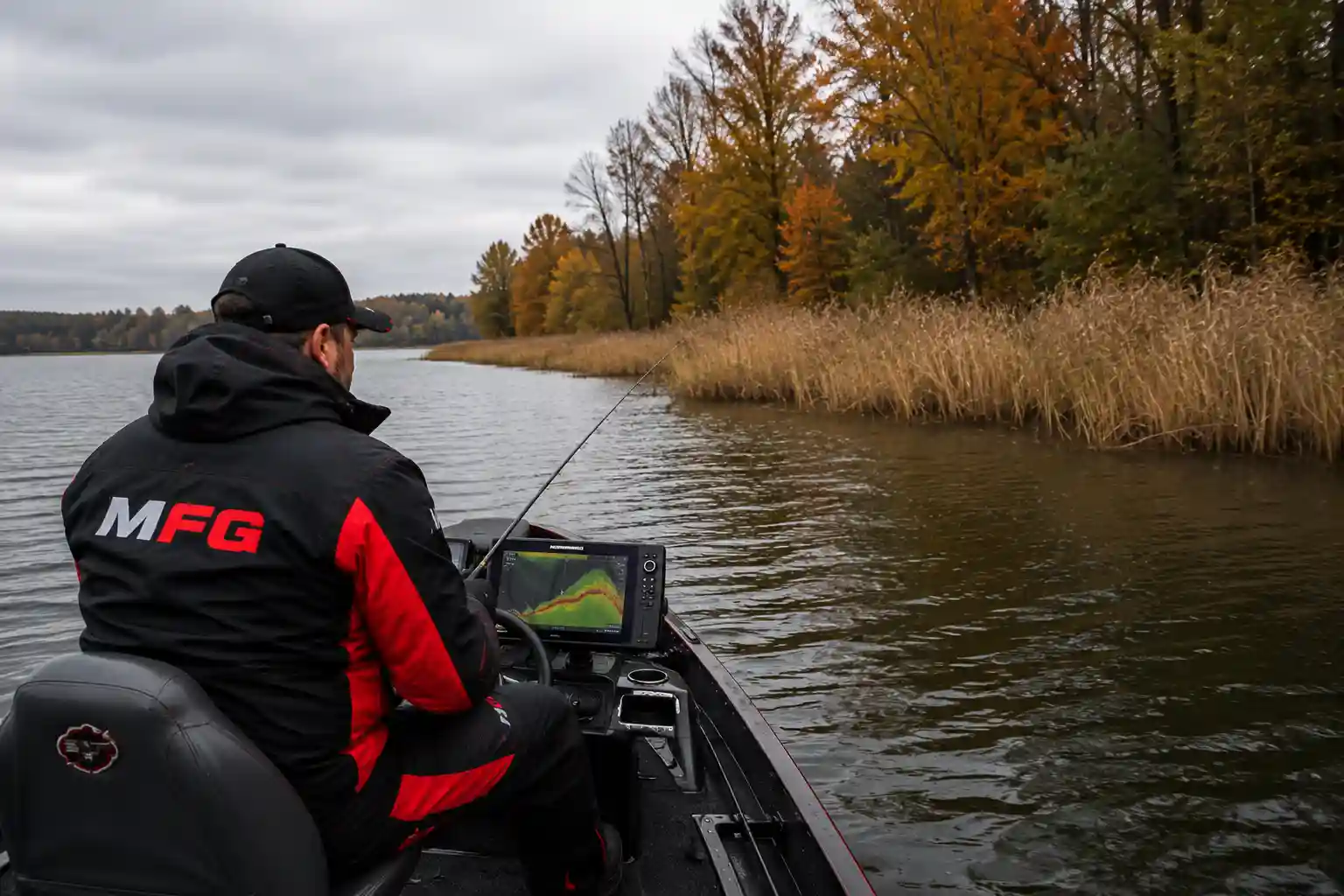
When a productive spot suddenly goes dead, we never start the motor right away. First, we slow the retrieve and add longer pauses to see whether the fish are still there but hesitant to chase. If that fails, we switch to a slightly heavier lure or a deeper-diving profile and probe the first drop-off just outside the weedline. In our experience, pike often slide a few feet (around a meter) deeper when light or boat pressure changes. Only after working that deeper edge without a follow do we assume the fish have relocated and move on to search new water.
How Far Do Pike Move in Winter?
Ice cover does not mean pike stop moving. Anyone ice fishing for pike benefits from knowing this. In Buffalo Pound Lake, Saskatchewan, researchers followed 15 northern pike using manual acoustic tracking for up to seven days after catch and release. The fish measured 56–98.5 cm (22–38.8 in) in total length. Somers et al. (2021)
Among fish tracked for the full week, cumulative recorded paths ranged from 1.4–18.4 km (0.9–11.4 miles). Minimum daily distances ranged from 0–4.6 km (0–2.9 miles). These are minimum distances: a fish could have swum farther between recorded positions. These were accumulated movements, not necessarily journeys directly away from the capture location.
Body size did not give a simple answer. Over the first two days, larger pike moved shorter daily distances and stayed closer to the release site. By day five, however, both the largest and the smallest fish had dispersed the farthest, while intermediate-sized fish stayed closest.
The important limitation is that these fish had recently been caught and released. The results demonstrate substantial movement under ice in that setting; they do not establish how far undisturbed pike normally travel each winter day.
Other research also shows why winter movement needs local context. In the lower River Severn study, the probability of detecting movement was significantly lower in winter, while mean daily movement was higher in spring. An ice-covered Canadian lake and an English river should not be expected to produce identical patterns. For more on how cold water changes pike activity, see our winter pike behavior article. Nolan et al. (2024)
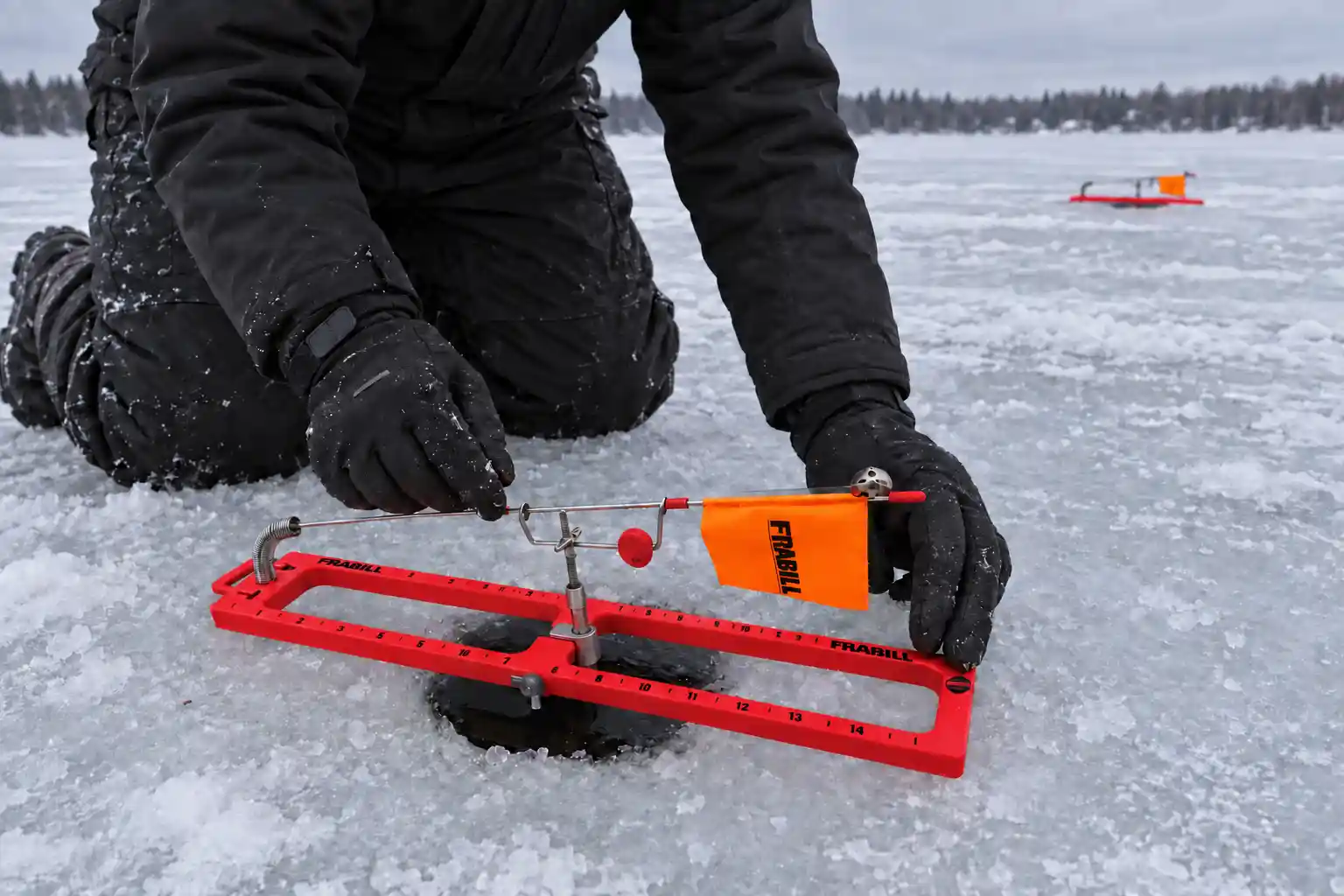
Fishing tip-ups through the ice has shown us how much pike move in winter. We have sat through hours of complete silence on our best shallow weed edges, only to have flags start popping one after another on our deepest sets over the open basin, several hundred yards (a few hundred meters) away. When pike hit baits that far from classic cover, it suggests at least some of them are not sitting motionless in the weeds all winter but cruising open water under the ice while they hunt.
Our practical interpretation: a slow presentation and a wide search are not opposites. On the ice, that means spreading tip-ups across both the weed edge and deeper open water rather than stacking every set on one spot. On open water, the same idea applies to winter pike fishing from a boat or shore. Still, a long recorded swimming path does not prove that constantly changing spots produces more bites.
Do Bigger Pike Travel Farther?
A larger pike does not automatically travel farther than a smaller one. The relationship between body size and movement depends on the population, the habitat and the measurement being analyzed. As the winter study above showed, the answer can even change from day to day after release.
In the southern Baltic study, researchers found no body-length effect on the movement metrics they modeled, including capture-to-recapture distance, maximum horizontal displacement and connectivity between receiver locations. Larger fish were not consistently the individuals linking more parts of the lagoon network. Lukyanova et al. (2026)
What mattered more was the individual fish. The same pike tended to be wide-rangers or homebodies year after year. However, males had greater maximum horizontal displacement outside the spawning season, so sex is not irrelevant either.
The River Bure study produced a more context-dependent result. Body length did not significantly explain total river-use span, but statistical models linked larger size with greater cumulative movement, with a location-specific effect in the Thurne tributary. A fish can accumulate more movement without using a wider stretch of river. Cittadino et al. (2024)
The Bure researchers suggested that movements of larger pike might be associated with their use of mobile prey such as common bream. However, they could not directly test whether the tagged pike were following bream shoals. That explanation remains a hypothesis rather than a demonstrated cause.
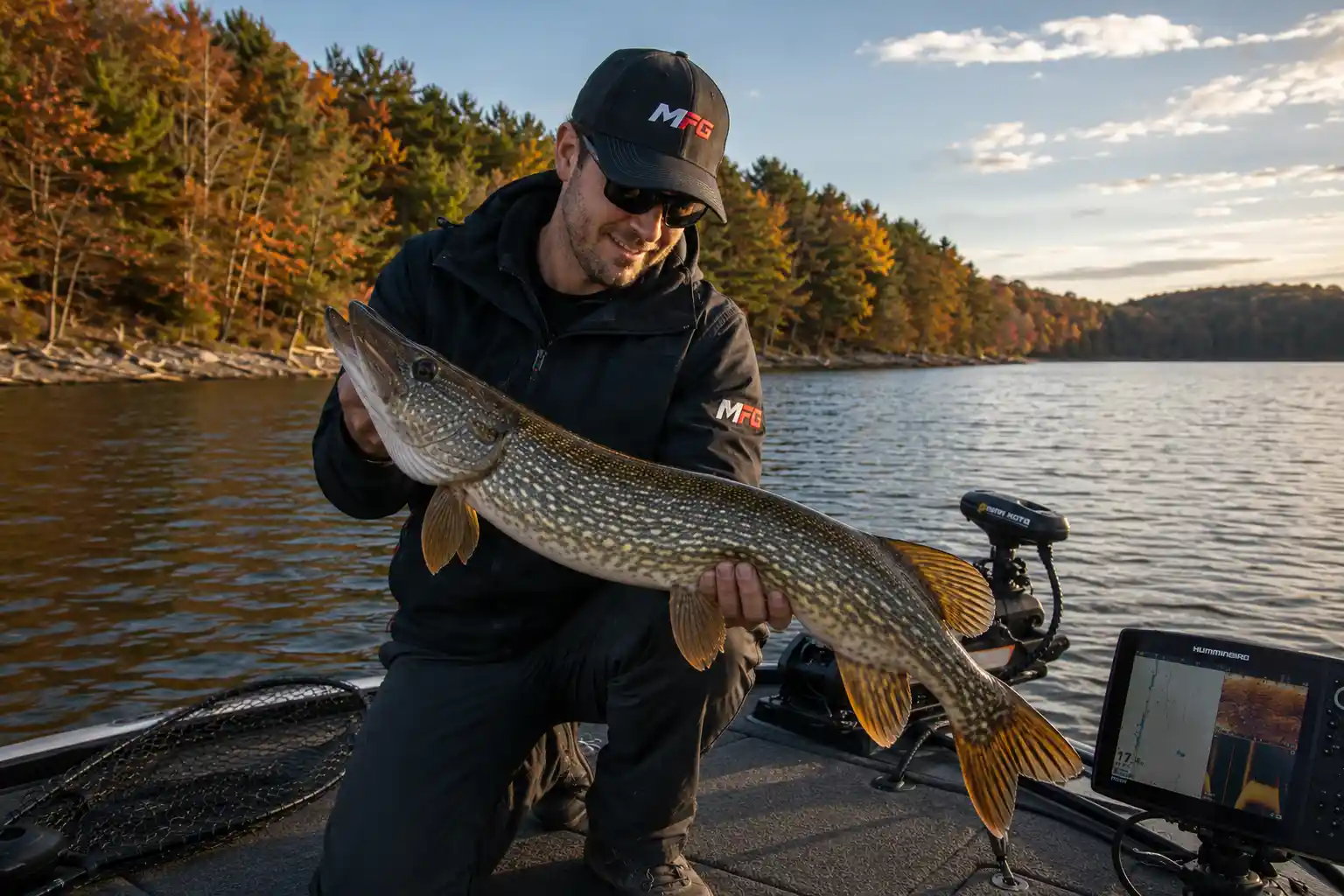
In our time on the water, the biggest difference with larger pike has not been how far they roam, but where they choose to hold. We have often found smaller “hammer-handle” pike around shallow weedlines and tight cover. Our better fish have consistently come from deeper drop-offs and open-water basins just outside those bays, and almost always on larger baits that smaller pike rarely bother to chase.
Our practical interpretation: do not assume that searching farther automatically puts you in front of larger pike. These studies measured movement, not the success of trophy-fishing tactics. If bigger fish are the goal, changing the type of water and the size of the bait, for example with heavy spoons for big pike on deeper edges, makes more sense to us than simply covering more distance.
How Does Pike Movement Change During Spawning?
Spawning can take pike beyond their usual holding areas. The distance depends on where suitable pike spawning habitat lies and whether fish can reach it through connected waterways.
In Belgium’s River Ourthe, researchers radio-tracked six northern pike for 149–349 days. All six made upstream movements toward potential spawning sites, covering 0.75–15.7 km (0.5–9.8 miles). These were seasonal migrations, not estimates of ordinary daily travel. Ovidio and Philippart (2005)
The upstream migrations began between February 8 and March 30, when mean water temperatures ranged from 6.7–8.7°C (44.1–47.7°F). Those observations describe one river population in one study year; they should not be treated as universal dates or temperature thresholds for pike migration.
After the spawning period, the fish moved downstream again. Some returned to previously used areas, while others settled between their capture and spawning locations or farther downstream. A spawning migration did not always end with a return to the original capture spot. Where pike settle in the weeks after spawning is covered in our post-spawn pike article.
The River Bure study also recorded a seasonal expansion in space use: total river-use range was, on average, 36% greater during the designated spawning season. However, the receiver network could not reliably identify the actual spawning sites. The result demonstrates a wider recorded range during that period, rather than confirming where each fish reproduced. Cittadino et al. (2024)
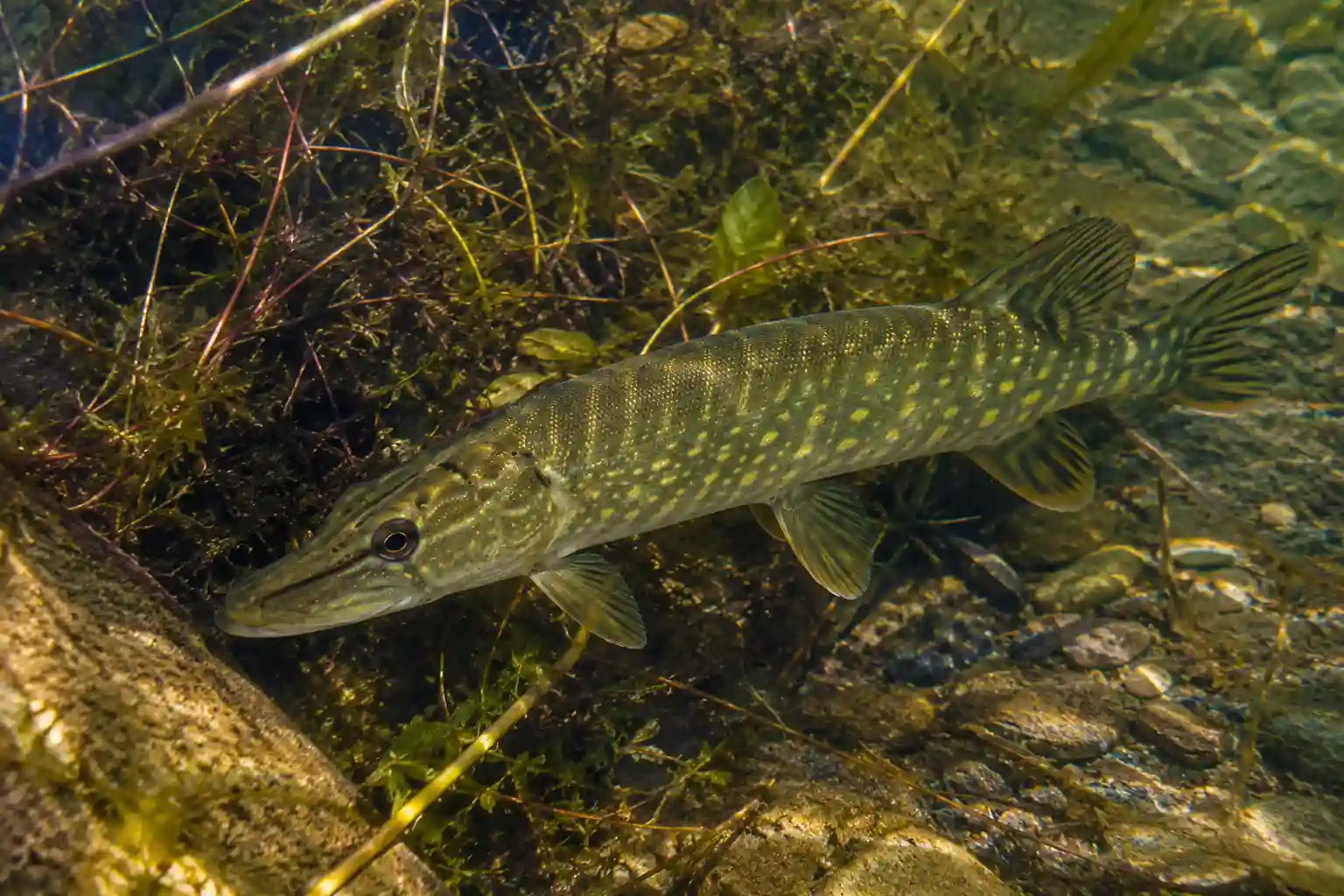
We see this seasonal shift most clearly around ice-out and early spring. We have found pike concentrated in the shallowest flooded backwaters and muddy bays that warm up first, only for those same spots to look completely empty a few weeks later. Once spawning wraps up, we typically find them back out on the first deeper weed edges and main-lake points just outside those spawning bays, where they are willing to hit baits as baitfish move through.
Our practical interpretation: a familiar location going quiet in spring may simply mean the fish have shifted to other parts of the system for the season. Check how the area connects to tributaries, side channels and the spring pike locations just outside the spawning bays. The first deeper edges are where we look first, but the research shows not every fish follows the same route afterward.
Follow local fishing closures and avoid disturbing actively spawning fish; movement toward a spawning area is not evidence that the fish are feeding.
Do Pike Return to the Same Areas?
Yes. Pike can travel between habitats and still return to familiar spawning grounds. This repeated use of a location is called site fidelity; it does not mean a fish stays there all year.
In Kabetogama Lake, Minnesota, researchers marked 1,900 northern pike at two spawning sites. Over the following four years, 23% were recaptured on spawning grounds. Among recaptured fish originally marked at the two sites, only 1.3% and 4.8%, respectively, were recaptured at the other site. Angler returns showed overlapping year-round ranges, so the spawning-site pattern could not be explained simply by the groups remaining geographically separated. Miller et al. (2001)
The same study added genetic evidence. DNA differences between the two spawning groups pointed to low gene flow, which the authors linked to natal-site fidelity: most pike likely first spawn where they were born and keep returning there.
Other studies point the same way. In Belgium’s River Ourthe, one tracked pike returned to its March spawning site in early December, months before the next spawning season. Ovidio and Philippart (2005) In the southern Baltic, spawning-site fidelity followed the same pattern as movement: it varied with the individual fish, not with body size. Lukyanova et al. (2026)
Tracking data show that pike can cover long distances, but on the waters we fish year after year, seasonal spots stay remarkably predictable. We have specific shallow bays that reliably produce fish every early spring and certain deeper weed edges that hold them every autumn. That is not necessarily because the exact same fish never left, but because those spots consistently offer the right temperature, cover and baitfish when that season comes back around.
Our practical interpretation: a productive area is worth recording and revisiting in comparable seasonal conditions, especially around the best time to catch pike in spring. Site fidelity, however, does not guarantee that the same fish will occupy the same spot on your next trip.
How We Reviewed the Research
We selected six field studies covering winter movement, river-use ranges, spawning migrations and site fidelity. This is a focused research review, not a systematic review or meta-analysis. We checked original publisher pages, an author-deposited paper and conference proceedings hosted by the FAO; for the Canadian winter study and the Minnesota site-fidelity study, we used the publicly available abstracts.
Throughout this article, we distinguish recorded paths from spatial ranges and note differences in tracking duration and sample size. Our angling interpretation is always marked separately from the researchers’ findings. Distances in miles and feet are rounded conversions. Studies and figures were last checked in November 2026.
Frequently Asked Questions
How far do pike travel in a day?
There is no universal daily distance. In England’s lower River Severn, pike moved an average of 245 m (804 ft) per day across a year of receiver data, with more movement in spring. In a Canadian winter study, daily distances after catch and release ranged from 0 to 4.6 km (0 to 2.9 miles). Daily movement depends on the season, the water and the individual fish.
Do pike move under the ice in winter?
Yes. In a Canadian study, pike tracked for a full week under the ice covered recorded paths of 1.4 to 18.4 km (0.9 to 11.4 miles). These fish had recently been caught and released, so the results show that pike can move substantially in winter, not how far undisturbed pike travel every winter week.
How far do pike travel to spawn?
It depends on where suitable spawning habitat lies. In Belgium’s River Ourthe, six tracked pike traveled 0.75 to 15.7 km (0.5 to 9.8 miles) upstream toward potential spawning sites, then moved back downstream after spawning.
Do bigger pike travel farther?
Not automatically. A large Baltic Sea study found no effect of body length on the movement measures it modeled. In England’s River Bure, larger pike accumulated more total movement, but body size did not explain how long a stretch of river they used.
Do pike stay in the same spot all year?
Not necessarily. Pike can repeatedly use familiar areas while moving between seasonal habitats. Many return to the same spawning grounds year after year, but returning to a spawning site does not mean remaining there throughout the year.
Does more movement mean pike are feeding more?
Not necessarily. Tracking records changes in location, but movement alone does not establish feeding. Fish may also move toward spawning areas or between other habitats. Greater travel distance does not automatically mean greater willingness to take a bait.
How to Cite This Page
If you use our comparison table or research summary in an article, report or forum post, please credit Master Fishing Guide and link to this page.
Jonic, A. (2026). How Far Do Pike Travel? What Tracking Studies Reveal. Master Fishing Guide. https://masterfishingguide.com/how-far-do-pike-travel/
For original findings, cite the individual studies below. When quoting a distance, include the measurement type and observation period.
Sources & Scientific References
- Somers, C. M., Goncin, U., Hamilton, S., Chupik, M., & Fisher, R. (2021). Chasing Northern Pike under Ice: Long-Distance Movements Following Catch-and-Release Ice Angling. North American Journal of Fisheries Management, 41(5), 1341–1350. DOI: 10.1002/nafm.10638.
- Cittadino, S., Tarkan, A. S., Aksu, S., Wright, R. M., Hindes, A. M., Lane, S., Winter, E., Lyons, J., & Britton, J. R. (2024). Individual variability in the movement ecology of Northern pike Esox lucius in a highly connected wetland system. Aquatic Sciences, 86, article 105. DOI: 10.1007/s00027-024-01124-4.
- Lukyanova, O., Arlinghaus, R., & Dhellemmes, F. (2026). Individual behavioural differences, not body size or sex, structure spatial connectivity in coastal northern pike (Esox lucius) in the southern Baltic Sea. Environmental Biology of Fishes, 109, article 132. DOI: 10.1007/s10641-026-01894-w.
- Ovidio, M., & Philippart, J.-C. (2005). Long range seasonal movements of northern pike (Esox lucius L.) in the barbel zone of the River Ourthe (River Meuse basin, Belgium). In M. T. Spedicato, G. Lembo & G. Marmulla (Eds.), Aquatic telemetry: advances and applications. FAO.
- Nolan, E. T., Hindes, A. M., Bolland, J. D., Davies, P., Gutmann Roberts, C., Tarkan, A. S., & Britton, J. R. (2025; first published online in 2024). Movements and habitat use of native and invasive piscivorous fishes in a temperate and channelized lowland river. Hydrobiologia, 852, 2187–2206. DOI: 10.1007/s10750-024-05533-2.
- Miller, L. M., Kallemeyn, L., & Senanan, W. (2001). Spawning-Site and Natal-Site Fidelity by Northern Pike in a Large Lake: Mark–Recapture and Genetic Evidence. Transactions of the American Fisheries Society, 130(2), 307–316. DOI: 10.1577/1548-8659(2001)130<0307:SSANSF>2.0.CO;2.