

Northern Pike Teeth: Anatomy, Tooth Replacement & Common Myths
Northern pike teeth are the subject of some persistent fishing myths — from the widely repeated claim that a pike has up to 700 teeth to the old story that pike shed their teeth in late summer and stop feeding until their sore gums heal. After years of unhooking pike in every season, we wanted to know what the evidence actually shows.
This guide covers where each type of tooth sits, how pike lose and replace teeth, and what a 1935 Michigan study of 188 pike found about seasonal tooth loss. For a broader overview of the species, see our northern pike species guide.
Quick Answer: What You Need to Know About Pike Teeth
- Pike have teeth well beyond their jaws. Besides the large lower-jaw teeth, there are small teeth at the front of the upper jaw, across the roof of the mouth and on the tongue.
- Pike replace teeth one at a time, not as a seasonal set. Each side of the lower jaw holds about 16 large canines, counting those still growing in — a figure for the canines only, not for every tooth in the mouth.
- There is no evidence of a late-summer shedding season. In the months the 1935 study sampled, the number of working and replacement canines stayed about the same.
- Summer pike keep eating. Stomachs from fish caught in July and August held about as much food as those from cooler months.
Where Pike Teeth Are and How They Differ
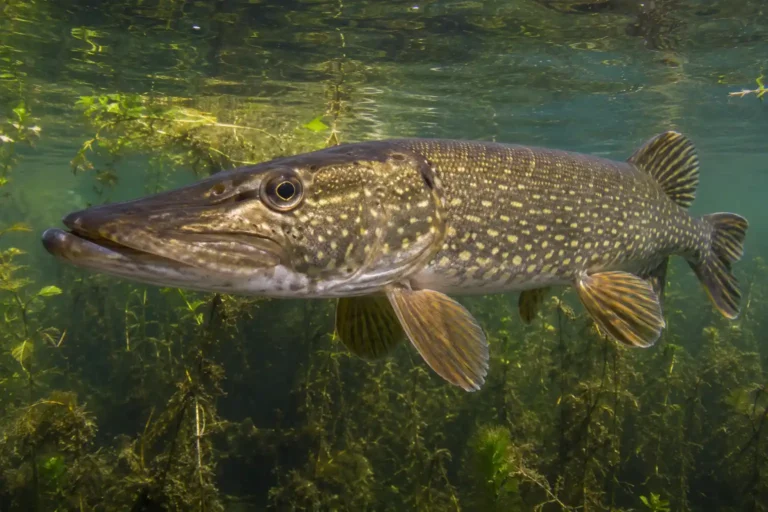
Look into a pike’s mouth and the big lower-jaw teeth catch the eye first, but they are only one of four toothed areas. The upper jaw, the roof of the mouth and the tongue all carry teeth of their own.
Lower Jaw: Small Front Teeth and Large Canines
The lower jaw carries a single row of teeth along each side. Near the front, the teeth are relatively small, hooked and rounded in cross-section. Those closest to the point where the two sides of the jaw meet can bend backward under pressure.
The larger canines occupy the rear two-thirds of each side of the lower jaw. These are the prominent teeth anglers usually notice when removing a hook. Unlike the smaller front teeth, they are flattened, with sharp tips and thin cutting edges.
In Michigan Research Report 310, Milton B. Trautman and Carl L. Hubbs described working canines interspersed with teeth undergoing replacement. An apparent gap does not necessarily mean a pike has permanently lost a tooth.
Upper Jaw: A Row of Smaller Teeth
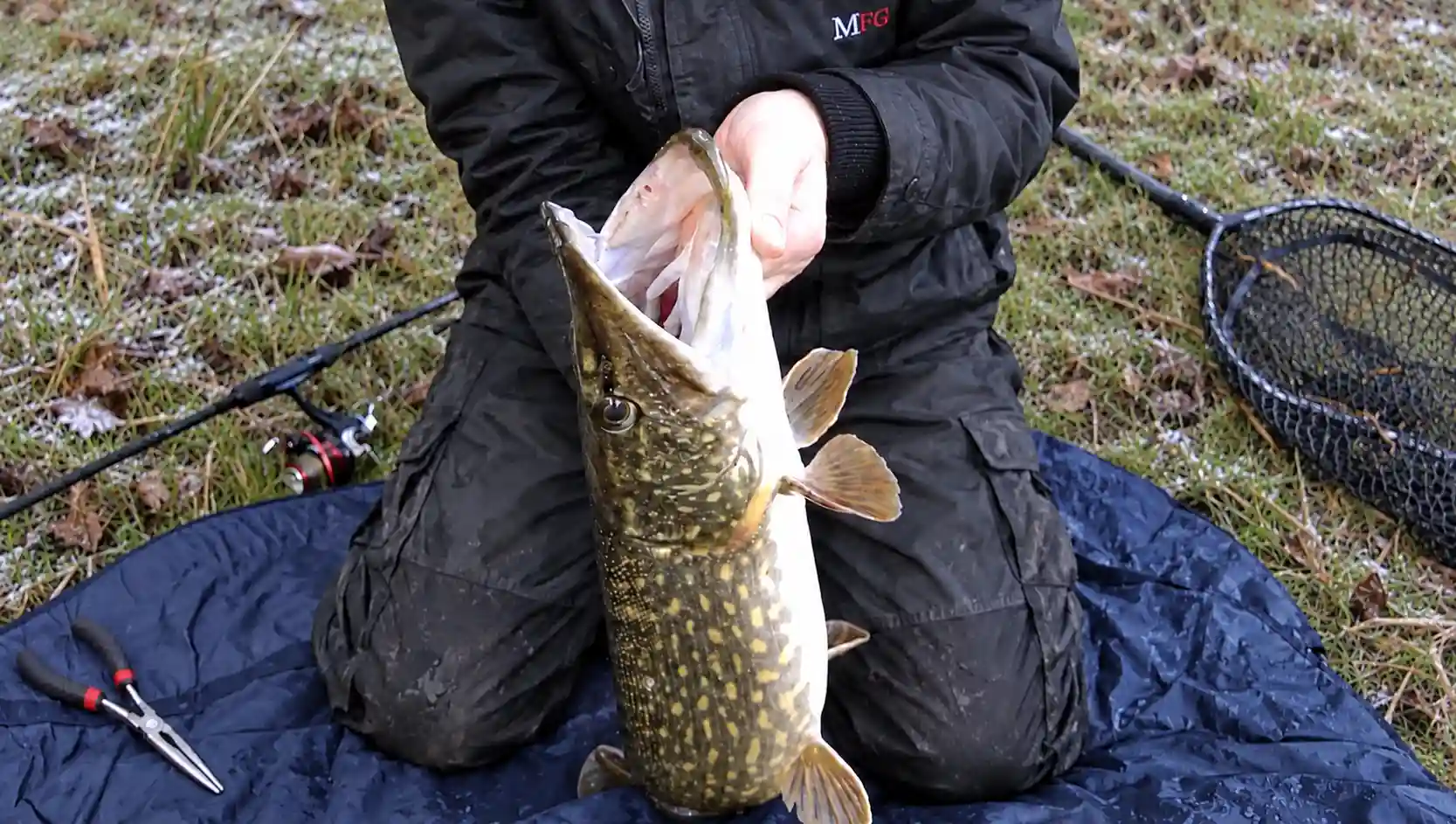
The front edge of the upper jaw has much smaller teeth. The report places them on the premaxillae, the paired bones at the front of the upper jaw, in a single row.
These small teeth are easy to overlook beside the lower-jaw canines, so a photograph showing only the large teeth reveals just part of a pike’s dental equipment.
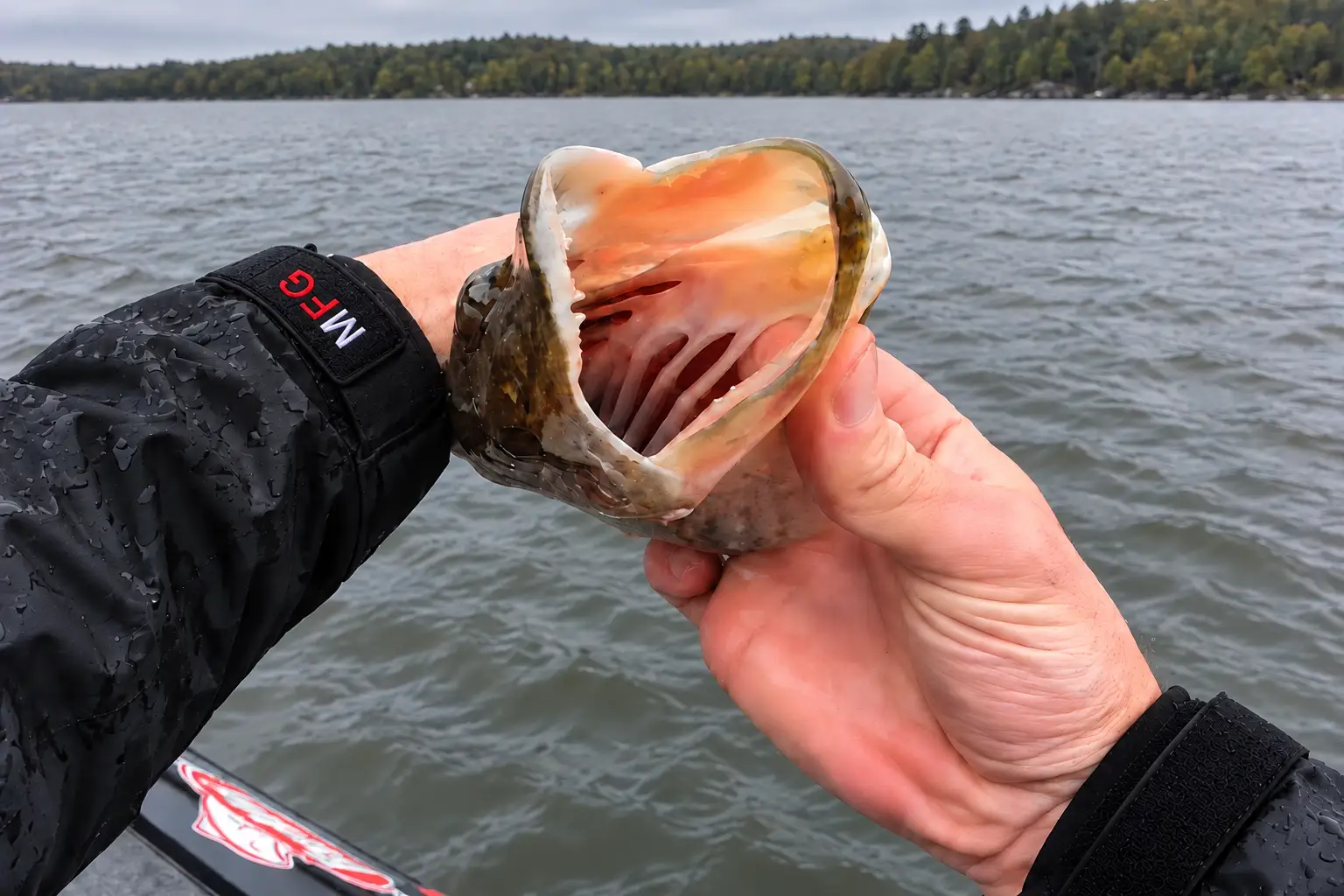
Roof of the Mouth: Fields of Depressible Teeth
The roof of the mouth carries numerous teeth that can bend down under pressure. They occur on the paired palatine bones and the vomer, the central bone in the roof of the mouth.
Their size varies across these surfaces, with particularly fine teeth toward the rear of the vomer. This arrangement helps explain why the inside of a pike’s mouth looks very different from a simple row of jaw teeth.
Tongue: Numerous Teeth and Taste Buds
The tongue also bears teeth. A microscopic study published in 2015 examined the tongues of five northern pike using light and scanning electron microscopy. It documented numerous teeth and scattered taste buds on the tongue surface.
The authors suggested that this combination supports both mechanical and sensory roles. A pike’s tongue should therefore not be pictured as a smooth surface like our own.
Only one of these groups visibly comes and goes. Trautman and Hubbs found the teeth on the roof of the mouth and the tongue always present in large numbers, with no obvious or extensive shedding or renewal at any time of year. The lower-jaw canines are the teeth that are lost and replaced in plain sight — and the ones their detailed counts focused on.
How Many Teeth Does a Northern Pike Have?
You will often read that a northern pike has between 300 and 700 teeth. The figure is repeated widely across fishing websites, but we could not find a primary study of Esox lucius that counted every tooth in the mouth and produced that range. It may be a reasonable rough estimate once the many small teeth on the roof of the mouth and tongue are included, but we have not been able to trace where it comes from.
What has been counted carefully is the group most anglers care about: the large canines on the lower jaw.
About 16 Canines on Each Side, at Any Size
Using dissection, so that teeth still growing in under the gum would not be missed, the 1935 study counted the canines on each lower jaw, including those being replaced. Five small pike, roughly 5 to 12 inches long, averaged 15.8 canines per jaw. Ten pike roughly 14 to 42 inches long averaged 15.9.
In other words, a big pike does not have more canines than a small one — its canines are bigger. As the jaw grows, each tooth position grows with it, which is why a three-foot pike has no more canine teeth than a five-inch one.
Why You Will Count Fewer on the Water
Counted without dissection, 178 adult pike averaged 11.9 canines per jaw, consistently about four short of the true number. Replacement teeth in early stages sit hidden in the gum, and a few tiny teeth behind the corner of the mouth are easy to miss.
Only part of those visible canines were actually in use. The same 178 pike averaged 6.8 working canines per jaw. Across the more than 200 fish examined, including northern pike, muskellunge and chain pickerel, none had three-quarters of its full canine complement in service. A row with gaps and half-grown teeth is the normal state of a healthy pike’s jaw, not a sign that something is wrong.
So the honest answer is that a pike has about 16 canine positions on each side of the lower jaw, plus many smaller teeth on the roof of the mouth and tongue that no source we found has precisely counted.
How Pike Lose and Replace Teeth
Every large lower-jaw canine has its own small section of the jaw, and it is lost and replaced there independently of its neighbors. Dissected jaws described in the 1935 report show how this works, and the authors compared it to the way a rattlesnake replaces its fangs — repeated about 16 times along each side of the lower jaw.
A Line of Replacement Teeth Behind Every Canine
The broad strip of gum covering the rear two-thirds of each lower jaw is divided internally by walls of connective tissue into about 16 sections. Inside each section sits a single file of teeth at different stages of development. The innermost is often just a sharp little tip. The outermost is either a tooth in service or one being prepared to take the place of a tooth that has been lost.
What Happens When a Canine Breaks
When a working canine breaks off, the pike first removes what is left. Its wide, flaring bony base is gradually resorbed until a bare, square patch of jawbone remains. The next tooth in line then moves into position and forms a new base, first from soft tissue that later hardens and fuses firmly to the jaw.
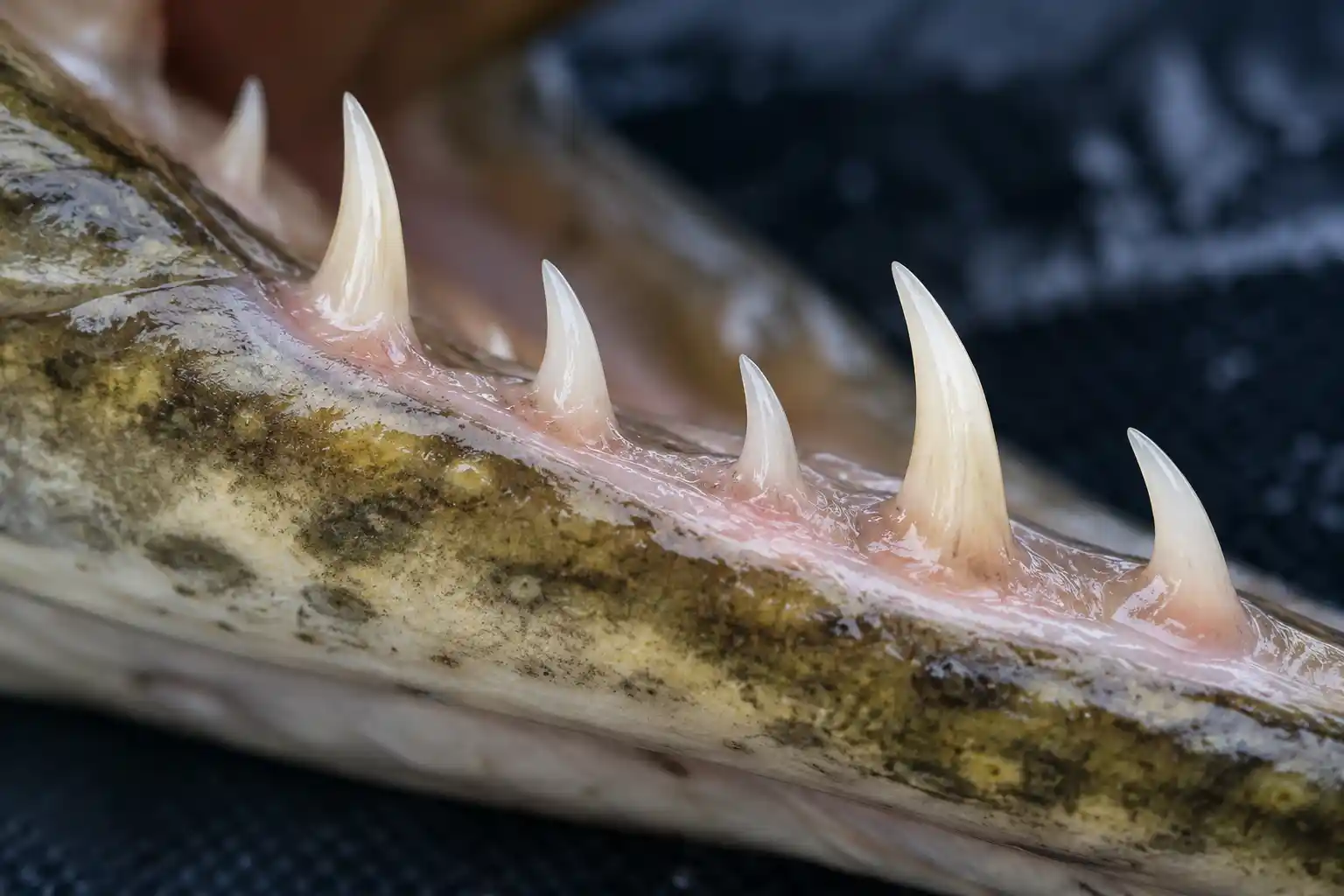
At the same time, the tip of the new tooth moves outward until it reaches the outer edge of the gum and breaks through, with its outer side resting against the lower lip. Once in service, the new canine has a needle-sharp tip and front and rear edges drawn out into knife-like keels.
Why a Pike Always Has Working Teeth
Because the canines are replaced one position at a time, the teeth in service are scattered along the jaw rather than grouped together. Barring rare accidents, this keeps an effective set of teeth in the jaw at all times. Larger adults also seemed to have more broken teeth than smaller fish — a sign, the authors suggested, that in bigger pike replacement runs somewhat slower than loss.
We see this process ourselves when unhooking pike. Gaps along the jaw and young, softer teeth that are not yet fully set are a regular sight, and we notice them most often in late spring and early summer, after the spawn. The 1935 counts showed no seasonal difference in how many canines were being replaced, so our observation likely reflects when we take the closest look, not a seasonal change in the pike.
Do Pike Lose Their Teeth in Summer (or Winter)?
Pike lose and replace individual teeth, but the 1935 Michigan study found no support for a late-summer event in which they shed their teeth and stop feeding. The story has nevertheless remained part of fishing folklore for generations.
Where the Myth Comes From
By the 1930s, many anglers believed that pike lost their appetite in summer because they shed their old teeth and grew a new set. Like a teething child, the story went, the fish developed gums so sore that it refused to eat. The same belief was widespread for muskellunge.
Trautman and Hubbs quoted an earlier angling account describing muskies losing their teeth around the middle of August. They also suspected that fishing guides had helped keep the story alive because it offered a convenient explanation for unsuccessful summer trips.
Winter versions of the story circulate among anglers too, including the claim that pike lose their teeth in February. The important distinction is between normal replacement of individual teeth and the alleged seasonal loss of a working set.
What the 1935 Study Tested
The study examined and tabulated the teeth of 188 northern pike, seven muskellunge and six chain pickerel. With only six exceptions, the fish exceeded 300 mm in standard length — approximately one foot, measured from the snout to the base of the tail rather than its tip.
Fish were collected in every month except February and December, with adequate numbers of northern pike for each month from April through September — the period when the supposed summer shedding should have occurred.
There was no important seasonal variation in the number of lower-jaw canines in service or undergoing replacement. Pike had working canines in every month sampled, with no late-summer drop. The much smaller muskellunge and chain pickerel samples pointed in the same direction.
Summer Feeding and “Sore Gums”
Stomachs of about 100 northern pike were checked as well. Those caught in July and August contained approximately as much food as fish caught during cooler months — not what you would expect if summer tooth replacement made pike stop eating.
The sore-gum explanation did not hold up either. Preserved specimens showed no apparent evidence of inflammation. In a separate examination of four northern pike and two mud pickerel taken in late August and early September, the gums showed no swelling or reddening immediately after removal from the water.
Reddening developed afterward. The authors described blood accumulating in small vessels, some of which ruptured, and attributed this apparently to the fishes’ struggles and bruising, including contact with hooks and lures. The effect was particularly noticeable around replacement teeth, where soft, blood-rich tissue lacked the protection of a fixed tooth.
We see red gums around the teeth mostly in the warmer months, often after a hard fight or a lure pressing against the jaw. That observation alone does not tell us what caused the redness, but it is no reason to assume the fish had stopped feeding because its teeth were changing.

Summer Catch Rates Can Fall Without a Tooth-Shedding Event
The myth offered an explanation for something anglers genuinely experienced: fewer summer catches. Creel census data from Houghton Lake, Michigan, collected from 1928 to 1932, recorded approximately 0.15–0.26 northern pike per fishing hour in May and June, compared with 0.04–0.15 per hour from July through September. The summer rate was lower in each of the five years.
Why catches fell was never established. The authors suggested that abundant natural food or reduced activity in warm water could help explain the difference — and lower catch rates did not, by themselves, show that the fish had stopped eating.
We regularly catch pike in July and August that strike fast-moving spinnerbaits, topwaters and jerkbaits hard. Those catches are inconsistent with a general summer feeding shutdown caused by tooth loss. For the practical fishing side, see our guide to why pike are not biting in summer.
What the Study Can and Cannot Tell Us
This is a historical study based on Michigan fish, not a worldwide survey. Its detailed counts concerned the lower-jaw canines, rather than every tooth in the mouth. The muskellunge and chain pickerel samples were small, and February and December were not sampled, so the report does not directly test a February shedding claim.
The authors also acknowledged that they had not entirely excluded the possibility of sore gums. Their observations should not be treated as proof that every red gum is harmless or that mouth injuries cannot affect an individual fish.
Even so, the central finding holds: missing or developing teeth are not evidence, on their own, of a seasonal feeding shutdown.
How Pike Teeth Hold and Swallow Prey
Pike teeth are built for gripping, not chewing. A pike swallows its prey whole, so its teeth are there to help hold a struggling fish after the strike rather than to cut it into pieces.
Canines Help Puncture and Hold
Trautman and Hubbs likened the two largest lower-jaw teeth in each row to the canines of a carnivorous mammal, in both position and function. With needle-sharp tips and thin cutting edges, they help puncture and hold prey — and because replacement happens one tooth at a time, that grip does not disappear while individual canines are being renewed.
Hinged Teeth on the Roof of the Mouth
The teeth on the palatines and vomer are hinged and depressible — they can bend down under pressure. These tooth-bearing surfaces provide additional contact with prey beyond the large lower-jaw canines.
The 1935 report documented their structure rather than their movement during feeding. It supports the anatomical description, but does not establish exactly how these teeth bend as a pike captures and swallows a fish.
The Tongue Adds Another Toothed Surface
With teeth on the roof of the mouth above and on the tongue below, prey inside a pike’s mouth meets toothed surfaces on more than one side. The 2015 tongue study’s suggestion of a mechanical role fits that picture, although the study examined tongue structure rather than observing feeding.
What Pike Teeth Mean for Leaders and Handling
Knowing how pike teeth are built explains two practical rules every pike angler learns quickly: use a leader, and keep your hands out of the mouth. Because working canines are present at every time of year, there is no season when a pike’s mouth becomes safe for bare line or bare fingers.
Why Pike Teeth Cut Line
Under the tension of a fight, the knife-edged lower-jaw canines act on line like a blade.
We have tested what happens without a wire or heavy fluorocarbon leader more than once. Even thicker 8-strand braid in the 0.20–0.25 mm range was cut almost instantly when a pike took the lure deep into its jaws. The problem was not the line’s breaking strength — it was the sharpness of the teeth working against a tight line. Monofilament lasted a little longer in some of our encounters, but pike still cut through it.
For choosing between wire and fluorocarbon, lengths and strengths, see our breakdown of the pike fishing leader.
Why Pike Teeth Cut Hands
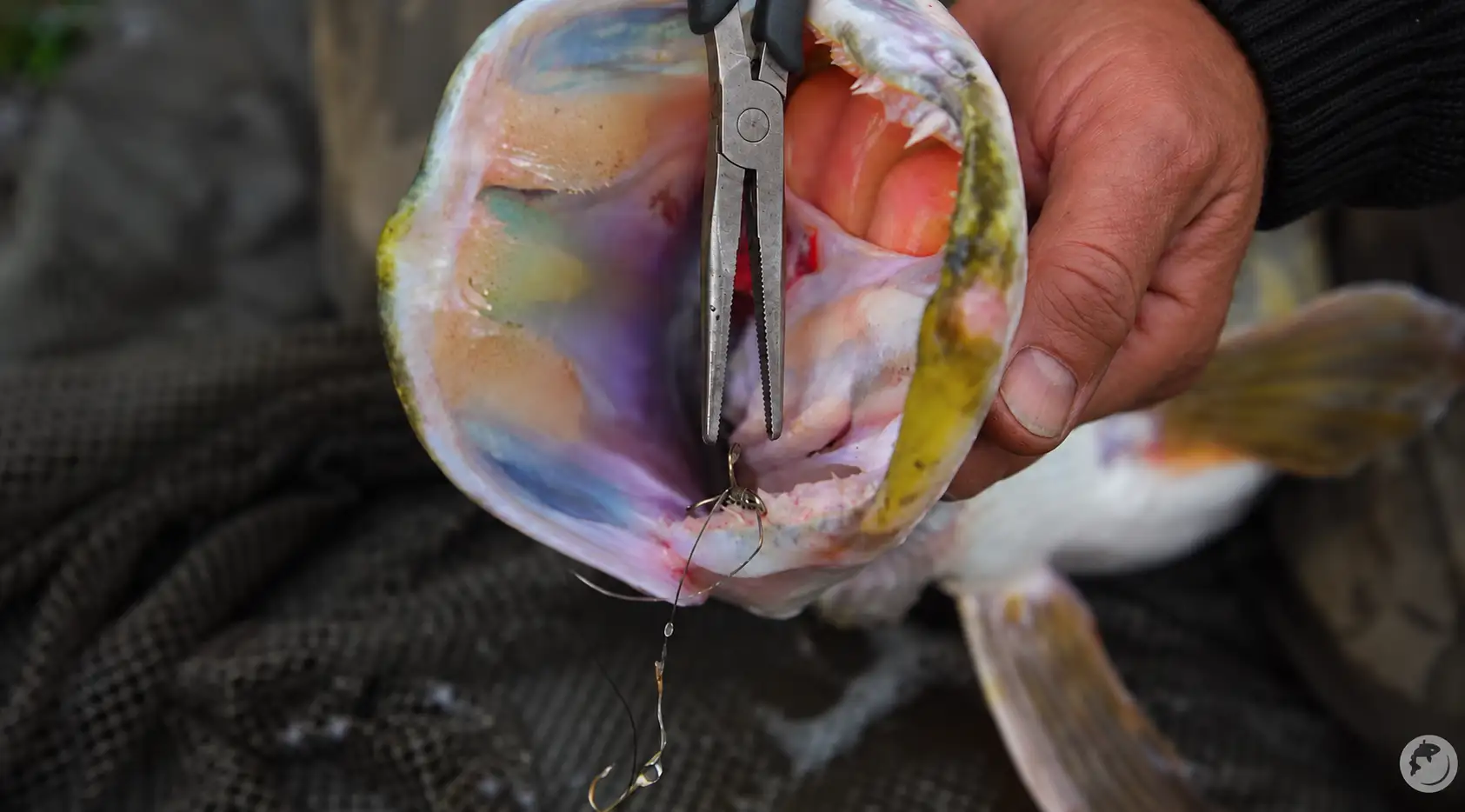
The same teeth are just as hard on skin. A careless grip under the gill cover or an attempt to free a deeply taken lure by hand almost always ends in small but deep cuts. In our experience, cuts from the gill rakers sting more and bleed longer than punctures from the teeth themselves.
Gaps in the jaw do not change any of this. Treat every pike’s mouth as fully armed.
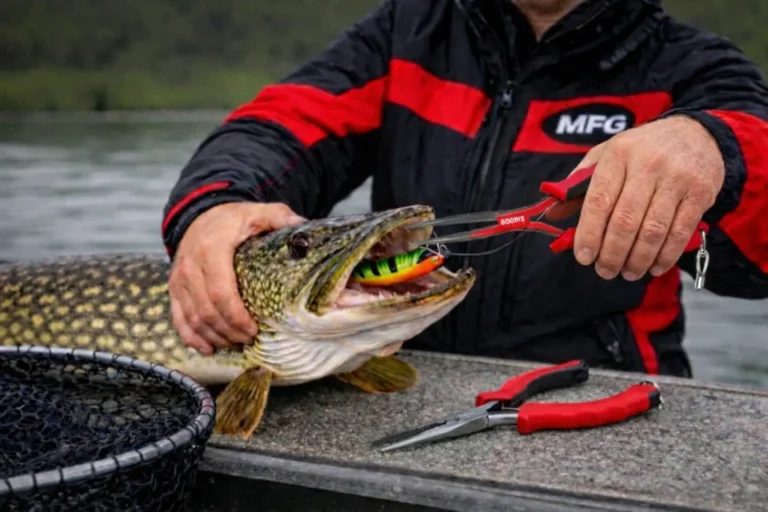
The safest approach is to keep your fingers out of the mouth entirely. Long pike fishing pliers let you reach hooks from a safe distance, and a jaw spreader holds the mouth open when a lure is deep. For grip, landing and release technique, see our guide on how to handle pike safely.
Pike Teeth Myths vs. Facts
Here is how the most common claims about pike teeth hold up against the evidence covered in this guide.
| Claim | What the evidence shows | Source |
|---|---|---|
| A pike has 300 to 700 teeth | No primary count of every tooth found. Lower-jaw canines: about 16 per side; other teeth uncounted. | Michigan Research Report 310 (1935) |
| Pike shed their teeth in late summer | No important seasonal change in working or replacement canines in the months sampled. | Michigan Research Report 310 (1935) |
| Pike stop feeding in summer because of sore gums | July and August stomachs held about as much food as those from cooler months. In a small sample, gums reddened only after capture. | Michigan Research Report 310 (1935) |
| Pike lose their teeth in February | Not directly tested — February was not sampled. Sampled months showed no seasonal pattern. | Michigan Research Report 310 (1935) |
| Bigger pike have more lower-jaw canines | 15.8 vs. 15.9 canines per jaw in small and large pike. The canines grow larger, not more numerous. | Michigan Research Report 310 (1935) |
| Gaps in the jaw mean a pike is unhealthy | Gaps are normal. None of the 200+ pike, muskellunge and pickerel examined had three-quarters of its canines in service at once. | Michigan Research Report 310 (1935) |
| A pike with missing teeth is safe to handle | Working canines and roof and tongue teeth are present year-round. Unprotected line and skin cut easily. | Michigan Research Report 310 (1935); MFG field experience |
Northern Pike Teeth FAQ
How many teeth does a northern pike have?
No study we found has counted every tooth in a pike’s mouth, so the popular 300–700 figure cannot be confirmed. The large lower-jaw canines number about 16 per side, including teeth being replaced, while the upper jaw, roof of the mouth and tongue add many smaller teeth.
Do pike lose their teeth in summer?
Not as a seasonal event. A 1935 Michigan study of 188 pike found no important seasonal change in working or replacement canines, and pike caught in July and August held about as much food as those from cooler months.
Do pike lose their teeth in winter?
The claim, often linked to February, has not been tested directly — the 1935 study collected no fish in February or December. The months it did sample showed no seasonal pattern of tooth loss.
Do pike teeth grow back?
Yes. Each lower-jaw canine has a line of replacement teeth behind it, and when one breaks, the next tooth moves into place — so a pike keeps working teeth throughout the year.
Why are a pike’s gums red after it’s caught?
In the 1935 study, gums looked normal right after capture and reddened afterward as small blood vessels ruptured, which the authors linked to the fish’s struggle and bruising from hooks and lures. It showed most around teeth being replaced.
Do muskellunge have the same kind of teeth as pike?
Probably the same basic pattern. Small muskellunge and chain pickerel samples in the 1935 study matched the pike findings: a steady number of lower-jaw canines, constant replacement and no obvious seasonal shedding.
Can pike teeth cut fishing line?
Yes — in our experience pike cut through braid and monofilament when a lure is taken deep. A wire leader provides bite resistance. Heavy fluorocarbon is another option, but pike can still damage or cut it.