


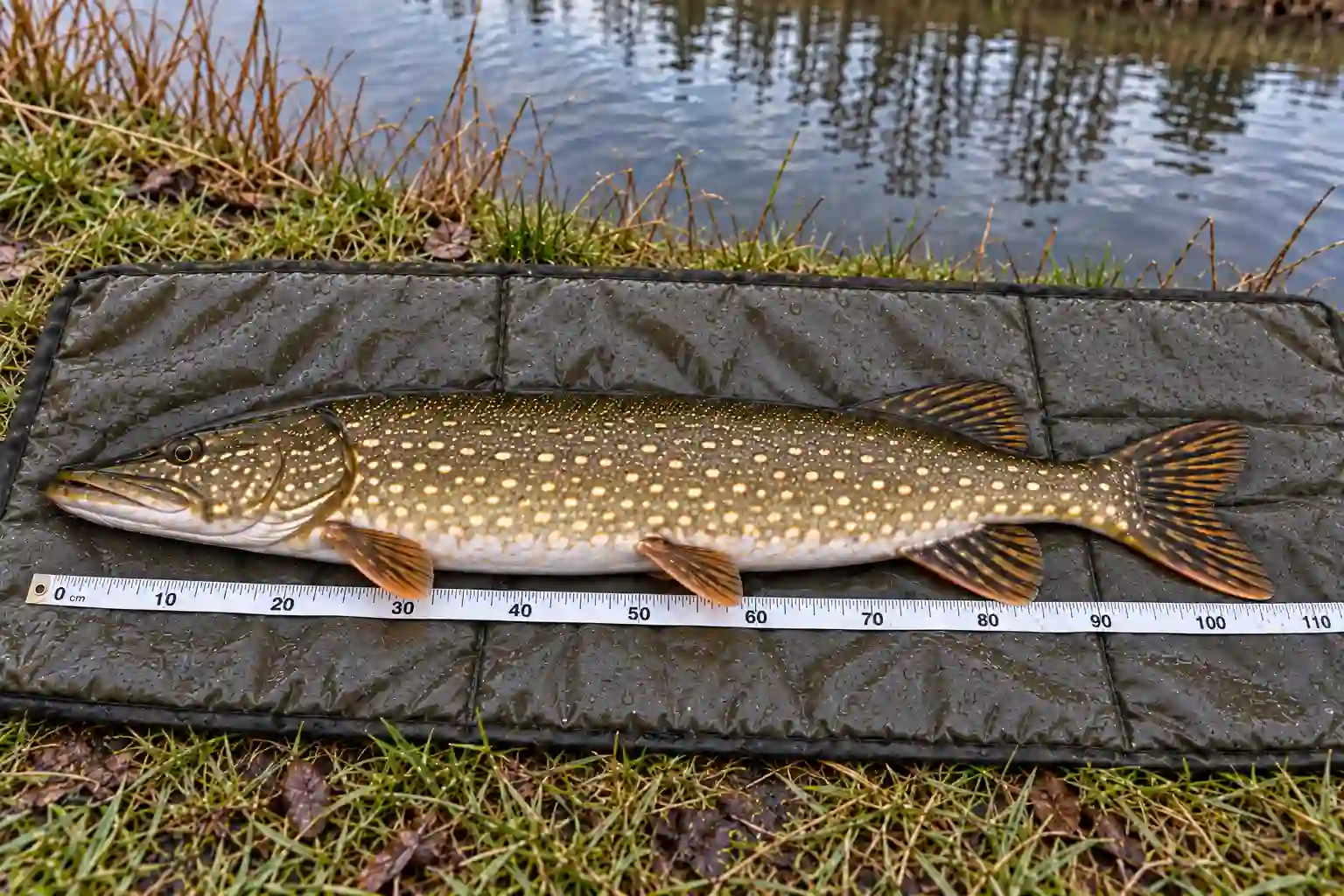
Northern Pike Weight Calculator & Length–Weight Chart
MASTER FISHING GUIDE
Northern Pike Weight Calculator
Enter a length. Get an estimate in pounds and kilograms.
Calculator is loading. If this message remains, JavaScript has not started.
Estimate range: 12–50 in / 30.48–127 cm / 0.3048–1.27 m. Use total length from the closed mouth to the tail tip.
Your pike
Compare another pike (optional)
Comparison uses the first pike’s length. Differences between methods are not a confidence interval.
Wr = 100 means measured weight equals Willis’s standard reference. This is not an average-weight estimate or a diagnosis of fish health.
Estimated weights are not measured weights. Sex, season, body condition and waterbody affect actual weight. These regional references are not validated for every waterbody worldwide.
Length–weight reference table
North Dakota published rows. Highlighting shows the nearest published length to the first pike.
| in | cm | lb | kg |
|---|---|---|---|
| 24 | 60.96 | 3.2 | 1.5 |
| 30 | 76.20 | 6.3 | 2.9 |
| 36 | 91.44 | 11.0 | 5.0 |
| 40 | 101.60 | 15.2 | 6.9 |
| 48 | 121.92 | 26.5 | 12.0 |
| 50 | 127.00 | 30.0 | 13.6 |
Methods, limits & sources
North Dakota Game and Fish: pike table, 12–50 in. New York DEC: pike table, 19–54 in. Both use linear interpolation between published rows. No table extrapolation. The New York table contains a published decrease at 21 inches and an irregular row at 48 inches; these values are reproduced as published, not corrected or treated as an accuracy range.
Wisconsin DNR: W(lb) = L(in)³ / 3,500. This tool limits comparison to 12–50 in; the source does not publish a validated range or percentage error.
Willis (1989): Ws(g) = 10⁻⁵·³⁶⁹ × L(mm)³·⁰⁵⁹. Wr = 100 × measured weight / Ws. Relative-weight mode is limited to the paper’s stated study range, 10–100 cm.
1 in = 2.54 cm; 1 lb = 0.45359237 kg; 16 oz = 1 lb. Display rounding does not indicate accuracy. No percentage-accuracy claim is made.
How to Use the Pike Weight Calculator
- Choose your length unit: inches, centimeters, meters, or feet and inches.
- Enter your pike’s total length: measure from the tip of the closed mouth to the tip of the tail, with the tail lobes pinched together. The estimate covers pike from 12 to 50 inches (30.48–127 cm).
- Read the estimated weight: the result updates automatically in pounds and kilograms. You can also press Calculate.
- Compare another pike if you want: enter a second length to see the difference between the two estimated weights.
You can enter decimals using a point or a comma, such as 76.2 or 76,2 cm. When you change units, the calculator converts the measurement you have already entered.
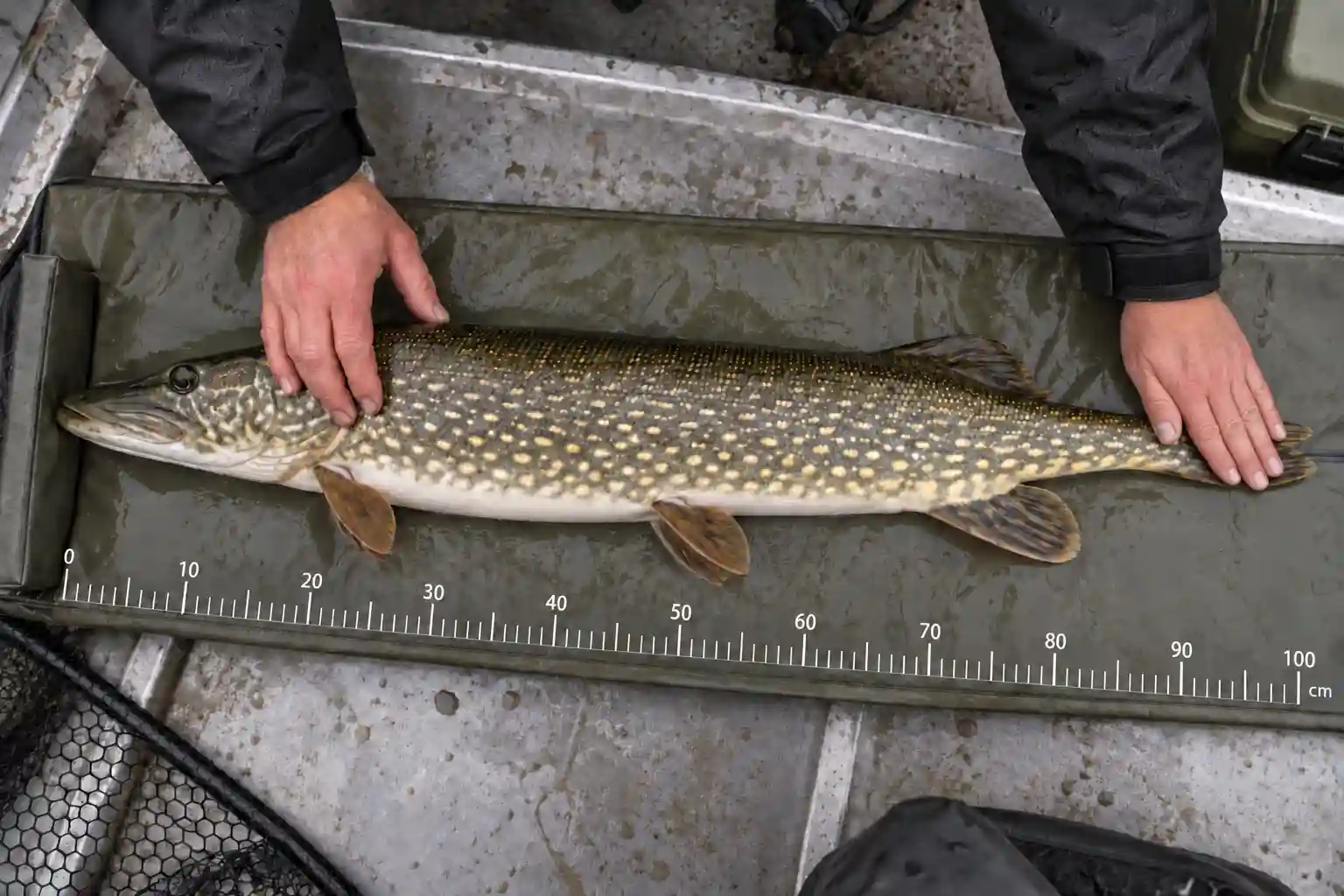
On the water, we measure first and calculate later. When we plan to release a pike, we lay it on a wet measuring board or mark its length on the rod, get it back in the water, and run the numbers once it swims away.
What Do the Other Tabs Do?
- Compare estimates: shows how different published tables and a length-based formula estimate the weight of your first pike.
- Relative weight: compares an actual weight measured on a scale with a scientific reference weight for the fish’s length. This mode requires both length and measured weight and works for pike from 10 to 100 cm.
Two pike of the same length can have different weights, depending on season, sex, food supply and how fast they grow in their home water. For an exact number, weigh the fish on a scale.
How to Measure and Weigh a Pike Without Hurting It
A good estimate starts with a good measurement, and a good measurement should not cost the fish. We keep the process short and keep the pike wet the whole time.
Measuring in the Boat or From Shore
- Wet everything first: your hands, the measuring board or mat, and any surface the pike will touch. A dry surface strips the protective slime.
- Keep the fish horizontal: support the belly with one hand. Holding a heavy pike vertically by the jaw puts strain on its jaw and internal organs.
- Close the mouth and pinch the tail: lay the closed mouth against the end of the board and pinch the tail lobes together before you read the length.
- Measure in the net when you can: a rubber pike landing net lets you keep the fish in the water while you unhook and get ready to measure.

Measuring on the Ice
In freezing air, a pike’s eyes and gills can be damaged quickly. Have the tape or board ready before the fish comes through the hole, lay the pike on a wet mat instead of bare ice, and get it back down the hole as fast as you can.
If You Want a Real Weight
Weigh the pike inside the net or a wet weigh sling, then subtract the weight of the empty net or sling. That way the fish stays supported along its whole body, and the number you get is the real weight you can enter in the Relative weight tab.
How Is Pike Weight Estimated from Length?
The main estimate uses the northern pike length–weight table published by North Dakota Game and Fish. Its values are average weights of pike measured across North Dakota.
If you enter a length between two published rows, the calculator estimates a weight between those values using linear interpolation. For example, the table lists a 32-inch pike at 7.7 lb and a 34-inch pike at 9.2 lb. A 33-inch pike therefore receives an estimate displayed as 8.4 lb (3.8 kg).
Why Can Different Methods Give Different Results?
The Compare estimates tab also shows the New York DEC table and the Wisconsin DNR length-based formula. These are separate references, so their results can differ. The calculator does not average them together.
For a 40-inch pike (101.6 cm), the North Dakota table gives 15.2 lb, the New York table 13.1 lb, and the Wisconsin formula 18.3 lb — a spread of more than 5 lb for the same length.
The Wisconsin formula uses total length in inches to estimate weight in pounds:
Estimated weight (lb) = length (in) × length (in) × length (in) ÷ 3,500
The published New York table shows a drop in weight at 21 inches and an unusually small increase at 48 inches. The calculator keeps both values exactly as published.
You can check the original references at New York DEC and Wisconsin DNR.
All three estimation references come from US fisheries. The centimeter and kilogram options make the calculator easy to use anywhere.
What Does Relative Weight (Wr) Mean for Pike?
Relative weight compares a pike’s measured weight with a standard reference weight for its length. Unlike the main calculator, this mode uses an actual scale reading instead of estimating weight from length.
- Wr = 100: the measured weight equals the standard reference weight.
- Wr below 100: the fish weighs less than the reference weight for its length.
- Wr above 100: the fish weighs more than the reference weight for its length.
How Is Relative Weight Calculated?
The calculator uses the northern pike standard-weight equation proposed by Willis (1989):
Standard weight (g) = 10−5.369 × total length (mm)3.059
It then compares your measured weight with that reference, using the same weight units for both:
Wr = 100 × measured weight ÷ standard weight
For example, if a pike weighs 10% less than its standard reference weight, its relative weight is 90 Wr. If it weighs 10% more, its relative weight is 110 Wr.
Does a Low Wr Mean the Fish Is Unhealthy?
Not necessarily. Wr shows how heavy a pike is for its length on the day you weigh it. Season, reproductive condition, feeding and measuring technique all move the number, so a female right after spawning can score low and the same fish before spawning can score high. Wr = 100 is a reference point for comparison.
This mode works for pike from 10–100 cm total length, the length range represented in the original study. It uses a different reference than the North Dakota average-weight table, so the two numbers measure different things.
How Accurate Is a Pike Weight Calculator?
A length-based calculator gives you the average weight for a given length. Your own pike may be leaner or more deep-bodied than average, and that changes its real weight.
The North Dakota source names sex, time of year, fish health and waterbody as the main reasons an individual fish differs from the published average.
Does Measuring Girth Improve the Estimate?
Girth measures the circumference of the fish’s body. It adds information about body shape that length alone does not, and the result depends on the formula used and how carefully the fish was measured.
Wisconsin DNR, for example, uses girth in its formulas for bass and trout, but its pike formula uses length only.
This calculator also uses length only. Its main result comes from the North Dakota length–weight table. The optional second fish is there for comparing two pike.
When Should You Use a Scale?
Use a scale when you need the fish’s exact weight. The Relative weight tab also needs a scale reading, because it compares a real weight with the standard reference.
Results such as 6.3 lb are rounded to one decimal place to make them easy to read and compare.
Why Two Pike of the Same Length Weigh Differently
The same length does not mean the same body shape or weight. During our fishing on the Danube and Sava, Lake Vänern in Sweden, and Mille Lacs and Lake of the Woods in North America, we have noticed clear differences in how pike of similar lengths are built. Some are deep-bodied and broad across the back; others look noticeably leaner.
What We Have Noticed on Different Waters
On Lake Vänern, many of the pike we have caught were deep-bodied and high-backed. In our Danube catches, fish of similar lengths often looked narrower and more elongated.
We have also noticed that our Mille Lacs pike often looked thicker around the belly than fish of similar lengths we caught on Lake of the Woods. We judge that difference by eye on the water.
| Water | Build observed in our catches | What it may mean for the estimate |
|---|---|---|
| Lake Vänern (Sweden) | Often deep-bodied and high-backed | Real weight may come in above the chart |
| Danube (river) | Often narrower and more elongated | Real weight may come in below the chart |
| Mille Lacs (Minnesota) | Often thicker around the belly | Real weight may come in above the chart |
| Lake of the Woods (MN/Ontario) | Often leaner-looking than our Mille Lacs catches | Real weight may sit closer to the chart |
What Might Explain These Differences?
Food availability, feeding history, sex and reproductive condition all affect how much a pike weighs at a given length, and habitat influences how much energy a fish spends to feed.
Season and Spawning Condition
Developing eggs add to a female’s weight before spawning, and releasing them changes her weight afterward. Our guide to pike spawning in spring explains this stage of the seasonal cycle.
Right after spawning, a pike can look long and lean even when it is perfectly healthy. For the fishing side of that period, see our guide to post-spawn pike.
We have caught full-bodied pike in autumn too, when fish feed heavily before winter. For seasonal location advice, see where to find pike in fall.
When reviewing your catch records, compare fish of similar lengths and note whether they were caught at similar times of year. Keep the measuring technique consistent, too, because a different tail position or an inaccurate scale reading changes the comparison.
What This Means for Your Calculator Result
Use body shape and season as context when you read your result. If you want to compare your own catches, record total length, measured weight, date and waterbody, then enter the actual measurements in the Relative weight tab. A consistent set of records tells you more about the pike in your water than appearance alone.
Pike Length–Weight Chart: Common Sizes
These examples use the same North Dakota reference table as the calculator’s main estimate. Weights are rounded.
On average, a 30-inch pike weighs about 6.3 lb (2.9 kg), a 36-inch pike about 11 lb (5.0 kg), and a 40-inch pike about 15.2 lb (6.9 kg).
| Length (in) | Length (cm) | Estimated weight (lb) | Estimated weight (kg) |
|---|---|---|---|
| 20 | 50.80 | 1.8 | 0.8 |
| 24 | 60.96 | 3.2 | 1.5 |
| 28 | 71.12 | 5.1 | 2.3 |
| 30 | 76.20 | 6.3 | 2.9 |
| 32 | 81.28 | 7.7 | 3.5 |
| 36 | 91.44 | 11.0 | 5.0 |
| 40 | 101.60 | 15.2 | 6.9 |
| 44 | 111.76 | 20.3 | 9.2 |
| 48 | 121.92 | 26.5 | 12.0 |
| 50 | 127.00 | 30.0 | 13.6 |
For a length between these examples, enter your measurement in the calculator above.
A note on the numbers on this page: every weight here is an estimate from a published reference, not a measured weight. The differences between the three references are not an error range for an individual fish, and our notes from different waters are field observations, not a scientific comparison. When you need the real weight, use a scale.
Pike Weight Calculator FAQ
How much does a 40-inch pike weigh?
Based on the North Dakota reference table, a 40-inch (101.6 cm) northern pike weighs about 15.2 lb (6.9 kg) on average. An individual fish can weigh noticeably more or less, depending on its sex, the season and its body condition.
Can I enter a pike’s length in centimeters?
Yes. Select Centimeters (cm) before entering your measurement. The main estimate supports lengths from 30.48 to 127 cm, and the result appears in both kilograms and pounds.
Can I calculate the weight of a pike longer than 50 inches?
The main estimate stops at 50 inches (127 cm), the upper limit of the North Dakota table used here. The calculator does not extend that table beyond its published range.
Should I enter total length or fork length?
Enter total length, from the tip of the closed mouth to the farthest tip of the tail. Fork length ends at the notch between the tail lobes and should not be entered in this calculator.
Can I use this calculator for muskie or chain pickerel?
No. The references used here are for northern pike (Esox lucius). Sharing a similar body shape does not make another species suitable for the same weight estimates.
Why does the calculator show different weights for the same length?
The Compare estimates tab uses three separate references. Their values differ because they use different tables or a formula. Your main result remains the North Dakota estimate.
Can I enter an estimated weight in the Relative weight tab?
That tab is intended for an actual weight measured on a scale. Entering a length-based estimate would compare two mathematical references rather than show how your measured fish compares with the standard weight.