

Winter Pike Fishing: Shore vs Boat — The Silent Reason Your Winter Sessions Stay Empty
Most winter anglers blame the cold. Or the pressure. Or the lure. In reality, winter pike fishing fails for a much quieter reason: you are standing in the wrong place when the window opens.
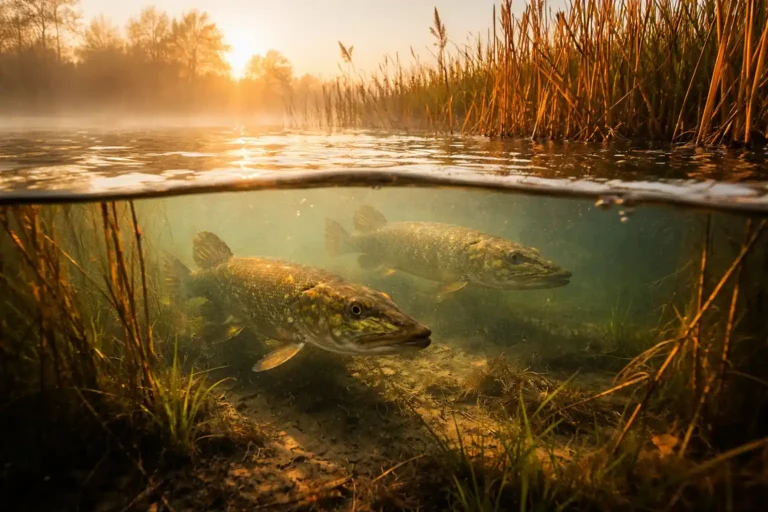
In cold water, pike do not roam. They do not “search.” They hold. They wait along specific lanes where energy is conserved and prey is forced to pass. Those lanes can be a few meters wide. Miss them, and an entire lake feels dead. Stand inside them, and one cast can change the day.
We’ve spent winters fishing the same waters from both sides of the equation — frozen banks and drifting boats. Same lakes. Same months. Same fish. What kept repeating was this: position mattered more than lure choice. Not because one platform is better, but because each one limits how you can reach a winter pike. This is the real core of winter pike fishing — shore vs boat.
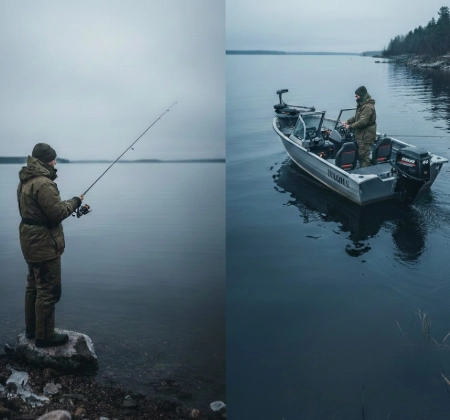
From shore, you trade mobility for silence. You live and die by micro-locations and short strike windows. From a boat, you gain depth and control — but lose forgiveness. Wind, drift, and cold can pull you out of the corridor without you noticing. In winter pike fishing from shore vs from a boat, that single difference decides whether your lure ever enters the lane at all.
This guide is not about which is “better.” It’s about understanding how winter pike use space — and how your position decides whether you ever intersect that space at all. It builds directly on the system we mapped in our Winter Pike Fishing Guide, where depth, temperature, behavior, and timing form a single cold-water logic.
Once you see winter water through that lens, empty sessions stop being mysterious. They become predictable.
Winter Pike Fishing: Shore vs Boat — How Pike Actually Use Space in Cold Water
To understand why position beats technique in winter, you first have to accept one uncomfortable truth: pike do not “fish” the lake the way you do. They don’t roam. They don’t explore. They don’t patrol large areas. In cold water, a pike chooses a place that minimizes effort and maximizes opportunity — and then it waits.
That place is almost never “a spot.” It is a lane. A narrow corridor where depth, structure, and prey movement intersect. A drop-off edge. The mouth of a basin. The lip of a winter flat.
In simple terms: these are the lines where shallow water suddenly turns deep, where a flat shelf falls into a hole, or where a wide open area narrows into a natural passage. They are the underwater equivalents of doorways — places everything must pass through.
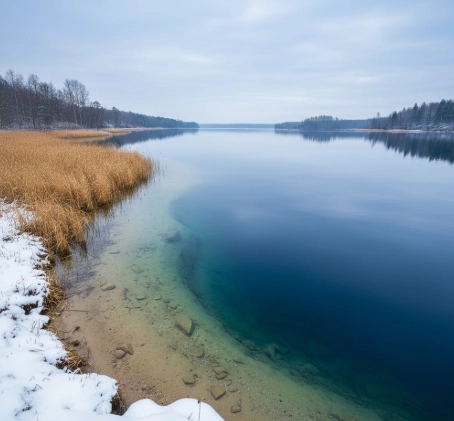
This is the same logic we mapped in Winter Pike Behavior: cold-water pike conserve energy first and feed only when the environment does the work for them. They don’t chase. They intercept. That interception only happens where movement is forced.
When anglers say “the lake is dead,” what they usually mean is: they are casting outside the lane. The fish are still there. They are simply positioned a few meters deeper, a few meters farther, or along an angle the angler cannot reach from where they stand.
This is why winter pike fishing — shore vs boat so often feels unfair. The fish are present, but the platform decides whether your lure ever crosses the corridor where a pike is willing to move.
Winter pike fishing is not about covering water. It is about intersecting a corridor. Your entire session succeeds or fails based on whether your position allows your lure to pass through that invisible line where a pike is willing to move.
Shore and boat fishing don’t change the fish. They change your relationship to that lane.
Shore Fishing in Winter — Silence, Precision, and the Short Strike Window
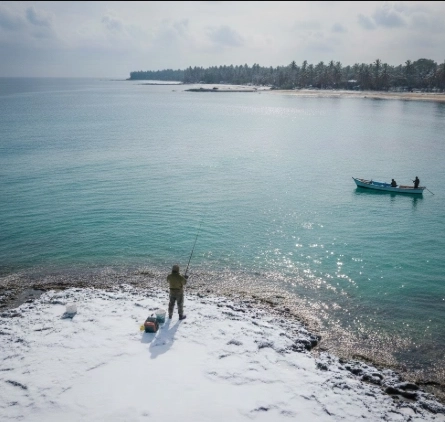
From the bank, winter pike fishing from shore is not about movement. It is about commitment. You trade mobility for silence, and that silence is powerful. No engine hum. No hull slap. No vibration bleeding into the water. In cold, clear conditions, that quiet keeps fish calm — especially in shallow bays and pressured shoreline zones.
But that advantage comes with a brutal limit: your radius is fixed. You are not “searching” winter water. You are waiting for a lane to wake up in front of you. If the pike’s window opens ten meters deeper or fifty meters left, you never even know it happened. This is the hard edge of winter pike fishing — shore vs boat: the fish may move, but your reach does not.
This is why winter shore fishing lives and dies by location discipline. Random banks fail. Featureless edges fail. What works are access points to movement: marina entrances, channel mouths, steep drop-offs that reach deep water within a long cast, and narrow passages where baitfish are forced to pass.
Once you choose a winter edge, the rule is simple: you do not leave quickly. In cold water, strike windows are short and rare. We treat one serious shore position like a stand — not a stop. Forty-five minutes. Sometimes ninety. Not because fish are “there,” but because that is how long it can take for a lane to open.
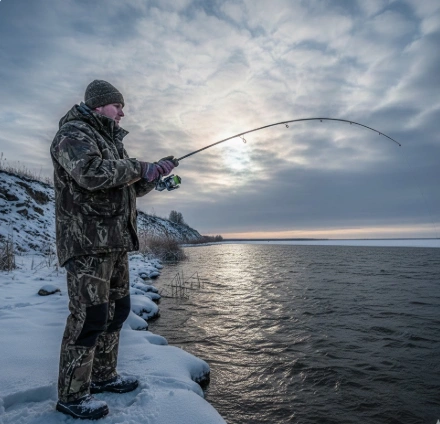
In winter, the bank does not forgive impatience.
Winter shore fishing follows a rhythm:
- First 15 minutes — establish the corridor. Overlapping casts, same angle, same lane.
- Next 20–30 minutes — slow down. Longer pauses. Let the lure live in the zone.
- After 45 minutes — change presentation, not position. Different depth, different pause length, stay in the same lane.
You move only for two reasons: You realize you misread the structure, or conditions shift (light, wind, pressure) and the lane itself changes. Everything else is impatience dressed as strategy.
Winter from shore is not about casting more. It’s about being in the right place when the lake finally exhales. That is the real meaning behind shore vs boat in winter pike fishing.
Frozen Rod Guides — The Small Problem That Ends Entire Sessions
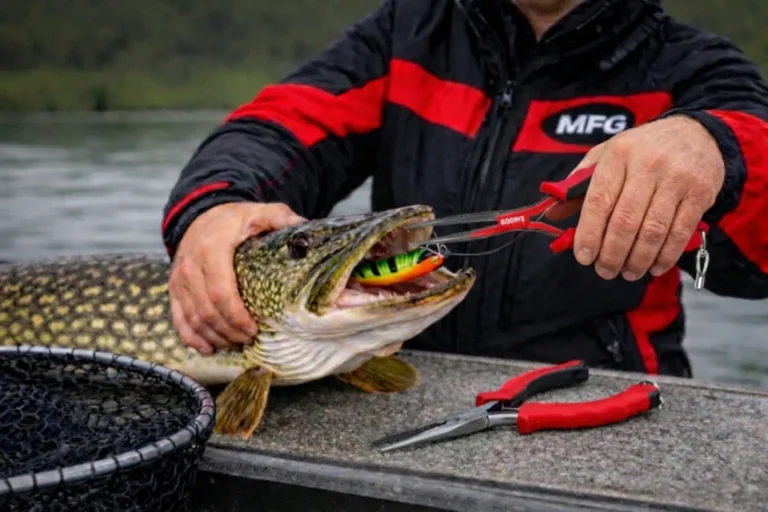
From shore, rod guides freeze faster because you are static. Most anglers scrape ice with teeth or nails — that slowly destroys the rings and turns a small issue into a permanent one. As we show in frozen rod guides in winter, a simple lip balm or a single drop of oil on the tip guide before your first cast can buy you 20–30 minutes of clean fishing before ice starts choking the line. In winter, that is the difference between staying in rhythm and packing up.
The Forgotten First Meter — Where Winter Pike Hide in Plain Sight
Most anglers fire “hero casts” and forget the water at their feet. Winter pike often sit in the first half-meter, where dying weed still offers cover and warmth lingers near the bank. More than once, we’ve watched a fish follow from thirty meters and only strike when the lure was almost out of the water. Before you even step to the edge, make one short, parallel cast from two meters back. The fish you never saw may already be there.
Numb Fingers vs. The Winter Strike — Why You Miss Fish Without Knowing
In January, a strike rarely feels like a hit. It feels like weight. Like grass. Like nothing. From shore, you must learn to read the smallest change in resistance. If something feels different — strike. Winter does not punish overreaction. It punishes hesitation. The missed fish stays with you all the way home.
Side Wind and Line Belly — How the Lake Pulls You Out of the Lane
From shore, you are a slave to wind. A crosswind creates a belly in your line and quietly pulls the lure out of the corridor. Drop your rod tip until it almost touches the surface. Let the line cut the wind. Keep the jerkbait in the lane instead of drifting back toward the bank. Most empty sessions are nothing more than lures that never stayed where the fish were.
The Moment Most Anglers Leave
Steam from your breath mixes with condensation on the reel. Fingers turn purple. You wait for the fifteen-minute window when clouds thin and the water warms by half a degree. Most anglers head for the car. We stay. That tiny shift is often the moment the lane comes alive.
From the bank, winter rewards those who understand that one good position beats a hundred empty casts.
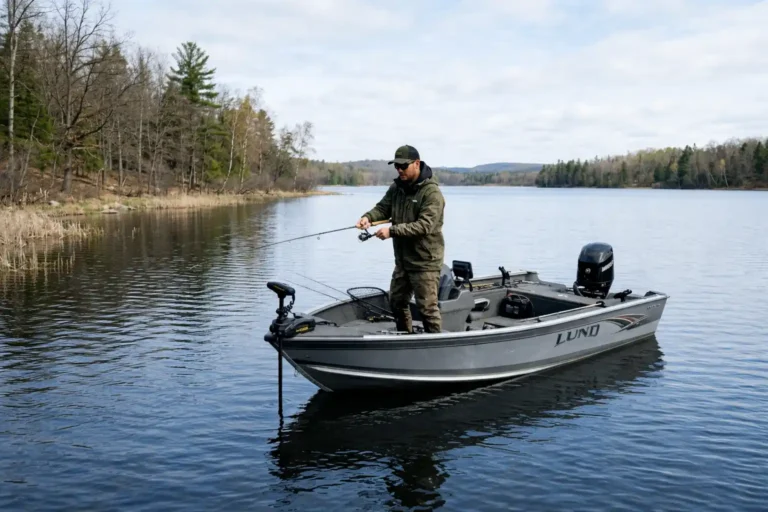
Boat Fishing in Winter — Control, Depth, and the Power to Stay in the Zone
Winter pike fishing from a boat is not “easier.” It is simply more precise. The boat gives you one unfair advantage the bank can’t: you can put your lure in the exact depth lane and keep it there. In winter, that is everything — and it’s why winter pike fishing: shore vs boat is really a question of control, not comfort.
From shore, you’re limited by casting angle and distance. From a boat, you control the approach. You can sit outside the fish, line up the corridor, and work the same lane over and over without the wind quietly pulling you out of position. That’s the real difference in boat vs shore winter pike fishing: the fish are the same, but the platform decides whether your lure actually stays where the fish live.
The problem most boat anglers make in winter is thinking the advantage is “covering more water.” That’s summer thinking. In winter, covering water is often just drifting away from the only productive line. The boat wins when it becomes a tool for staying locked on structure — not roaming.
Winter pike fishing from a boat is not about finding fish — it is about staying in the one depth lane where a fish is already willing to move. In the logic of winter pike fishing — shore vs boat, this is where the boat earns its edge.
Depth Control — Why Boat Anglers Reach Pike Shore Anglers Never Touch
In winter, big pike often hold deeper than most shore presentations can realistically fish for long. You might reach the zone on a cast — but you can’t keep the lure there. A boat can. That is why depth control becomes the deciding factor on tough days.
This aligns perfectly with what we mapped in winter pike depths: winter positioning is not random — it is a repeatable relationship between depth, structure, and comfort. If the fish are glued to the 6–8 m (20–26 ft) lane on a drop, the boat lets you work that lane like a surgeon instead of “hoping” a cast crosses it.
One simple rule we learned the hard way: if your lure cannot stay in the depth lane for at least 10–20 seconds per cast, you are not really fishing that lane. You’re passing through it.
Fish Finder Reality — Not a Gadget, a Time Machine
In winter, the fish finder doesn’t “find fish.” It saves time. It prevents that classic boat mistake: spending two hours confidently fishing water that looks perfect above the surface but is dead at the depth level that matters.
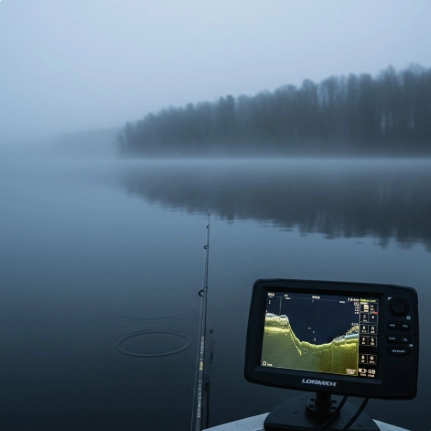
With electronics, you can confirm three things quickly: the exact depth break, whether bait is present, and whether your boat is holding the corridor. That is why we treat a fish finder as a winter tool, not a luxury — especially if you fish multiple waters or large systems. If you’re building a serious winter setup, our tested picks in all-season fish finders show what actually makes a difference when the screen is your only “eyes” below the surface.
The goal is not to chase marks. The goal is to keep your boat aligned so every cast repeats the same productive path. Winter is repetition, not exploration.
How Long to Stay on One Boat Spot — The Rule That Stops You From Drifting Into Nothing
Boat anglers lose fish the same way shore anglers do: impatience. They move because they feel they “should.” In winter, movement is often the reason nothing happens.
Here is the system we use:
- First 10 minutes — confirm you’re truly on the structure: depth break, bottom hardness changes, any bait presence.
- Next 20–30 minutes — fish one lane with discipline: same angle, same corridor, slow retrieve, long pauses.
- After 40 minutes — adjust speed and depth before you adjust location. Shorten the lane. Tighten the window.
If your boat is sliding, your “spot” is changing every minute — and you won’t even notice it until the entire session is gone. In winter, boat control is part of the presentation. Anchoring, controlled drifting, or using a trolling motor is not comfort — it is accuracy.
Strike Windows From a Boat — When Position Turns a Dead Day Into One Fish
Winter bites are rarely “steady.” They are usually short strike windows where the same lane turns on for a few minutes and then shuts down again. The boat advantage is that you can already be positioned on the corridor when that moment arrives.
This connects directly to what we mapped in water temperature vs pike activity: even a small change can open a window. Half a degree. A slight calm after wind. A shift in light. The fish don’t become aggressive — they become briefly reachable.
When the window opens, the angler who is already in the lane wins. Not the one who is still moving, still searching, still “setting up.”
Boat Winter Reality — The Cold Is Not the Enemy, the Drift Is
Boat fishing in winter looks powerful on paper — until wind starts pushing you sideways, your fingers stiffen, and the boat slowly slides off the break you thought you were fishing. That’s when most anglers start rushing. Shorter pauses. Faster retrieves. Random casts. And the whole reason you brought a boat disappears.
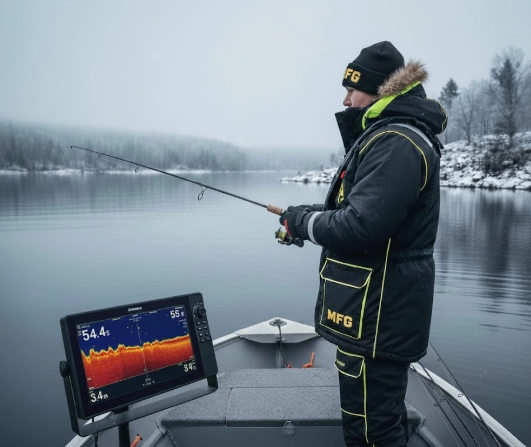
Winter boat success is boring on purpose. You hold position. You repeat the corridor. You let the lure sit in the depth lane. You wait for the lake to “exhale.”
Because in winter, the boat isn’t a mobility tool. It’s a lane control tool.
This is why winter pike fishing is not about choosing shore or boat — it is about understanding how position, depth, and timing work together. In the end, winter pike fishing — shore vs boat is simply two ways of trying to do the same thing: stay in the lane when the moment finally arrives. That full system is mapped in our winter pike fishing guide.
Winter Pike Fishing: Shore vs Boat — Which One Actually Fits You
The real question in winter pike fishing — shore vs boat is not what is “better.” It is what fits the water you fish — and the angler you already are.
If your winters are spent on canals, small rivers, and narrow bays where structure comes close to the bank, shore fishing is not a compromise. It is a weapon. You have silence. You have access. You have lanes that big pike already use. What you need is discipline — to stay in one place long enough for the window to open.
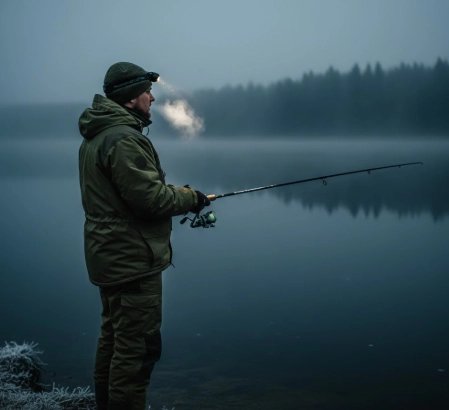
If your waters are wide reservoirs, deep natural lakes, or open systems where winter pike hold far from shore, a boat becomes more than convenience. It becomes access to depth. Not to roam — but to stay in the only lane that matters when the fish finally move. This is the other half of winter pike fishing: shore vs boat.
Many anglers own a boat but still fish like they’re on shore. They drift. They cast wide. They “cover water.” And many shore anglers give up because they believe the fish are unreachable. Both groups fail for the same reason: they think winter rewards movement.
It doesn’t.
Winter rewards position.
You can fish like a boat angler from the bank by choosing one serious edge and committing to it. You can fish like a shore angler from a boat by slowing down, locking onto a lane, and refusing to drift away from it.
The platform does not decide success. Your understanding of position does.
Once you grasp that, shore and boat stop being opposites. They become two tools for doing the same thing inside the same logic of winter pike fishing — shore vs boat:
Being in the right place when winter finally allows one fish to move.
Everything that follows — rods, reels, line control, and presentation — exists for one reason only: to let you stay in that place when the moment arrives.
Gear That Lets You Stay in the Lane — When Cold Tries to Push You Out
Everything you’ve learned about winter positioning — from shore discipline to boat control — collapses the moment your body or your gear stops cooperating. In cold water, success is not about strength. It is about control: of line, lure, timing, and your own hands. That control lives in four places: your rod, your reel, your line path, and your fingers. In winter pike fishing — shore vs boat, gear is what decides whether you can actually hold your position when conditions push back.
A winter reel must forgive mistakes when your hands are slow. Cold fingers backlash more. Thumbs react later. Spools behave differently. A reel that feels “fine” in October becomes a session killer in January. In winter, the reel is not just a line retriever — it is the mechanism that preserves rhythm when inertia sets in. Without that rhythm, both shore and boat anglers lose the lane.
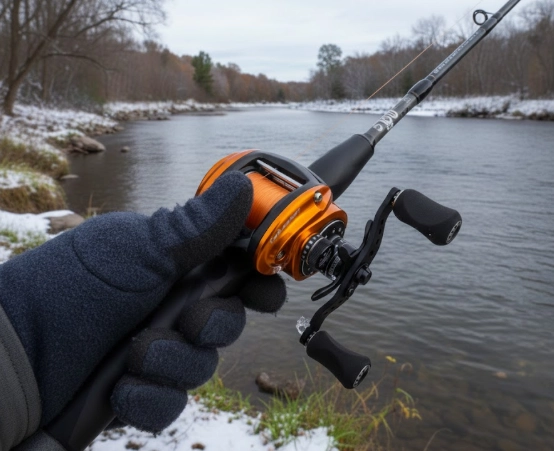
The rod carries the other half of that burden. In warm months, a strike is obvious. In winter, it rarely is. It feels like weight. Like vegetation. Like nothing at all. A proper winter rod must transmit pressure changes rather than “hits”, load under slow tension, and keep hooksets controlled when the fish barely moves — whether you’re fishing from rock, ice-edge, or a drifting hull.
No reel and no rod can compensate for fingers that no longer obey. That’s why your choice of winter gloves is not about warmth — it is about preserving control. The angler whose hands still work after an hour in the cold stays in the lane. The one who loses feeling starts compensating, and winter punishes compensation. This is true on the bank and on the boat.
This is why winter gear is not “comfort.” It is position insurance. It exists to keep you in the lane when cold tries to push you out. Because in winter, the angler who stays in control stays in the game — and that is the final edge in winter pike fishing — shore vs boat.
Our Tested Gear Selection for Winter Pike
Every item below was tested by the MFG team in real winter conditions — freezing guides, numb fingers, wind, snow, and long, empty sessions. These are not catalog picks. These are tools that survived rigorous on-water testing and proved they can keep you fishing when most gear quietly gives up.
➔ Best Pike Fishing Rods for Winter — blanks tuned for pressure bites and slow, controlled hooksets.
➔ Best Spinning Reels for Winter Pike — built for smoothness and freezing drag protection.
➔ Best Winter Baitcasting Reels — engineered to stay controllable when fingers are numb.
➔ Best Winter Fishing Gloves — the only gloves we’ve found that preserve real tactile control.
The Next Time Your Winter Session Feels Empty
There will be a day this winter when you walk the bank, make twenty casts, and feel nothing. Or when your boat drifts across a perfect-looking break and the screen stays quiet. The old instinct will whisper: change lure. move again. try somewhere else.
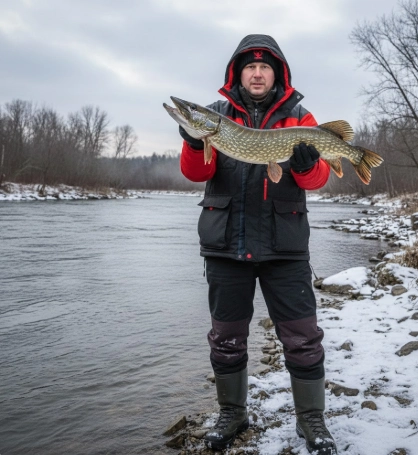
We’ve all been there — standing on a freezing bank in January, breath turning to steam, convinced we picked the wrong color, the wrong bait, the wrong spot. It feels personal. It feels like failure. This is the quiet moment where winter pike fishing — shore vs boat stops being theory and becomes real.
Remember this instead:
Winter does not reward motion. It rewards presence.
Somewhere under the surface, a narrow lane exists where depth, structure, and comfort intersect. A pike is holding there — not hunting, not roaming, just waiting. It will not chase your lure across the lake. It will not “wake up” because you switched colors. It will only move when the environment opens a brief window.
The only angler who ever meets that fish is the one who is already in the lane.
From shore, that means choosing one serious edge and staying when everything tells you to leave. From a boat, it means refusing to drift away from the corridor that actually matters. In both cases, it means understanding that position is the presentation. That is the real lesson behind winter pike fishing — shore vs boat.
Winter pike fishing is not hard because fish disappear. It is hard because the lake becomes honest. It strips away luck, speed, and noise — and leaves only one question:
Were you in the right place when the lake finally allowed one fish to move?
If the answer is yes, one cast is enough.
If you’re ready to stop guessing and start mapping your own lanes, dive into our full Winter Pike Fishing Guide.
And if you want to see how real anglers face these empty winter hours, missed windows, and rare giant moments, follow what we share on the Master Fishing Guide Facebook Page.
FAQ — Winter Pike Fishing Shore vs Boat
Is winter pike fishing shore vs boat really that different?
Yes — not because the fish change, but because your position control changes. In winter pike fishing shore vs boat, the ‘winner’ is the platform that lets you keep your lure in the depth lane for long enough. Shore fishing wins when the lane is reachable and you can commit to a tight corridor. Boat fishing wins when the lane sits beyond casting range or demands precise depth control.
What’s the biggest mistake anglers make in winter pike fishing shore vs boat?
The biggest mistake is moving like it’s summer. Shore anglers leave too fast, and boat anglers drift off structure without noticing. In winter pike fishing shore vs boat, motion usually pulls you away from the only corridor that matters.
When does winter pike fishing shore vs boat favor the bank?
Shore fishing wins when deep water sits close to the bank — canals, rivers, narrow bays, marina mouths, and steep drop-offs you can reach with disciplined angles. In those waters, winter pike fishing from shore becomes a weapon because you can stay silent and commit to one lane until the window opens.
When does winter pike fishing shore vs boat clearly favor a boat?
A boat becomes dominant when pike hold on breaks and basins that are simply out of reach from shore, or when the productive lane sits at a specific depth you must hold precisely. In winter pike fishing shore vs boat, the boat wins when it becomes a lane control tool, not a roaming tool.
How long should you stay in one place during winter pike fishing from shore?
A serious winter shore position is a stand, not a stop. If the structure is right, give it 45–90 minutes. Change presentation before location. That patience is the core edge in winter pike fishing shore vs boat when you’re land-bound.
How do you avoid drifting into nothing during winter pike fishing from a boat?
If your lure cannot stay in the depth lane for 10–20 seconds per cast, you’re not really fishing that lane. Slow down, shorten the corridor, and focus on holding position. In winter pike fishing shore vs boat, boat control is part of the presentation.
What’s the one idea that makes winter pike fishing shore vs boat finally ‘click’?
Position is the presentation. Lure choice matters only after position is solved. Once you accept that, winter pike fishing shore vs boat stops being a debate and becomes two ways of doing the same job: staying in the corridor until the lake opens a window.
Can winter pike fishing shore vs boat work on the same lake?
Absolutely. On the same water, winter pike fishing shore vs boat can produce completely different results on the same day. The fish are identical — what changes is whether your position allows you to intersect the active lane. One angler may be perfectly placed from shore, while another needs a boat to reach the same corridor.
Does lure choice matter less in winter pike fishing shore vs boat?
Lure choice only matters after position is solved. In winter pike fishing shore vs boat, most empty sessions happen because the lure never passes through the lane at all. The right bait in the wrong place is invisible. The ‘wrong’ bait in the right lane still gets eaten.
Why does winter pike fishing shore vs boat feel mentally harder than other seasons?
Because winter removes feedback. You can cast for an hour and feel nothing. In winter pike fishing shore vs boat, success often comes from not moving when every instinct tells you to. That mental pressure breaks more anglers than cold ever will.