


Spring Pike Depths 4–10°C: Exact Pre-Spawn Depth Zones That Trigger Strikes
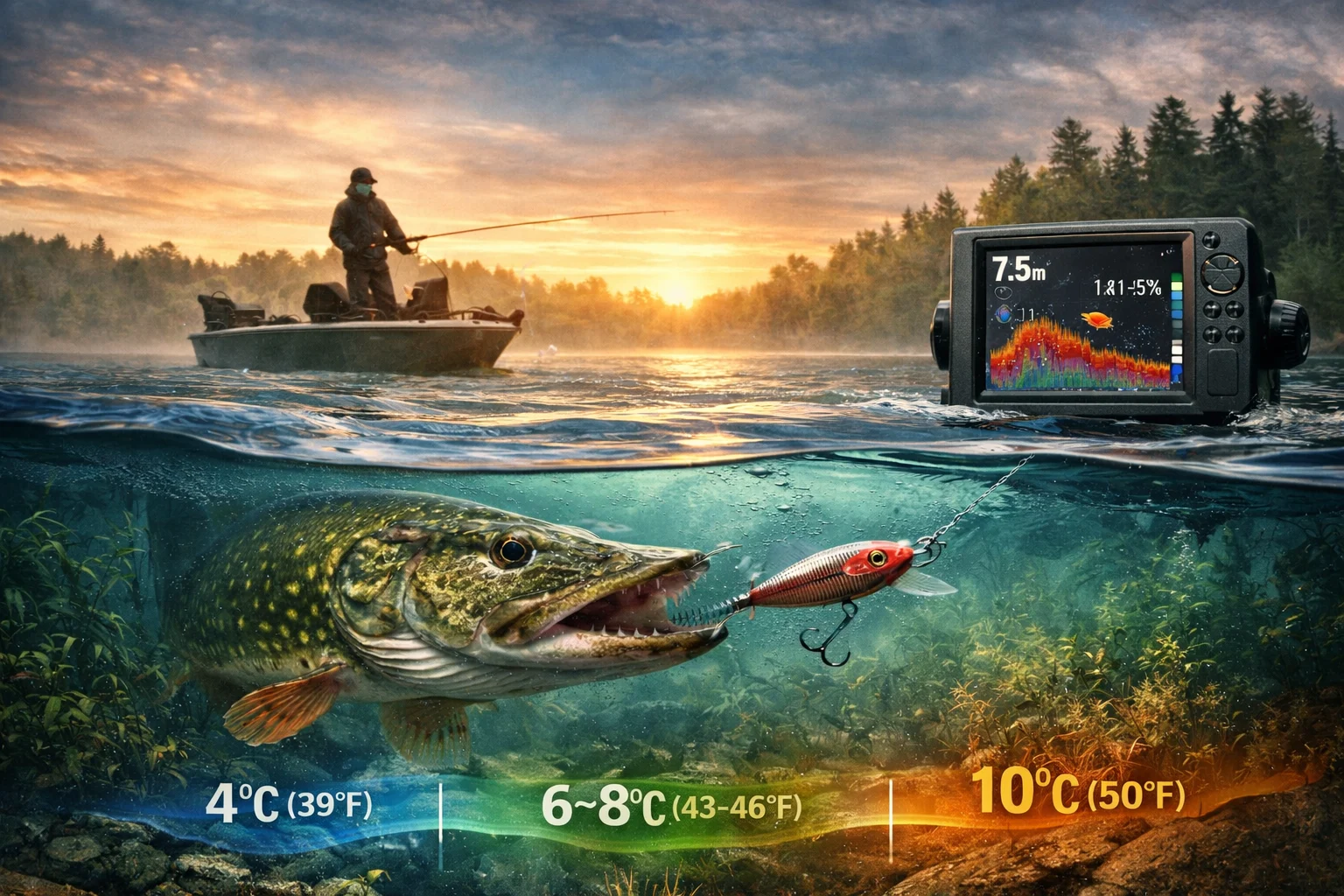
Spring pike depths are not random. If you’re asking how deep are pike in spring, the real answer sits inside one narrow temperature window — 4–10°C (39–50°F) — and how fish respond to bait movement as the water slowly stabilizes.
Over the last three spring seasons — across 37 logged sessions between 2022 and 2025 — the MFG team tracked sonar marks, strike windows, and temperature shifts on shallow, weedy natural lakes and slow-flowing rivers. One pattern repeated every year in spring pike sessions: miss the depth band by 1–2 meters (3–6 feet) and the lake feels empty. Hit the correct range and follows turn into decisive strikes. The difference is rarely lure choice — it’s positioning.
During early cold phases around 4–6°C (39–43°F), many anglers continue fishing traditional winter depths. As water stabilizes in the 6–8°C (43–46°F) range, pike often stage along subtle break lines just off warming flats. When temperatures approach 8–10°C (46–50°F), part of the population shifts shallower — but not all fish move at once. Understanding that staggered repositioning defines real pre-spawn depth control.
The MFG team divides these transitions into three specific temperature windows to show exactly how fish reposition as water warms, where they pause, and why most anglers fish either too deep or too shallow during pre-spawn. If fish appear on electronics but refuse to commit, the problem is usually depth control — not lure choice.
Control the depth band first. Everything else becomes execution.
How Water Temperature Controls Spring Pike Depths (And Why You’re Fishing Too Deep or Too Shallow)
Water temperature is the primary driver behind spring pike depths in early season. If you’re asking how deep are pike in spring, the answer shifts as water climbs through 4–10°C (39–50°F). Pike reposition vertically to stay inside a narrow feeding band where metabolism, oxygen levels, and bait movement intersect.
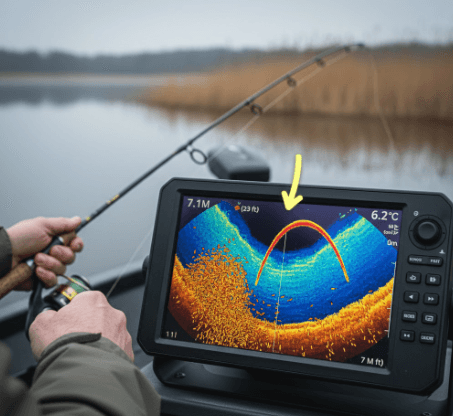
During true early cold phases around 4–5°C (39–41°F), fish behavior still mirrors late-winter structure. Our team consistently marked pike between 5–8 meters (16–26 ft), often holding just above deeper break lines or basin edges. At those depths, distinguishing individual fish from dense bait clusters requires careful sonar interpretation. High-detail imaging on modern fish finders makes it significantly easier to separate pike from tightly packed bait clouds in cold water.
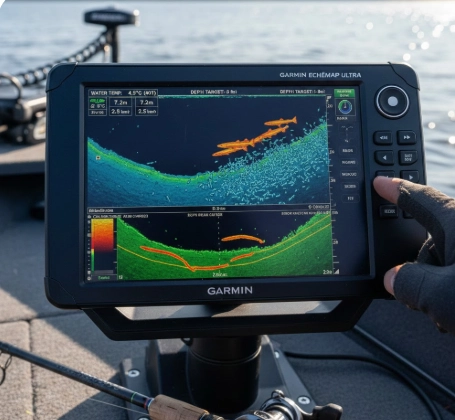
This 5–8 meter band proved most consistent on clear natural lakes where bait remained loosely staged over depth transitions. That explains why pike depth in 4°C water rarely matches shallow expectations.
As temperatures stabilize into the 6–8°C (43–46°F) window, the pre-spawn depth range tightens. Instead of hugging bottom, fish frequently suspend between 3–6 meters (10–20 ft) along staging lines where bait collects before moving shallow. If you’re searching for where do pike hold before spawn, this mid-depth transition zone produces the most consistent activity.
When surface readings approach 8–10°C (46–50°F), anglers ask when do pike move shallow. The shift is gradual and uneven. Some fish slide into 2–4 meters (6–13 ft) along wind-driven banks or sun-exposed flats, while others remain slightly deeper after cold nights.
Our team repeatedly logged that even a 0.5–1 meter (1.5–3 ft) vertical error reduced strike commitment. Pike may follow outside their comfort band, but they fully commit when the presentation stays inside the correct depth window.
In our experience, depth control is where most spring sessions quietly fail — even when electronics show fish and conditions appear perfect.
How Deep Are Pike in March? (4–6°C / 39–43°F Water Explained)
If you’re asking how deep are pike in March, the honest answer is this: they are not shallow yet — even if the sun is stronger and the air feels like spring.
When water stabilizes between 4–6°C (39–43°F), pike depth in March remains structured and controlled. Across natural lakes and slow-flowing rivers, we repeatedly marked fish holding in 5–9 meters (16–30 ft), positioned along the first major breaklines that connect deeper water to future spawning bays.
March is a transitional month. The biological clock has started ticking, but full shallow commitment has not happened yet. As detailed in our analysis of spring pike behavior, even at 4°C increasing daylight begins influencing metabolism. However, temperature stability still dictates positioning.
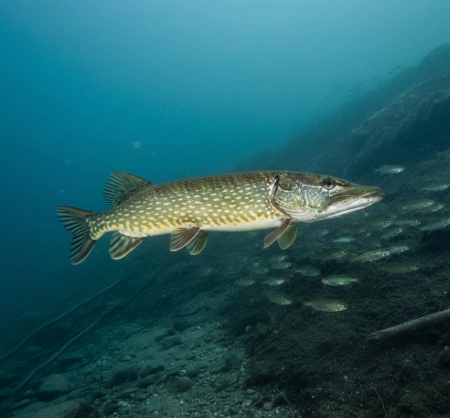
In practical terms, cold water pike positioning in March means fish stage along depth transitions rather than roaming flats. Focus on edges where 6 meters drops into 8–9 meters (20–30 ft), channel turns near spawning access routes, and subtle humps just outside protected bays.
One consistent observation from our logs: pike frequently suspend 0.5–1 meter (1.5–3 ft) above bottom during this phase. That small vertical difference explains why anglers often mark fish but fail to trigger strikes — the presentation is either too deep or slightly above their comfort band.
How to Fish the 5–9 Meter (16–30 ft) Depth Band in March
In March, depth accuracy matters more than lure variety. Fish are not actively chasing across large flats. They are positioned with intent along structure, and your presentation must pass through their exact holding level.
At 5–9 meters (16–30 ft), slow-sinking jerkbaits, controlled soft baits, and moderately weighted spoons perform best because they allow precise vertical control. The key is not dragging bottom — it is keeping the lure 0.5–1 meter (1.5–3 ft) above marked fish. Pike in cold water prefer striking slightly upward rather than diving down to feed.
Long pauses are critical. In 4–6°C water, a 3–5 second pause near the breakline often triggers more commitment than continuous retrieves. Most follows convert when the lure suspends inside the holding band rather than racing past it.
Boat Positioning in March
From a boat, position parallel to the breakline — not directly on top of it. Sitting over 8–9 meters (26–30 ft) and casting toward 6 meters (20 ft) allows you to work the lure naturally down the contour instead of pulling it vertically away from fish.
Use wind to your advantage. A controlled drift across staging edges covers water while keeping your presentation inside the depth band longer. Avoid anchoring directly above marked fish — cold water pike can become inactive if pressured vertically.
Bank Fishing Strategy in Cold March Water
From shore, the biggest mistake is casting only into visible shallow water. In March, the highest-percentage fish are usually just beyond the first drop. Target areas where the bank transitions quickly into deeper water — especially near channel bends or steeper shorelines.
Count your lure down. If the break sits around 6–7 meters (20–23 ft), allow the bait to reach depth before beginning a slow retrieve. Many bank anglers retrieve too early and stay above the strike zone.
Common March Depth Mistakes
Mistake 1: Fishing 2–3 meters (6–10 ft) just because it “feels like spring.”
Mistake 2: Working the lure too fast. At 4–6°C, speed kills more bites than it creates.
Mistake 3: Staying glued to bottom. Remember the suspension rule — most fish hold slightly above contour.
March is not about covering water quickly. It is about dissecting structure precisely inside the 5–9 meter band.
At 4–6°C in March, pike are repositioning — not committing shallow.
Where Do Pike Hold in April? (6–8°C / 43–46°F Pre-Spawn Staging Explained)
If you’re asking where do pike hold in April, this is the most important depth window of the entire pre-spawn period. When water stabilizes between 6–8°C (43–46°F), spring pike depths compress into a tight staging band.
Unlike March, where fish remain disciplined along deeper breaks, April positioning shifts upward. Our logs consistently showed pike suspending between 3–6 meters (10–20 ft), especially along structural lines that lead directly into spawning bays.
This is the true pre-spawn staging phase. Fish are no longer simply holding depth — they are aligning along migration corridors. Subtle breaklines, inside channel turns, and small humps just outside warming flats become high-percentage zones. These exact movement paths are covered in detail in our guide to spring pike locations, where staging routes consistently funnel fish into predictable holding lines.
One of the biggest misconceptions about pike depth in April is assuming fish sit on bottom. In reality, many larger females suspend slightly off structure, holding 1–2 meters (3–6 ft) above the contour while baitfish stage below them.
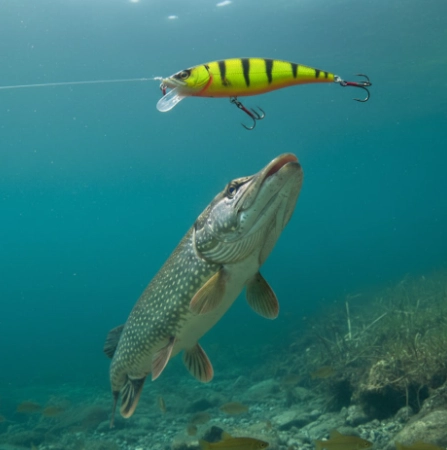
This creates a narrow vertical feeding band. If you fish too deep, you’re under them. If you fish too shallow, you’re outside their strike window. Our team repeatedly logged that even a 0.5–1 meter (1.5–3 ft) vertical error reduced strike commitment significantly.
During stable warming trends, fish gradually creep toward the upper end of this range. After cold nights or minor pressure shifts, they slide slightly deeper — but rarely back to true March depth levels.
How to Fish the 3–6 Meter (10–20 ft) Staging Band
April is about controlled horizontal coverage at mid-depth. Unlike March, where slower bottom-oriented work dominates, April fish are suspended and responsive — but still temperature-conscious.
Suspending jerkbaits excel here because they allow you to keep the lure inside the 1–2 meter (3–6 ft) suspension zone where larger females hold. Long pauses — often 4–6 seconds — near break transitions trigger commitment from fish that follow but hesitate.
Soft swimbaits worked slowly across staging edges also perform well, especially when retrieved just above marked fish. The rule remains the same: stay slightly above their holding level. Pike in this phase are more willing to rise than dive.
Boat Positioning During April Staging
From a boat, positioning is everything. Set up slightly deeper than the break — often in 6–7 meters (20–23 ft) — and cast up toward 3–4 meters (10–13 ft). This allows the lure to naturally travel down the staging corridor rather than cutting across it unnaturally.
Wind becomes an ally in April. A light wind pushing into staging edges often concentrates bait, tightening the depth band even further. Controlled drifts parallel to breaklines maintain presentation inside the strike window longer than repeated short casts.
Avoid parking directly on top of fish. In 6–8°C water, pike are alert and grouped. Vertical pressure can shut down the entire band quickly.
Shore Fishing in April: Where to Stand and Where to Cast
From shore, focus on banks where depth drops quickly into 3–5 meters (10–16 ft) near spawning access routes. Long gradual flats are lower percentage unless they border deeper staging water.
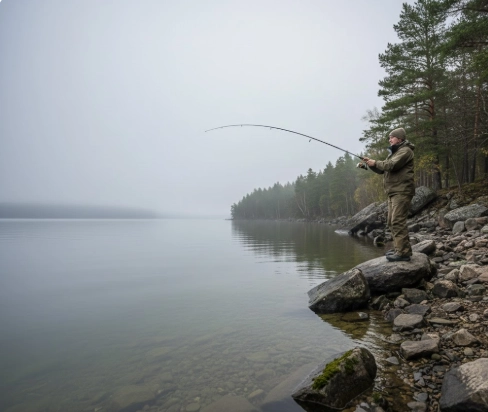
Angle your casts diagonally across the break instead of straight out. This keeps your lure inside the mid-depth transition zone longer and increases exposure time inside the strike band.
Count-down retrieves are crucial. Many bank anglers retrieve too soon and stay above the 3–6 meter holding range.
Common April Depth Mistakes
Mistake 1: Fishing too shallow too early. Just because fish are moving toward spawn does not mean they are already in 1 meter (3 ft).
Mistake 2: Ignoring suspension. Many anglers fish bottom contact while pike are holding above contour.
Mistake 3: Over-speeding the retrieve. April fish are more active than March fish — but they are not summer-aggressive.
April is compression season. Depth tightens, fish group along staging lines, and precise control within the 3–6 meter band determines success.
How Shallow Are Pike in Late April or Early May? (8–10°C / 46–50°F Pre-Spawn & Spawning Depths)
When water stabilizes between 8–10°C (46–50°F), spring pike depths shift decisively toward shoreline structure. This is the first true shallow commitment phase of the season.
Note: In warmer southern regions, this 8–10°C window may occur earlier in March, while in northern climates it often aligns with late April or May. The calendar shifts — but the depth-to-temperature relationship remains identical.
Across natural lakes and slow rivers, our logs consistently showed fish moving into 1–3 meters (3–10 ft), especially along reed edges, flooded grass, protected bays, and sun-exposed flats. However, movement is rarely uniform. Larger females often hold slightly deeper at 2–4 meters (6–13 ft) just outside spawning pockets before sliding fully shallow under stable overnight conditions.
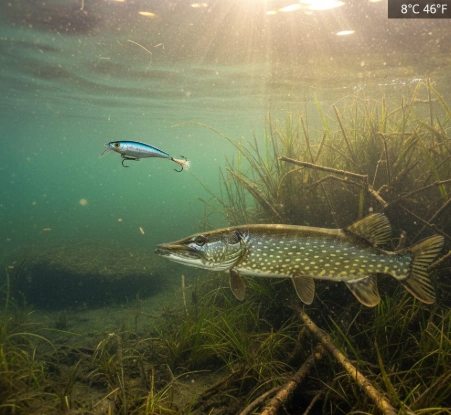
This is the pre-spawn tipping point. Daylight length, warming surface layers, and bait movement converge. At this stage, shallow-running jerkbaits, glide presentations, and slow-worked spoons consistently outperform deeper-diving profiles inside the compressed depth band. We break down specific seasonal lure profiles in our guide to best spring pike lures, but even the right bait will fail if it runs outside the 1–3 meter strike zone.
What Happens Right Before Pike Spawn?
Pike typically spawn when water reaches roughly 7–10°C (45–50°F), depending on regional stability. Males often enter ultra-shallow water first — sometimes holding in less than 1 meter (3 ft). Larger females follow but frequently pause in slightly deeper water before committing fully to shoreline vegetation.
During this short window, fish may stage in 1–2 meters (3–6 ft) during warm afternoons and reposition slightly deeper overnight if surface temperatures drop. This explains why anglers sometimes believe fish have “left” a shallow bay after a cold night — in reality, they often shift only 1–2 meters vertically or toward the outer edge.
The strongest bite window usually occurs just before active spawning begins. Once spawning activity is fully underway, feeding intensity commonly decreases for a short period.
Even in shallow water, depth precision remains critical. A difference of 0.5–1 meter (1.5–3 ft) can determine whether fish follow passively or commit aggressively.
How to Fish the 1–3 Meter (3–10 ft) Commitment Zone
This phase demands controlled horizontal coverage. Fish are now relating directly to structure rather than deep contour. Work lures parallel to reed lines, along inside turns of shallow bays, and across subtle depth transitions within the flat.
Keep retrieves measured and deliberate. Water is still below 10°C, so aggressive burning rarely outperforms steady, medium-slow presentations with controlled pauses. Most decisive strikes occur when the lure enters open pockets between vegetation or crosses from 2 meters into 1 meter along the staging edge.
If larger females remain staged slightly deeper at 2–4 meters (6–13 ft), count your lure down and keep it just above that outer band before guiding it gradually toward shallower cover.
Boat Positioning in Shallow Pre-Spawn Water
Approach shallow bays quietly and from the outside in. Hold the boat in 2–3 meters (6–10 ft) and cast toward 1–2 meters (3–6 ft). Entering directly into ultra-shallow water often pushes fish outward before you even make a cast.
Use wind to drift naturally along reed edges rather than constant motor corrections. In clear systems, fish in less than 1.5 meters (5 ft) can spook easily from shadow and noise.
Bank Fishing Strategy in Late April or Early May
From shore, focus on protected coves, reed transitions, and dark-bottom flats that warm faster. Fan-cast across depth transitions between 0.5–2 meters (1.5–6 ft), paying close attention to slightly deeper outer edges where larger females pause.
If a cold front lowers overnight temperature, shift attention slightly outward toward the 2–3 meter (6–10 ft) zone rather than the extreme shoreline.
Common Late-Season Shallow Mistakes
Mistake 1: Fishing too deep out of habit. Once water consistently holds above 8°C, traditional basin depths lose relevance.
Mistake 2: Charging into the shallowest water immediately. Quiet positioning often determines success.
Mistake 3: Increasing speed because fish are shallow. Temperature still controls metabolism, even at 8–10°C.
At 8–10°C in late April or early May, pike commit to spawning zones — but disciplined depth control remains the factor that separates average sessions from exceptional ones.
Spring Pike Depth Chart (4–10°C / 39–50°F Quick Reference)
| Water Temperature (°C / °F) | Typical Month (North Hemisphere) | Primary Depth Range (m / ft) | Fish Positioning | Key Tactical Focus |
|---|---|---|---|---|
| 4–6°C / 39–43°F | March (or early spring) | 5–9 m / 16–30 ft | Staging along deeper breaklines near spawning access routes | Slow presentations slightly above fish; depth precision over speed |
| 6–8°C / 43–46°F | April (pre-spawn staging) | 3–6 m / 10–20 ft | Compressed along migration corridors and structural edges | Suspended presentations; work parallel to staging lines |
| 8–10°C / 46–50°F | Late April – Early May (spawn window) | 1–3 m / 3–10 ft Outer edge: 2–4 m / 6–13 ft | Committed to shallow bays, reeds, flooded grass | Horizontal coverage; quiet approach; control retrieve speed |
Spring Pike Depths FAQ: Exact March, April, and Pre-Spawn Depth Answers
How deep are pike in early spring?
In early season conditions around 4-6°C (39-43°F), spring pike depths typically range between 5-9 meters (16-30 ft). During this March phase, fish stage along deeper structural breaks rather than committing to shallow water. If you are targeting pike depth in March, focus on transition edges that connect deeper water to spawning routes.
What is the average pike depth in April?
As water warms into the 6-8°C (43-46°F) window, pike depth in April compresses into 3-6 meters (10-20 ft). This is the classic pre-spawn pike depth range, where fish suspend slightly above breaklines and migration corridors leading toward spawning bays.
When do pike move shallow in spring?
Pike begin committing shallow when water stabilizes around 8-10°C (46-50°F). At this stage, spring pike depths often shift into 1-3 meters (3-10 ft), especially in protected bays with vegetation. Larger females may still stage slightly deeper at 2-4 meters (6-13 ft) before fully entering spawning cover.
How does water temperature affect spring pike depths?
Water temperature controls spring pike depths by influencing metabolism and bait movement. At 4-6°C, fish hold deeper and stage along structural edges. At 6-8°C, depth tightens along migration lines. At 8-10°C, spawning zones become dominant. The shift is gradual and tied to stability rather than the calendar alone.
Do pike stay deep during pre-spawn?
During early pre-spawn, pre-spawn pike depths often remain mid-range at 3-6 meters (10-20 ft). Fish frequently suspend above contour and rarely hug bottom. As temperatures approach the spawning trigger, they compress further into shallow water.
What depth are pike during spawning?
The typical spawning depth of pike ranges from under 1 meter (3 ft) up to about 2 meters (6 ft), depending on vegetation and shoreline structure. Even during this phase, spring pike depths can shift outward after cold nights, with fish repositioning to the outer 2-3 meter (6-10 ft) band.
Spring Pike Depths 4–10°C: The Exact Pre-Spawn Depth Pattern That Decides Your Season
Spring pike depths are controlled by temperature, not by the calendar. From the 5-9 meter (16-30 ft) staging band in March, to the 3-6 meter (10-20 ft) pre-spawn compression in April, and finally the 1-3 meter (3-10 ft) shallow commitment phase in late April or early May, every movement follows a biological trigger.
What changes is not the species — it is the stability of the water column. As surface layers warm unevenly and bait shifts vertically, spring pike depths narrow before fish commit shallow. That compression phase is where most anglers either dial in or completely miss the active band.
Independent biological data supports this same depth-to-temperature relationship. The species profile for Pike (Esox lucius) – Animal Diversity Web Species Account confirms that northern pike spawning behavior aligns with specific temperature thresholds and shallow vegetation access rather than fixed calendar dates. That biological trigger explains why pre-spawn pike depths shift gradually instead of instantly.
If you control depth first, everything else becomes execution. Lure profile, retrieve speed, boat positioning, and casting angle all matter — but only after you are fishing inside the correct depth window.
Whether you are targeting early March staging fish, April migration corridors, or late April spawning edges, remember this principle: spring pike depths tighten before they explode shallow. Stay aligned with the 4-10°C (39-50°F) window, stay inside the correct vertical band, and your strike conversion rate improves dramatically.
Master the depth. Let the season unfold naturally.