


Late Winter Pike — When Winter Ends and Everything Starts Moving
Late winter pike behavior is the moment when winter quietly stops behaving like winter — not on the calendar, but in the water. The surface still feels cold. Your breath still turns to steam. Yet beneath it, something begins to loosen. Pike that spent months locked into deep holding lanes start to shift. Not migrate. Not roam. Just… reposition.
At Master Fishing Guide, this is the phase that has fooled us more than any other. One week, the classic winter spots produce. The next, the same edges feel empty. Nothing looks different. The water is still cold. The air still bites. But the fish are no longer anchored. They are preparing.
This usually unfolds in late February and early March, when daylight stretches and thermal stability begins to wobble. Temperatures may still hover around 3–6°C (37–43°F), yet the biological clock inside the fish starts ticking differently. Winter is no longer “locked.” It becomes transitional.
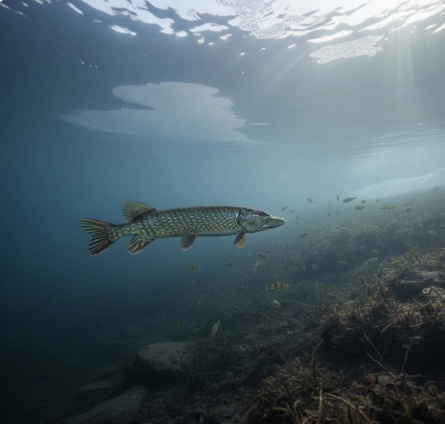
This is not spring fishing. Pike are still energy-conscious. Strike windows remain short. Depth still matters. But the rigid winter patterns you relied on begin to crack. Fish that refused to move now slide a little. Holding zones expand. Routes appear between deep basins and the first staging areas.
Most anglers miss this phase because it feels confusing. One day winter tactics work. The next day, the same water feels dead. It’s not that the fish stopped feeding — it’s that their geometry changed. They are no longer living in one place. They are passing through.
Late winter is where pattern readers separate themselves. You are no longer just fishing “winter.” You are fishing the first movement of the year.
Where Pike Move First in Late Winter
Late winter pike behavior is not about rushing shallow. Pike do not abandon depth. They begin to probe outward. In water still holding 3–6°C (37–43°F), the fish remains energy-conscious, but it starts testing routes beyond its winter core.
This phase cost countless empty hours before it became clear what was actually happening. We kept grinding the same winter breaks within their winter depth range, convinced the fish had “shut off.” They hadn’t. They were simply no longer living in one room. They were moving between rooms.
The first movements follow three predictable paths:
- Deep-to-shallow corridors – subtle channels connecting 6–9 m (20–30 ft) winter depth with 3–4 m (10–13 ft) staging shelves.
- Inside turns on break lines – soft edges where a hard drop bends and baitfish pause.
- Sun-facing shelves near depth – not flats, but the first “step up” that warms 0.3–0.6°C (0.5–1°F) faster than the basin.
These zones are not feeding grounds. They are transitional lanes. Pike pass through them during narrow windows, often lasting only 20–45 minutes, once or twice per day. Miss the timing and the water feels lifeless. Hit it right, and the lake suddenly wakes up.
This is why late winter breaks confidence. You can sit on a perfect winter spot for three hours and see nothing. Slide 30–60 meters along the same structure — and suddenly a fish appears. Nothing dramatic changed. Only the geometry did.
Late winter pike behavior is no longer about “holding.”
It becomes about traveling with intention.
You are not searching for a spot anymore.
You are intercepting movement.
How Strike Windows Change in Late Winter
Late winter pike behavior does not create longer feeding periods — it creates different timing. In January, winter pike often feed in brutally short windows of 10–30 minutes. In late winter, those windows begin to stretch and drift.
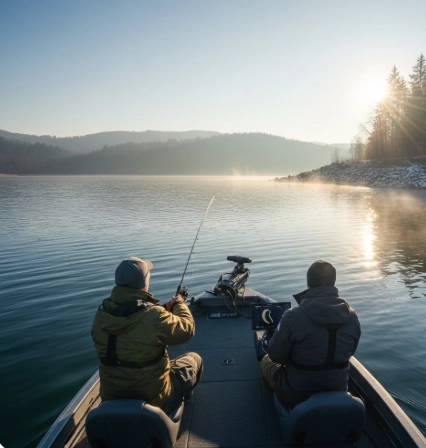
This shift became obvious long before it was fully understood. Instead of a single violent burst of activity, fish began appearing in two to three softer windows per day. Each one still brief — often 20–45 minutes — but no longer locked to a single moment.
MFG Pro Note: We’ve seen sessions where the lake felt like a graveyard until 1:15 PM. Then, as the sun hit a specific western bank, we’d get three strikes in 30 minutes. By 2:00 PM, the window would vanish as if it never existed. That is the “drift” we are talking about.
The reason is simple: light and stability are no longer static.
- Morning light – It begins reaching deeper shelves, waking up baitfish that were dormant in the dark.
- Midday warmth – Even a tiny lift in protected zones is enough to trigger a shift in the winter pike strike windows we’ve previously analyzed.
- Evening transitions – As the sun dips, baitfish slide back toward depth, and pike intercept them in the transitional corridors.
Each of these changes creates a micro-window. Pike do not suddenly “feed all day.” They respond when a corridor becomes active.
This is why many anglers fail. They arrive early, grind one spot, feel nothing, and leave convinced the lake is dead. In reality, the fish may pass that exact edge one or two hours later.
Late winter pike behavior is not about catching a moment.
It is about staying inside the system long enough to meet it.
Winter taught you patience.
Late winter teaches you timing.
When Pike Start Moving Again (The First Break from Winter)
The biggest mistake anglers make in late winter is assuming that pike suddenly “wake up” and become spring fish. They don’t. What changes first in late winter pike behavior is not aggression — it is location.
For months, winter pike live in narrow zones: deep edges, stable basins, and slow river pockets. In January, we’ve watched the same fish sit on one mark for hours. On modern side-imaging sonar, that shadow does not move. But by late February, that same shadow begins to walk — sliding 15–25 meters left and right along the same contour. This subtle shift is the core of late winter pike behavior: the fish begin using the same contour as a highway rather than a bed.
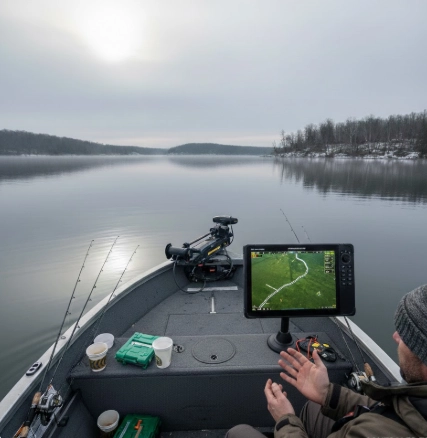
In practice, this means a fish that was glued to 9 m (30 ft) now steps up to the first shelf at 6 m (20 ft), holds there for ten or fifteen minutes, then drifts back. Not a migration. Not a spawn run. Just controlled movement inside the same winter structure.
This is the phase where the entire mindset shifts — where “spots” stop making sense and everything begins to revolve around lanes.
- A pike slides along a contour instead of sitting on one pixel.
- It checks the upper edge of a shelf, then retreats.
- It follows baitfish halfway into a bay before turning back.
These movements are not random. They follow the same winter framework — but with range. Understanding this specific late winter pike behavior is the only way to avoid fishing empty water when the season begins to turn.
This is where many anglers fall out of sync. They keep fishing as if every pike is still nailed to a single point. In reality, the fish has become transitional. It appears, disappears, and reappears along the same line.
Late winter is the first season where pike stop being static targets.
They become moving problems.
Your job is no longer to “find the fish.”
Your job is to intercept its path.
MFG Field Rule – Intercept, Don’t Sit: In January, we often position the boat directly over a single mark and work vertically. Because of how late winter pike behavior changes, that strategy stops working. Instead, we back off 15–25 meters and cast parallel to the contour, not at it. The goal is no longer to hit one pixel on the sonar — it is to cover the entire lane of movement.
The first real signal that this phase has begun is not a pike strike. It is baitfish behavior. On side imaging, the tight winter balls begin to break apart and drift closer to edges instead of sitting in the basin. When that happens, pike are already moving — even if you haven’t felt a bite yet.
Why Old Winter Patterns Start Failing
Late winter is where good winter anglers quietly start missing fish.
Not because they forgot how to fish — but because they keep executing a system that no longer matches the shifting late winter pike behavior. The rules are changing, but the angler’s habits are not.
The most common mistake is treating late winter like “more January.” Same spots. Same angles. Same vertical mindset. Same belief that if you park over the right dot long enough, the bite will come.
It often doesn’t. Because the fish is no longer living on that dot.
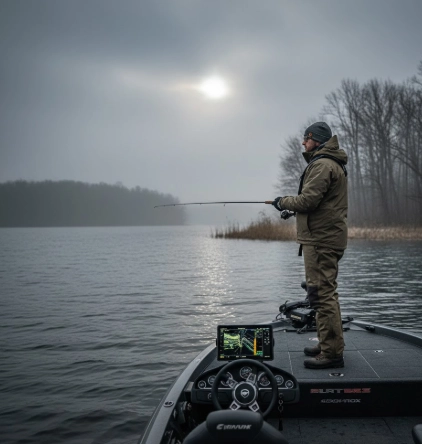
Through countless hours on the water, we’ve watched this happen: anglers stay glued to a perfect winter mark, convinced that patience will solve everything. Meanwhile, the pike has already shifted ten meters along the contour, followed bait into a side pocket, and slipped back — unseen.
The pattern did not stop working.
The fish simply stepped outside of it.
Late winter punishes rigidity. It exposes anglers who only know how to fish “where the fish used to be.” It rewards those who begin to think in terms of movement, not just position.
This is the psychological trap of the season: You feel close. You know the fish are there. The water still looks like winter. So you keep fishing yesterday’s map.
But late winter pike behavior is not about holding ground. It is about letting go of the anchor point and following the drift.
If you are not willing to change angles, distances, and timing — not just lures — you will fish well… in the wrong place.
How Water Clarity Shapes Pike Movement in Late Winter
One of the subtle but powerful drivers in late winter pike behavior is how water clarity alters visibility and decision-making below the surface. When pike begin to slide along contours and corridors, the visual environment they perceive changes everything — not just depth and movement, but how confidently they travel and commit to a strike.
In clear water during late winter, pike often remain more cautious and precise in how they move between transitional lanes. High visibility gives a pike the ability to see prey, structure, and lure presentations from farther away, which means the fish may hold slightly higher in the water column or along subtle edges where light penetrates deeper. This affects not only where pike position themselves but also how they choose the routes that connect winter holding lanes to staging areas. Anglers fishing clear water during this phase need to think in visuals — how the fish sees the world — as much as in geometry.
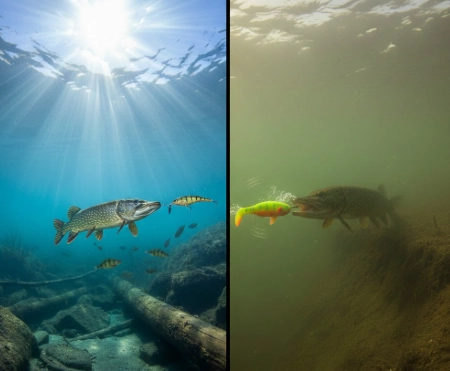
In contrast, in stained or murky late winter water, pike rely far more on vibration and lateral line sensing than on sight alone. Limited clarity compresses the decision window and forces pike to react quickly in the corridors they travel. Instead of evaluating a lure from a distance, a pike in low-visibility water often responds to the first presentable signal that comes close enough to trigger a reaction. This dynamic can make movement feel more abrupt and strike windows seem shorter — even if fish are actively on the move.
This difference in visual conditions also feeds directly back into how anglers interpret movement and timing during late winter. In clearer water, transitions appear slow and deliberate, while in murkier conditions those same transitions seem like sharp pulses of activity. Understanding how clarity reshapes both position and movement gives a more complete picture of the shifting late winter season and helps bridge what you see on your sounder with what the fish actually perceives in their water.
For a deeper breakdown of how clarity changes winter pike behavior and strike logic — including specific strategies for clear vs muddy water — check out our in-depth guide on Pike Water Clarity in Winter and how that affects both holding location and reaction patterns.
Late Winter Is Not an Ending — It’s the Bridge
Late winter is the only phase of the year that belongs to two seasons at once.
It still carries the weight of winter: cold water, short windows, conservative fish. But it whispers the first truth of spring: movement.
This is why so many anglers feel lost here. They are no longer wrong — but they are no longer right either. The lake stops behaving like January, yet refuses to behave like April. Every familiar reference point starts drifting.
Late winter pike behavior is not chaos. It is transition with rules.
- Pike still conserve energy — but they no longer anchor.
- Depth still matters — but it no longer defines.
- Windows still exist — but they begin to move.
This is where winter anglers either evolve or fall behind.
Those who cling to static spots feel betrayed. Those who accept motion begin to see lanes, timing, and light as living systems.
If you can read late winter, spring becomes easier. You will already recognize what starts happening in February pike fishing — before most anglers even realize the season has shifted.
You won’t be guessing in March. You will already be waiting.
Winter teaches you how to survive on the water. Late winter teaches you how to anticipate.
And anticipation is the first real skill of the open season.
This is not the end of winter fishing.
It is the beginning of understanding how seasons actually move.
The pike has already started.
Now it’s your turn.
Fishing unfrozen water right now? These are the pieces of gear we’ve personally tested and rely on when cold water exposes every weakness. They’re built for late winter — when mistakes cost fish.

FAQ — Late Winter Pike
Is late winter still winter fishing, or is it already spring?
It is still winter — just no longer static winter. Water remains cold and pike stay energy-conservative. What changes first is movement, not aggression. Fish begin to slide along contours instead of living on a single dot.
Why do “perfect” winter spots suddenly go dead?
Because pike stop holding in one place. They begin using the same structure as a lane. Your spot is still correct — the fish simply pass through it instead of living there.
Do I need spring tactics in late winter?
No. You still fish slow. You still respect depth. The shift is mental — from holding to intercepting. Late winter rewards anglers who follow movement without abandoning winter discipline.
What is the biggest mistake anglers make in this phase?
Fishing yesterday’s map. Late winter punishes anglers who refuse to change angles, lanes, and timing. The pattern did not fail — the fish stepped outside of it.
How can I tell when late winter has actually started?
The first sign is not a strike. It is baitfish behavior. Tight winter balls begin to loosen and drift toward edges. When bait starts to move, pike are already in motion — even if you have not felt a bite yet.
Should I stay longer or move more in late winter?
You should move with purpose. Do not abandon winter structure, but expand along it. Slide 20–50 meters, fish parallel, and think in corridors. Late winter is about covering lanes, not camping on dots.
Why does late winter feel harder than any other phase?
Because feedback disappears. You can do everything right and feel nothing for hours. Success often comes from not leaving when every instinct tells you to. Late winter breaks impatience before it rewards understanding.
Share your late-winter catches and experiences with us on the Master Fishing Guide Facebook Page — we follow every report from the water.