

Best Time to Catch Pike in Spring: Morning, Midday or Late Afternoon?
The best time to catch pike in spring is controlled by metabolism, not luck. As water temperature stabilizes between 4–10°C (39–50°F), a pike’s metabolic rate gradually increases. That shift determines when fish move from neutral tracking behavior to short, aggressive feeding bursts.
On shallow natural lakes, low-land reservoirs, and oxbow lakes connected to slow rivers, the pattern repeats every season. Pike do not roam and feed continuously. They position near warming zones, conserve energy, and wait for environmental alignment — slightly rising temperature, suspended baitfish, improving light penetration.
When those elements converge, a narrow feeding window opens. Most spring feeding windows last 20–60 minutes. Outside of them, fish often follow without committing, while inside them strikes feel deliberate and heavy.
This shift from neutral to aggressive behavior is directly tied to metabolic activation and prey visibility, not random mood changes. Within the broader structure of spring pike fishing, timing overrides everything else.
Location, depth, lure selection, and retrieve speed only matter when fish are physiologically ready to feed. Experienced anglers track temperature stability across multiple days, not just hourly changes, because stability — not sudden spikes — consistently triggers movement.
This guide breaks down exactly when pike bite in spring — morning versus midday, stable warming trends versus cold fronts, shallow warming bays versus transition edges — and how to recognize a feeding window while it is forming. Once you understand the metabolic rhythm behind pre-spawn behavior, spring stops feeling unpredictable.
Why Spring Pike Feeding Windows Are So Short
In early spring, pike are not “lazy” — they are energy-managed. Pre-spawn fish are coming out of winter physiology, and their body still runs on a cold-water budget. That means they cannot afford to chase all day, even when they look active and present in a bay or along an edge.
This is the core reason the best time to catch pike in spring happens in bursts. Pike set up where food can come to them, then switch on for a short period when conditions make feeding efficient.
Maintaining control during these short feeding windows becomes significantly easier when using the best pike fishing line, especially when detecting subtle strikes and keeping your lure precisely in the strike zone.
The window is short because spring water is unstable: temperature, light, and bait movement change hour by hour, not week by week like mid-summer.
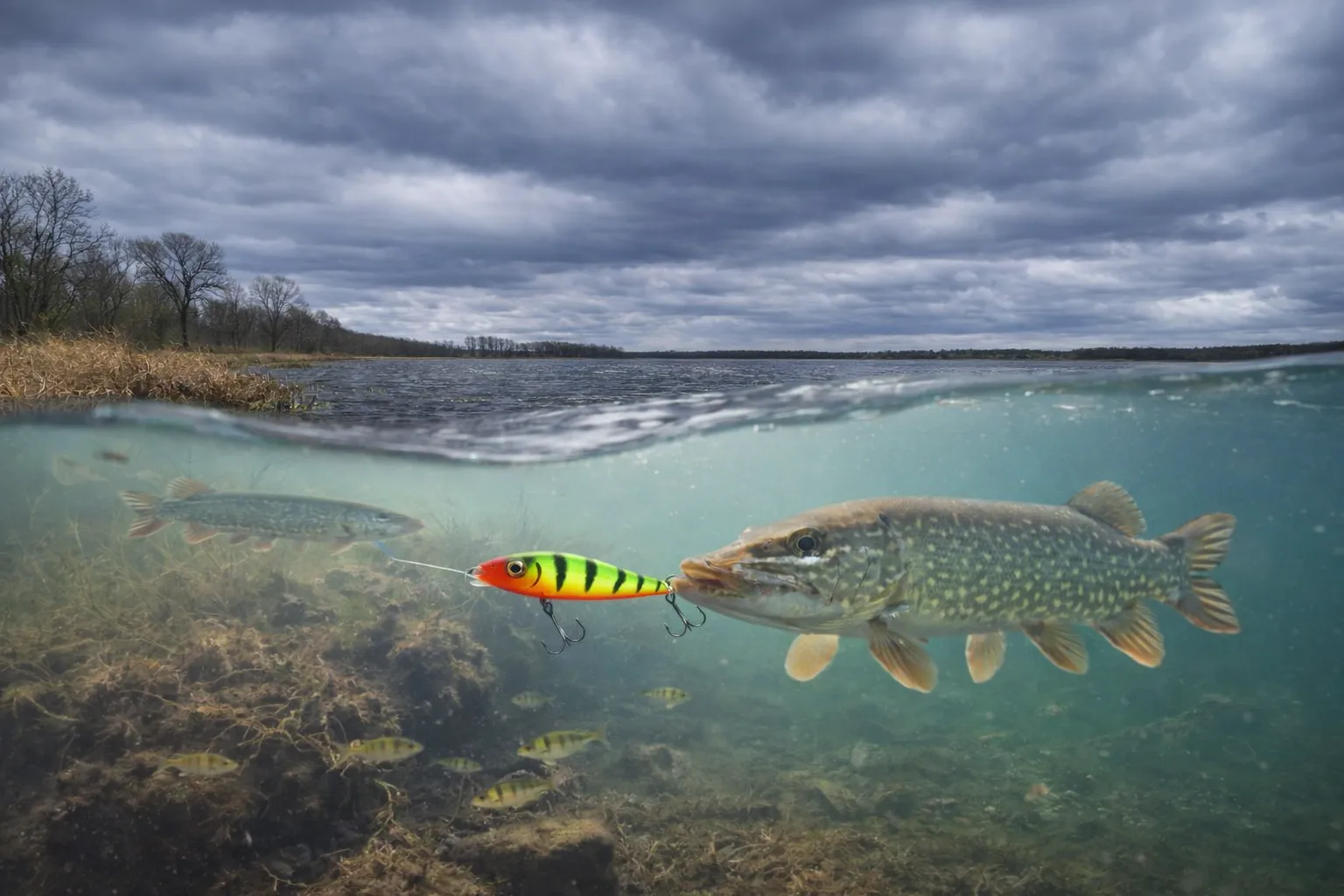
Think of a feeding window as a “profit moment.” The fish gets the maximum reward (a meal) for the minimum cost (chasing). When water warms a little and holds steady, baitfish lift and drift. Visibility improves. Pike can track prey with less effort, and that is when neutral following behavior turns into clean commits.
This is exactly where most anglers lose fish — not because of timing, but because their setup can’t keep up with that short window. When a pike finally commits, you have only seconds to react, and without the right spinning reels for pike, that opportunity often turns into a missed strike or a lost fish.
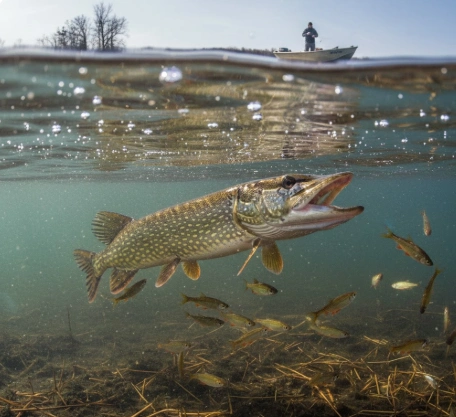
Most anglers miss these windows because they fish on clock time instead of condition time. They pick “morning” or “afternoon” and stay married to it. But spring pike respond to micro-changes: a half-degree warming trend, calmer surface, clearer light, or bait suddenly appearing off the bottom. That is why one hour can be dead and the next can feel like you found a different lake.
The practical takeaway is simple: stop judging spring by “good days” and “bad days.” Start judging it by short, repeatable trigger periods. Once you learn what opens and closes your feeding window, you don’t need to fish longer — you need to fish smarter.
How Water Temperature Controls the Best Time to Catch Pike in Spring
Water temperature is the single strongest trigger behind the best time to catch pike in spring. Not air temperature. Not calendar date. Not sunrise or sunset. When early-season water stabilizes inside the 4–10°C (39–50°F) range, metabolic response increases just enough to create predictable feeding bursts.
Temperature does not work alone — it controls positioning. As water warms gradually, pike adjust vertically and horizontally, sliding from deeper winter carryover zones toward transitional edges and protected warming areas. This movement pattern directly influences feeding windows and is closely connected to seasonal depth shifts explained in spring pike depths.
On a calm reservoir session last spring, surface temperature read 6.7°C (44°F) at 11:40 AM after three consecutive days of slow warming. For nearly two hours we logged only follows — heavy fish tracking the lure from the same 3.5–4 m (11–13 ft) transition edge without committing. They were there. They were aware. But they were not switched on yet.
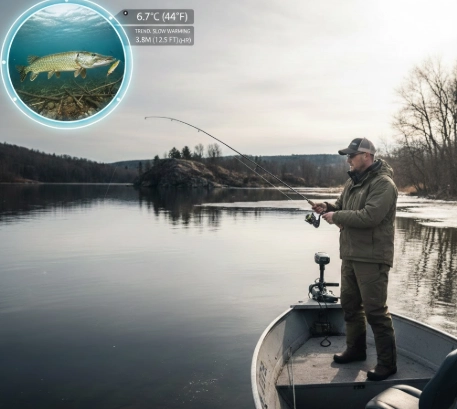
At 12:10 PM we made the classic mistake — we increased retrieve speed too aggressively, assuming activity was building. The follows stopped immediately, not because fish left but because the window had not fully opened. We slowed back down, returned to a controlled, methodical retrieve, and waited.
Then between 12:25 and 1:05 PM, something shifted. Bait lifted slightly off bottom, light stabilized under thin cloud cover, and water gained less than half a degree. In that 40-minute span, three follows turned into two committed strikes from the exact same depth band. Nothing dramatic changed — only temperature stability and retrieve discipline aligned.
At 4–6°C (39–43°F), pike remain near deeper structure and feed cautiously. Windows are short and usually tied to midday warmth, and slow, methodical retrieves are mandatory. Aggressive presentations frequently create curiosity without commitment, and strikes often feel heavy and controlled rather than explosive.
At 6–8°C (43–46°F), baitfish begin lifting higher in the column, and pike start sliding shallower during calm, warming stretches. Retrieve speed can increase slightly as fish transition from neutral tracking to short pursuit bursts. This is the temperature band where hesitation begins turning into reaction.
At 8–10°C (46–50°F), pre-spawn aggression increases noticeably, especially near protected bays and structural transitions, and feeding windows tend to open faster once conditions align.
The key is not the exact number — it is the direction and stability. Rising and holding temperatures expand feeding windows, while dropping or fluctuating water compresses them. Two identical temperature readings on different days can produce opposite results depending on whether the trend is warming or falling.
If you want to consistently hit the best time to catch pike in spring, track multi-day temperature trends instead of single-session readings. Stable warming combined with visible bait movement is the clearest signal that a feeding window is about to open. When you see a half-degree hold instead of a spike, and bait suspends instead of hugging bottom, you are no longer guessing — you are inside the window.
Morning vs Midday vs Late Afternoon — What Actually Produces Strikes?
The best time to catch pike in spring is not automatically sunrise. Unlike summer, early-season fish are controlled by water warming cycles, not just light levels. In cold spring conditions, the best time to catch pike in spring often shifts toward the warmest and most stable part of the day rather than the earliest light.
Early Morning (Cold Water Start)
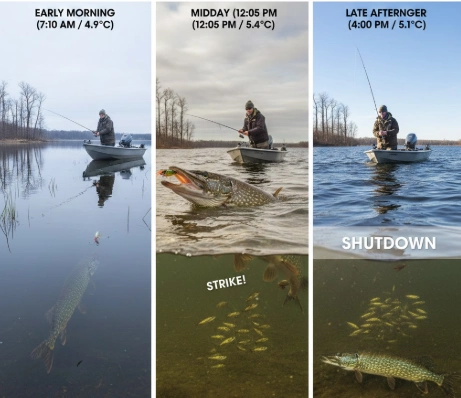
At first light, especially after a cold night, surface layers are often at their lowest daily temperature. On one mid-April lake session during early pre-spawn, water read 4.9°C (40.8°F) at 7:10 AM after a clear, cold night. The bay looked perfect — light wind, visible bait, clean structure.
But for nearly two hours we logged nothing but slow follows from deeper transition edges around 3–4 m (10–13 ft). Fish tracked hard, then faded away. No aggression. No clean commits. The window had not opened yet.
Advice: Fish slower than you think necessary. Work deeper transition edges first. Avoid aggressive retrieves until you confirm active movement. That morning, speeding up too early only killed the follows. If you get tracks without contact, note the depth and angle — that data often predicts when the best time to catch pike in spring is about to shift into midday, especially if you confirm those subtle depth-band changes with reliable fish finders instead of guessing from surface clues.
Midday (Primary Spring Feeding Window)
By 12:05 PM, water temperature climbed to 5.4°C (41.7°F) — less than a half-degree difference. But light stabilized under thin cloud cover and bait lifted slightly off bottom.
This is the exact moment where weak gear costs you fish. When pike finally switch from follows to committed strikes, you need instant control and hook-setting power. A strong spinning rod for pike ensures you transfer that energy directly, instead of losing the fish during the most important window of the day.
At 12:18 PM, the first strike came from the same depth band that produced morning follows. Between 12:18 and 12:55 PM, three fish hit from within a 25-meter stretch of edge. Nothing dramatic changed — only thermal stability and bait positioning aligned. This is where the best time to catch pike in spring most often appears inside the 4–8°C (39–46°F) range.
Advice: Shift slightly shallower. Increase retrieve speed just enough to trigger reaction without forcing the fish. Midday light also improves underwater visibility, and polarized glasses make spotting followers dramatically easier. Seeing a pike accelerate instead of glide is usually the first signal that the window has fully opened.
Late Afternoon (Secondary Window or Shutdown)
Late-day feeding depends entirely on trend. On steady warming days, a second short burst often appears between 3:30 and 4:30 PM as surface layers hold heat.
But if wind shifts north or clouds break into sharp, bright sun, the system tightens quickly. We have watched active midday fish disappear within 30 minutes after a cold gust cooled shallow water by less than a degree. In those conditions, the best time to catch pike in spring may compress into a very short window — or close entirely.
Advice: Watch surface texture and bait behavior. If small fish remain suspended and flickering near edges, stay disciplined. If they drop tight to bottom or vanish from the column, the window may already be closing.
The consistent pattern across lakes and reservoirs is this: spring pike respond to thermal gain more than clock time. A calm, warming 1:30 PM period can outperform sunrise by a wide margin. Conversely, after a cold front, even perfect sunlight may not create a window.
Do not choose your fishing time based on habit — choose it based on temperature progression. In spring, the clock matters less than the trend behind it. When you align with that rhythm instead of fighting it, hitting the best time to catch pike in spring becomes repeatable rather than accidental.
How Weather Fronts Expand or Kill a Spring Feeding Window
Weather fronts can expand or completely shut down the best time to catch pike in spring. In early season, fish are highly sensitive to pressure shifts, wind direction changes, and light stability. Small atmospheric swings create noticeable behavioral adjustments.
On a late-April reservoir session, barometric pressure dropped steadily from 1016 hPa to 1004 hPa over 18 hours ahead of an approaching front. Water temperature held stable at 7.2°C (45°F), and a light southwest wind pushed into a shallow transition bay.
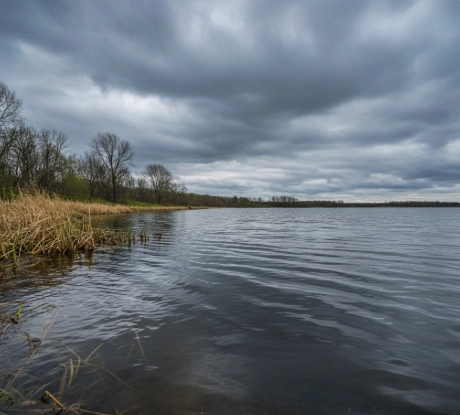
Between 11:50 AM and 1:10 PM, four fish struck within a 60-meter stretch of wind-blown edge. The lake felt alive. Follows turned into acceleration, and strikes were decisive. That was the expanded feeding window.
The next morning, after the front passed, pressure jumped back above 1020 hPa overnight. Same bay. Same structure. Same temperature reading within a tenth of a degree.
But the system had tightened. For nearly three hours we saw only hesitant follows from slightly deeper water around 4–5 m (13–16 ft). No clean commits. The best time to catch pike in spring had compressed into a narrow, hard-to-detect window.
This reaction pattern is deeply connected to broader shifts in spring pike behavior. During falling pressure before a front, roaming increases and short chase bursts become more common. Fish position higher in the column and move farther off structure.
After the front passes and pressure rises sharply, feeding windows often shrink dramatically and positioning tightens.
Wind direction matters more than most anglers admit. A consistent wind pushing into warming water concentrates bait and can extend a developing window. On that pre-front day, the windward side of the bay produced every strike, while the protected side — visually cleaner and calmer — produced none.
In contrast, a hard north wind after the front cooled shallow water quickly and delayed activity by several hours.
Light stability is often the final trigger. Heavy cloud cover during a warming trend can help pike feel secure in shallow water, extending a window that might otherwise close under bright, high-pressure sun.
When clouds broke abruptly after the front and light intensity increased, fish tucked tighter to deeper transition edges almost instantly.
Advice: Before adjusting lure choice, evaluate pressure trend, wind direction, and light stability. In spring, those three factors determine whether the best time to catch pike in spring expands into a 60-minute opportunity — or disappears into a narrow, difficult window that demands precision.
How to Identify a Spring Feeding Window in Real Time
The best time to catch pike in spring rarely announces itself with obvious surface explosions. In early season, feeding windows often begin with subtle environmental signals long before the first strike happens.
The first indicator is bait movement. If small fish rise slightly off bottom, suspend higher in the column, or begin drifting along edges instead of holding tight to cover, something is changing. Pike react to prey behavior before anglers notice it.
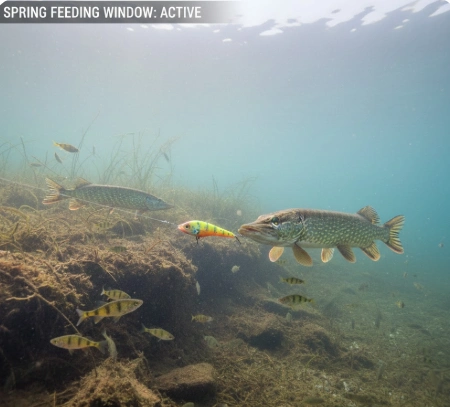
The second indicator is follower behavior. When fish begin tracking your lure more confidently — holding closer, accelerating behind it, or appearing repeatedly from the same zone — a window is forming. Followers are not failures; they are information.
The third indicator is positional shift. If fish begin sliding slightly shallower than they were an hour earlier, or reposition from the base of a drop toward the edge line, activity is building. These adjustments often happen around structural transitions and spring pike locations where warming water and bait concentration intersect.
This is where lure selection becomes critical. When a window begins to open, switching to more responsive spring pike lures that match the depth and retrieve speed of the moment can convert neutral tracking into committed strikes.
How long should you stay before moving? In stable warming conditions with light wind pushing into the area and consistent cloud cover, give a productive zone 60–90 minutes if at least one behavioral signal is present. Wind that concentrates bait and soft, stable light can extend a developing window.
In unstable conditions — falling pressure, shifting cold wind, or clouds breaking into harsh bright sun — reduce that window to 30–45 minutes. If there are zero signs (no bait lift, no follows, no subtle depth changes), relocation is justified.
Advice: When two or more signals stack together — warming trend, wind positioning bait, light stability, stronger follows — stay disciplined and refine your approach instead of changing locations too quickly. Spring feeding windows reward controlled persistence.
If nothing changes after structured adjustments, assume the window has not opened yet — not that the fish are absent. In spring, observation and timing consistently outperform random movement.
Common Mistakes That Make You Miss the Best Time to Catch Pike in Spring
Most anglers do not miss spring pike because fish are absent — they miss them because they misread timing. Early season rewards precision and punishes routine. The following mistakes consistently shorten or completely erase feeding opportunities.
Fishing the clock instead of the conditions.
Many anglers commit to sunrise or sunset out of habit. In spring, thermal progression matters more than light schedule.
On one mid-April reservoir trip, we launched at 6:30 AM with water at 5.1°C (41°F) and perfect light. Two hours passed with nothing but slow follows. We almost called it a “dead morning.”
By 12:20 PM, after a half-degree rise and stable cloud cover, three fish hit within 35 minutes from the same stretch we fished at sunrise. The fish were always there — the window wasn’t.
Correction: Track multi-day temperature trend, not just the hour of the day. The best time to catch pike in spring often appears when conditions stabilize — not when the clock says it should.
Moving too quickly from productive water.
If you see followers, slight bait lift, or subtle depth changes, leaving after 15–20 minutes often means abandoning a forming window.
We once left a shallow wind-blown edge after 25 quiet minutes — only to see another boat hook two fish from the same line less than half an hour later. Nothing changed except patience.
Correction: In stable warming weather, give a promising area up to 60–90 minutes before relocating, especially if at least one behavioral signal is present.
Overpowering cold-water fish with aggressive retrieves.
At 4–6°C (39–43°F), pike metabolism is increasing but still limited. Fast, erratic presentations frequently create follows without commitment.
One early session produced five follows in 40 minutes — all lost when we forced speed too early. Slowing down immediately produced a heavy, deliberate strike from the same depth band.
Correction: Start slower than feels natural. Increase speed only when behavioral signals confirm activity. Pairing this with the right pike fishing leader setup (steel vs fluorocarbon depending on conditions) can make the difference between follows and committed strikes.
Ignoring wind positioning.
Wind that pushes into warming zones concentrates bait and can quietly extend a feeding window. Fishing the calm, visually attractive side of a bay often produces less activity.
We have watched the windward side produce three strikes in 30 minutes while the protected side remained silent under identical temperature readings.
Correction: Evaluate where wind is stacking forage before choosing casting direction.
Overreacting to a cold front.
Many anglers assume a front kills activity completely. In reality, it compresses windows and tightens positioning rather than eliminating feeding entirely.
After one sharp pressure rise, activity vanished for two hours — then a 20-minute window opened once bait repositioned along a deeper transition edge.
Correction: Slow down, adjust depth, and focus on structure transitions instead of abandoning the session. The best time to catch pike in spring may simply shift — not disappear.
The biggest mistake is assuming spring is unpredictable. It is highly responsive to temperature stability, wind positioning, light consistency, and bait movement. When those align, the best time to catch pike in spring becomes repeatable — not accidental.
Frequently Asked Questions About the Best Time to Catch Pike in Spring
When is the best time of day to catch pike in spring?
The best time of day to catch pike in spring is usually midday during stable warming conditions. Early-season feeding windows often open between late morning and mid-afternoon when water temperature stabilizes. Sunrise is not automatically the most productive period in cold water.
Do pike bite better before or after a cold front in spring?
Pike often bite better before a cold front than immediately after it. Falling pressure and stable warming trends can expand feeding windows, while sharp pressure increases after a front typically compress activity and tighten fish positioning.
What water temperature triggers spring pike feeding?
Spring pike feeding activity increases between 4–10°C (39–50°F). Stable warming trends within that range create more reliable feeding windows than sudden temperature spikes.
Why do pike follow but not strike in spring?
Pike follow without striking when metabolism is rising but not fully activated. During neutral phases in early spring, subtle increases in temperature, light stability, or bait movement often convert follows into committed strikes.
Spring Timing Is Predictable When You Read It Correctly
The best time to catch pike in spring is not tied to a clock — it is tied to alignment. Water temperature stability, bait movement, wind positioning, light consistency, and pressure trend must stack together before a true feeding window opens.
Much of this behavior is rooted in cold-water pike metabolism and seasonal energy management. As metabolic demand rises gradually during pre-spawn, feeding windows expand in short, efficient bursts rather than all-day activity.
On a quiet mid-April afternoon, with water holding steady at 6.8°C (44°F) after three stable days, the lake looked almost empty. No surface explosions. No visible chaos. Just subtle bait flickers along a windward edge. Then, in less than 35 minutes, two heavy strikes came from the same 20-meter stretch. Nothing dramatic happened. No sudden weather shift. No lure change. Only alignment.
That is the moment most anglers miss. They leave too early. They speed up too soon. They assume the lake is “off.” But the system was building quietly the entire time.
What separates consistent spring anglers from frustrated ones is not lure choice — it is observation discipline. The ability to notice subtle bait elevation, a slight increase in follower confidence, or a half-degree temperature hold across two days creates repeatable results. These are not dramatic signals. They are quiet adjustments that indicate alignment is forming.
Track multi-day warming trends. Watch bait behavior. Pay attention to wind direction and cloud cover. Those details determine whether you are early, late, or perfectly positioned inside a feeding window.
Spring does not reward random movement or rigid schedules. It rewards anglers who observe first, adjust second, and move only when conditions demand it. When you begin reading those signals correctly, the best time to catch pike in spring becomes repeatable — not accidental.
And once you understand that rhythm, you stop chasing the bite — and start arriving exactly when it happens.